
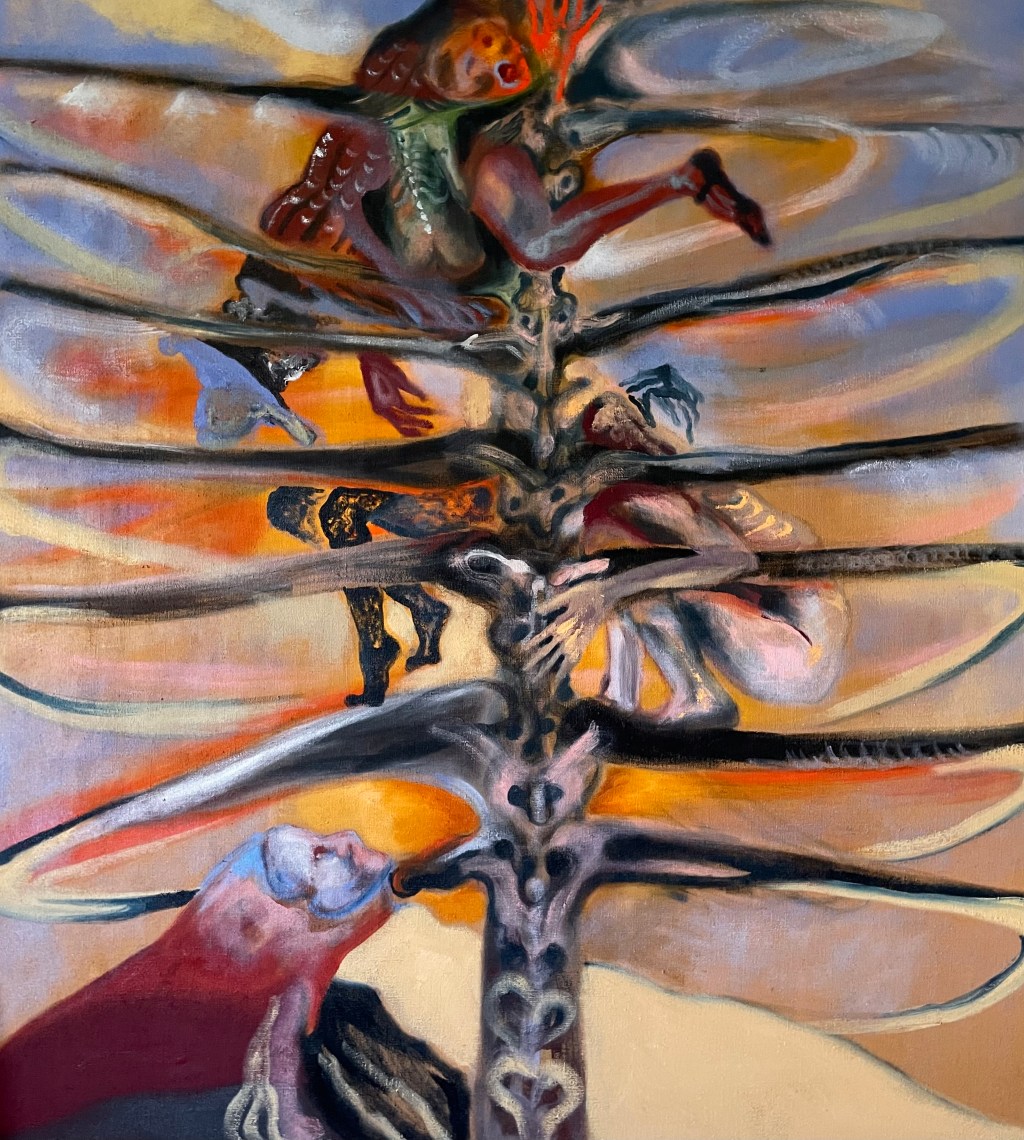
MC: I saw your work in ‘In Rapture’ at the Bomb Factory Marylebone, and especially noticed the painting with the rib cage – I loved that so much and was really impressed by that work. I was wondering if we could start with you talking me through that piece?
AM: I feel like I started it during summer. When I first started off after uni, my work was super personal. Not that I wanted to be like Tracy Emin or something, but I really thought about her because I used my own personal life as a subject. And then I realised that this is not going to work, this is actually quite bad. But I feel like I came back to review works from last year because… I don’t want to go too deep, but after ten years of failed dating I’ve finally started a relationship with somebody. And I’ve found it incredibly difficult. And it really did bring me back to this whole Tracy Emin vibe. Not directly, but indirectly, it fed into my work. After we had a fight this summer about something quite trivial, I realised how I am constantly raising those fights for no reason, just to test him, sort of… is it really going well? I feel almost like it’s an alter-ego, a separate personality in me. And it sort of goes out of control. Not that I’m psycho or anything like that, but I do feel that… I mean, ‘Thoughts and Voices’ is the title, and I do feel like a split personality sometimes. So I thought I would make this ribcage which has actual people as the speaking voices inside. And underneath the figure was the unknown. At the time I had seen a psychoanalyst for almost three years, and that feeds into my work quite a lot. So I made this literal depiction of that, but also it distances it from the relationship itself. So it’s just about having multiple voices inside you, and I wanted it to look like a tree as well as a body.
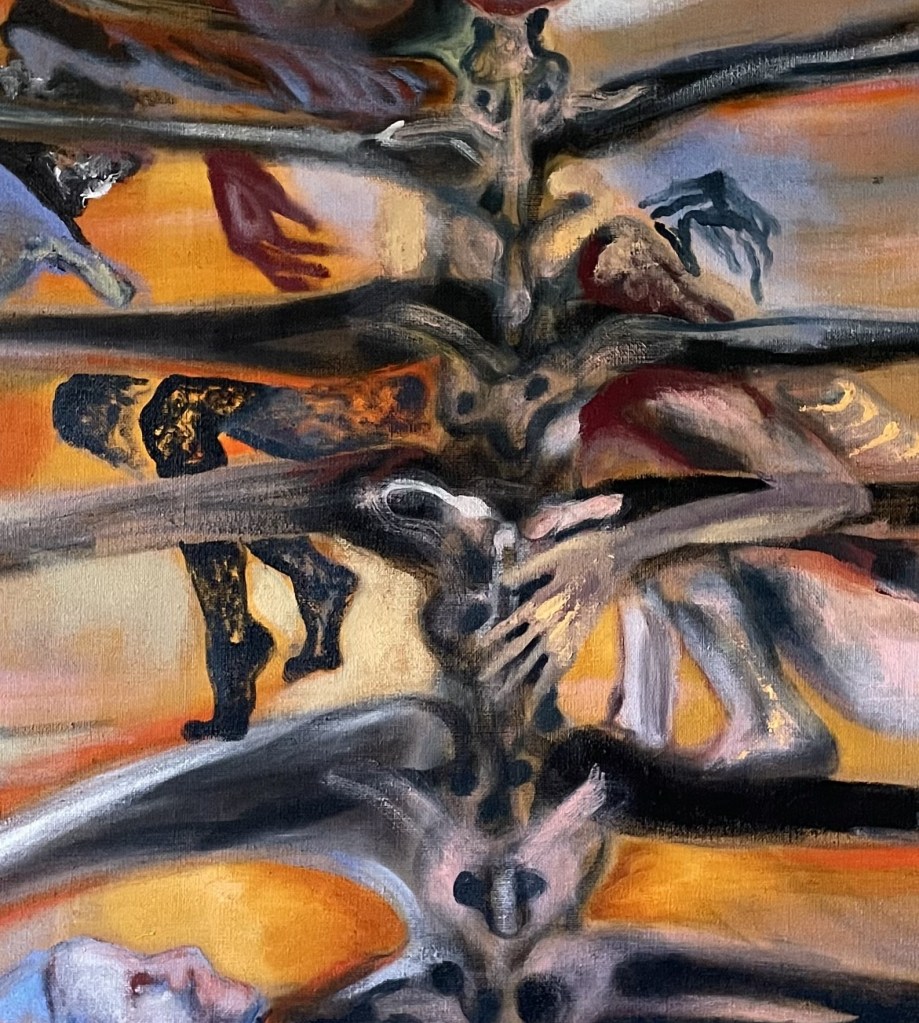
MC: It seemed to me quite Biblical, like one of those Medieval paintings with the sinners climbing from Hell to Heaven.
AM: I have been quite interested in medieval paintings, and old art more than new art in general. And sometimes I’ll directly use those motifs that I’ll rip off from something, like an old painting, a fragment of something, and use it in my work. But not as conscious research, but sometimes I’ll just see something and think, oh that’s cool.
MC: Do you tend to cast your net widely when looking for things to inspire your work? Or are you not really looking?
AM: I’m not really looking. Because, I have to say, I have so little time. I feel like it is quite bizarre as well – up to now I have had virtually not much success, but in the last couple of years I’ve had more shows and more attention, and I feel like more pressure to make more work. I don’t have time still because I still have to work a job. But at the same time, this works quite well because when I have had time – like I did this residency this year and I had three weeks of just working in the studio I was given, and I couldn’t make fuck-all. It was really hard. Whereas if I go home from work, and I feel like I really want to be in the studio and I come here for a couple of hours, it actually makes me better.
So don’t really have time for research, but I just stumble upon things. Sometimes I’ll see something on Instagram, like interior design – I mostly follow interior design – and think it looks cool. And there’s all sorts of shit in there, isn’t there? Someone could be posting medieval paintings. And also from my own stuff – I could go to Gemaldegalerie in Berlin, and then years later look at one of the pictures where this guy had a lion on his shirt, and just like, I’ll use that. But it’s not conscious, I don’t really have time for that. I wish I could. I keep thinking that if I was a freelance artist I would do so much reading and it would be so great – but I don’t know if I would.
MC: Well, it seems that if you had the residency and it didn’t inspire you, that it’s more sort of… coming from within, rather than outside influences.
AM: I guess if I’m running into a wall with a painting, and I don’t know where it’s going, then I might look at some stuff. But it just sort of comes to me. And normally I start something and I have no prior idea of what it’s about to be, and as things starts to appear I start to think about what it’s about. And if I can figure out an idea, it starts to accumulate other things. And sometimes I figure out what it’s supposed to be about later. Or it doesn’t have to be about anything.
MC: No, true. Your painting in the Bomb Factory show kind of typifies what I was thinking when I was looking at the rest of your work about the idea of representing the self. Or selves, multiple selves. I noticed that you had a lot of masked figures, and also veils. I think it’s the way that you lay the paint, in this kind of layered way, which makes it look like everything’s behind a veil.
AM: I have to be really honest. I think artist are more simplistic than you’d expect, I’m not really trying to create any sort of fucking narrative around the self – I’m just shit at painting faces. And I didn’t know how to do it in a cool way, to adapt the face to the rest of the image, in the language which I wanted to use. But at the same time, the mask was supposed to represent the idea that I don’t want the paintings to be about a particular thing. As soon as you give something a face, even if it just comes out of your mind, it gives the personal some sort of personality, or agency, or character. And I want the paintings to be more universal – in an ‘insert your meaning here’ sort of way – so the viewer could have a way to think of multiple meanings for things. So the mask was a way to do that.
Also the mask was because I was thinking about jesters, a sort of fooling oneself or others, in a lot of my work before. One show I did last year was all about that, so most figures had something to do with masks. I’ve been moving away from that, but I might bring it back.
MC: That’s interesting. So if you’re not having any particular figures in your work, you’re not trying to present any narrative at all?
AM: I guess I am in a way, and I guess the jester was always representing… well, the show that I did last year was after I read Lauren Berlant’s book ‘Cruel Optimism’, which is all about how in our current society we fool ourselves about what makes us happy and the things that we try and perceive or pursue are actually just keeping us stuck in the shit we’re in. Obviously, everything is just getting worse and worse and worse. I feel like using the jester or pierrot or another miserable motif somehow represented that for me, in a symbolist way. I guess I use symbols that are quite common in order to portray something contemporary.
When I first started painting, I thought painting was so lame and its hard to put any narrative into it, and it’s so boring – whereas there’s video artists and people making all this cool shit that can say so much. But I do feel that painting can actually have quite a lot of layers put into it, but its more about whether the viewer wants to see it or not. But at the same time, I admire lots of artists – like I love Albert Oehlen, this German painter, who’s very much like ‘there has to be no meaning in painting’. I guess some post-war German artists went one way and said ‘there has to be narrative’, and some went the other way, which is Albert Oehlen and some other people – Gerhard Richter probably has fuck-all meaning as well. So I thought that that was cool. Although some of Albert Oehlen’s work is quite figurative. Like, there’s layers of meanings in there which you can’t avoid either, but personally he has not tried to convey meaning.
MC: This conversation makes me think about how we learned about surrealism and symbolism. The only way we ever approached it was through the psychoanalytical lens – where you end up psychoanalysing the artist, rather than looking at the work. I feel like it is easy to just psychoanalyse your work. How do you feel about that?
AM: I think it’s a good thing. I want the other person to psychoanalyse my work, rather than me having to do a very detailed explanation of why I did things. All the works have beginning stories and stories half-way through, and also what the title means – I always have quite elaborate titles. I am interested in psychoanalysis, and I went to see a psychoanalyst for three years because I thought it would be useful for my practice, as well as not being in a great place at the time. Weirdly, because I didn’t study formally in the UK, I don’t really have many artist friends, and most of my friends are therapists.
MC: Helpful!
AM: And there’s a lot of chatter about this kind of stuff. One of them is working with people with acute multiple personality disorder, where one day they’ll be like a little girl when they’re really an old man, or whatever. So I think it has been interesting listening to them, as well as my own psychoanalyst. I saw this woman who was from the Jungian school, which is far more relaxed than the Freudian, and it’s very much about images. So sometimes we would chat about dreams, and she’d feed me ideas that I’d snap up – this is a great painting idea, thank you very much!
One time we were talking about me being quite emotionally closed up, and we used this ice queen motif, and I wanted to paint that. So I started this blue painting of this woman, but it was really hot outside, so it turned into her swimming in this kind of melted pool, and then it became something else. That’s quite similar to how I would start all my paintings, with this one particular thing, and idea that drifts into something else.
MC: It’s interesting that you are so able to distance yourself above the things that you’re learning in the psychoanalytical context, and put it into your work instead.
AM: I don’t think you learn that much, because if you go and see an analyst they don’t feed you their theories. Sometimes I’ll try and bring her some of the theories that I’ve learned from my friends, and she’ll be like – are you lecturing me? Because I feel that nowadays, therapy language has seeped into everyday life so much. Everyone talks that way. I find it really interesting – there was an article about it in the New Yorker years ago, how it has got worse and worse and people drift away from what those really harsh words actually embody. In my therapy room we didn’t use any of that kind of terminology, and she wouldn’t give me direct feedback in that framework either.
MC: I feel like the word ‘trauma’ … it loses all meaning! But this is probably a good time to ask you about dreams, and dreamworlds in your work.
AM: This is quite relevant for me because I’ve used it a lot over the years. I’ve done series of works which directly come from dreams. I have really vivid, narrative-heavy dreams quite often. When I don’t have them I think, oh fuck, there’s no content coming in!
This blue painting – before I made it blue there was this big building and a little woman walking up the staircase with a big key. I made that 2017, 2018. My dad died in 2016, and then after that my mum was grieving – even though their relationship wasn’t great and he was a kind of problematic character – but afterwards she kind of re-narrated her whole life, as if there couldn’t be a better man. And then she told me a dream that she’d had, where she’d be going around with this key that didn’t fit into any door, and the key gets heavier and heavier. Because she felt kind of traumatised and she had to sell the house and didn’t know where she was going to be. This whole thing was very traumatic, and I made this image where she was this little character with this big key. And then I was thinking that I would use the canvas for something else because the painting was shit – but I quite liked it, and I painted these female figures on it which I thought could be me and my sisters. Which kind of carries on this traumatic relationship of ours with her and in our family. It’s not done, but it is very dream-orientated.
MC: It’s dream-orientated, but a very literal translation of the dream, which in itself seems to be a very literal translation of the real life. I like that you’re creating almost a fairy-tale mirror version of these things that have happened to you and your family.
AM: Exactly. But if I were to finish it and present it, I wouldn’t want to give the title or any chatter about it for the viewer. It would have to have an absolutely vague title.
MC: Yes, you can see the depth in it even when you don’t know its story. But I mentioned dreaming as more formal element in your work. The way that you lay paint down, very layered. Almost a dry-brushing.
AM: I do that quite a lot, I feel like I’m getting quite addicted to that. I need to think of some other ways of using paint, because I just use this big brush and fuzz it over. I call it fuzzing. And I just go over everything so it creates this kind of see-through layer
MC: Has your technique changed over the years as your subject has changed?
AM: I feel like the fuzzing situation is quite a new thing. My older stuff used to be more defined. Although I still make paintings that have one strong figure, but I’m trying to add more layers and more distorted bits so that it becomes less obvious and less just one thing.
MC: Now, its almost like a landscape is taking over all the figures.
AM: I used to do a very simple background, all one colour, and there would be one or two figures with very clear edges, but I don’t want to do that anymore.
MC: I want to talk about how you represent the body in your work. You have done lots of works with the body, wounded, the nude body especially, distorted. Things dripping, wounds opening. It’s the abject, right? Kind of taking the body out of what we’re expecting into something that disturbs us…
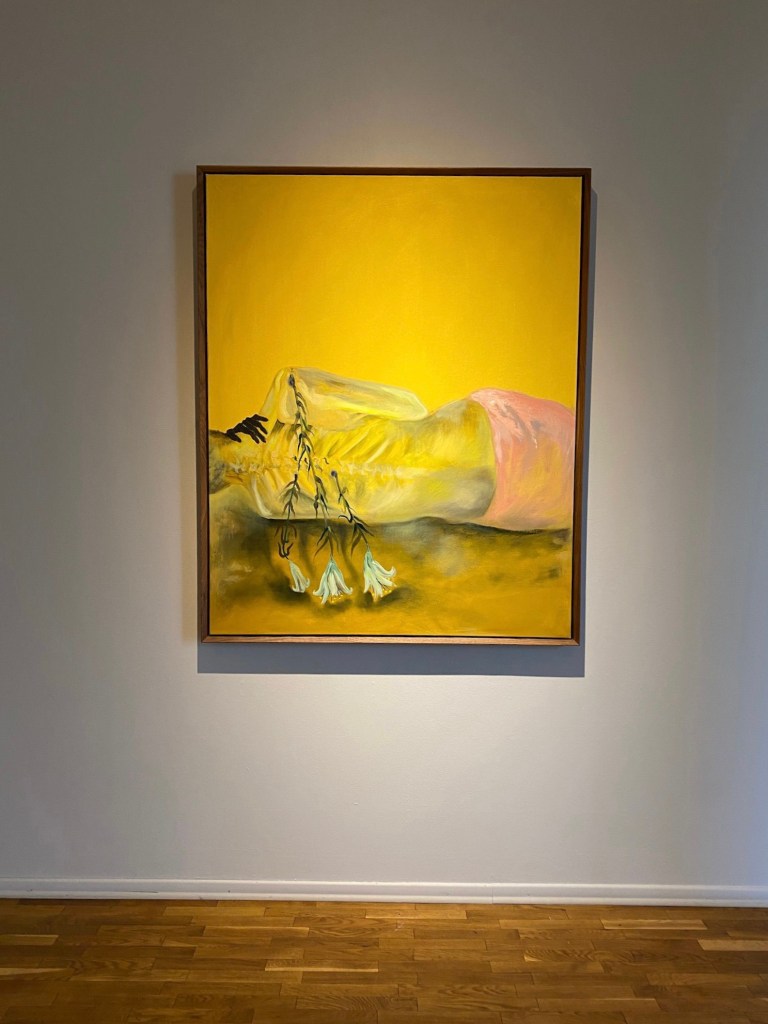
AM: Kind of, but actually sort of disintegrating. Thinking about how nothing is permanent, and thinking about that sense of time or sense of loss. I have this one painting which is a woman with no hair on pink background and she’s kind of ripping herself open. For me, at the time, I was talking to my analyst about me not being able to express my emotions, and I was like what if there was this literal, violent sort of expression of emotions – if I could just channel this physically. So I made this cut-up figure. Initially I called it ‘Take Everything’. If I can’t express this in this normal way, with language failing me, why can’t we just do an x-ray of the body and just see it there. There you go.
All these cut-up figures have various different meanings and I feel like this whole disappearing of the figure is something slightly different – the fragility of it. There was one work which had the ribcage coming through, and I wanted to have it glowing inside, because I thought about aging. I know it’s kind of a stupid topic, but I think about aging quite a lot. So this work was called ‘Glowing, Rotting’, looking at the young naked woman but at the same time it looks like she is disintegrating, and these leaves grow out of her.
MC: So you’re using the body to express things that you can’t express with language?
AM: Kind of. But I guess I could tell a story of how I’m worried about aging, and this whole situation of how people consume each other, what your value is and how it drops as you age, and what that means as a woman. This is what I was putting into that painting, and I could narrate it with words, but I could also make this weird yellow figure and call it ‘glowing, rotting’. And someone else could be wondering if she is dead or is she alive. And I don’t want to talk to people about how I’m worried about aging. Like, is it cool for an artist to worry about aging?
MC: I think it’s very valid! So, when you create a piece of work about your fear of aging, or your emotions, do you feel better?
AM: The only thing that makes me feel good about my work is – and this has happened to me only in the last couple of years – when I finish a painting and I think ‘fuck that’s good’, and the topic becomes secondary. It’s still there, but I can distance myself from it in the work. It’s done, and I’m proud of it. The topic can go to another work if its unresolved and deserves another painting, but normally I don’t think about it that way, no.
MC: OK, my final question I’d like to ask you is about other artists. I’d like three names. People who inspire you, your contemporaries, people that you’ve seen…
AM: I really like the work of Kate Lyddon. She’s with the Acme studios in Hackney. She’s about ten years older than me, she’s been trying to do art for many years but didn’t have much time for her work because she’s got a child and she’s a single mum. We had a show together in 2019, and after that I felt like I took her advice about things, and that if I was in trouble I could ask her. There was a time where we would chat every day. I feel like I owe her, in terms of where I’ve gone with the painting. Lots of good advice comes from her. She’s also a figurative painter.
MC: Being an artist who also has to work, like Kate Lyddon – does that have an effect on the content of your work? Like if you were a full-time freelance artist and had all the time in the world, do you think your paintings would change?
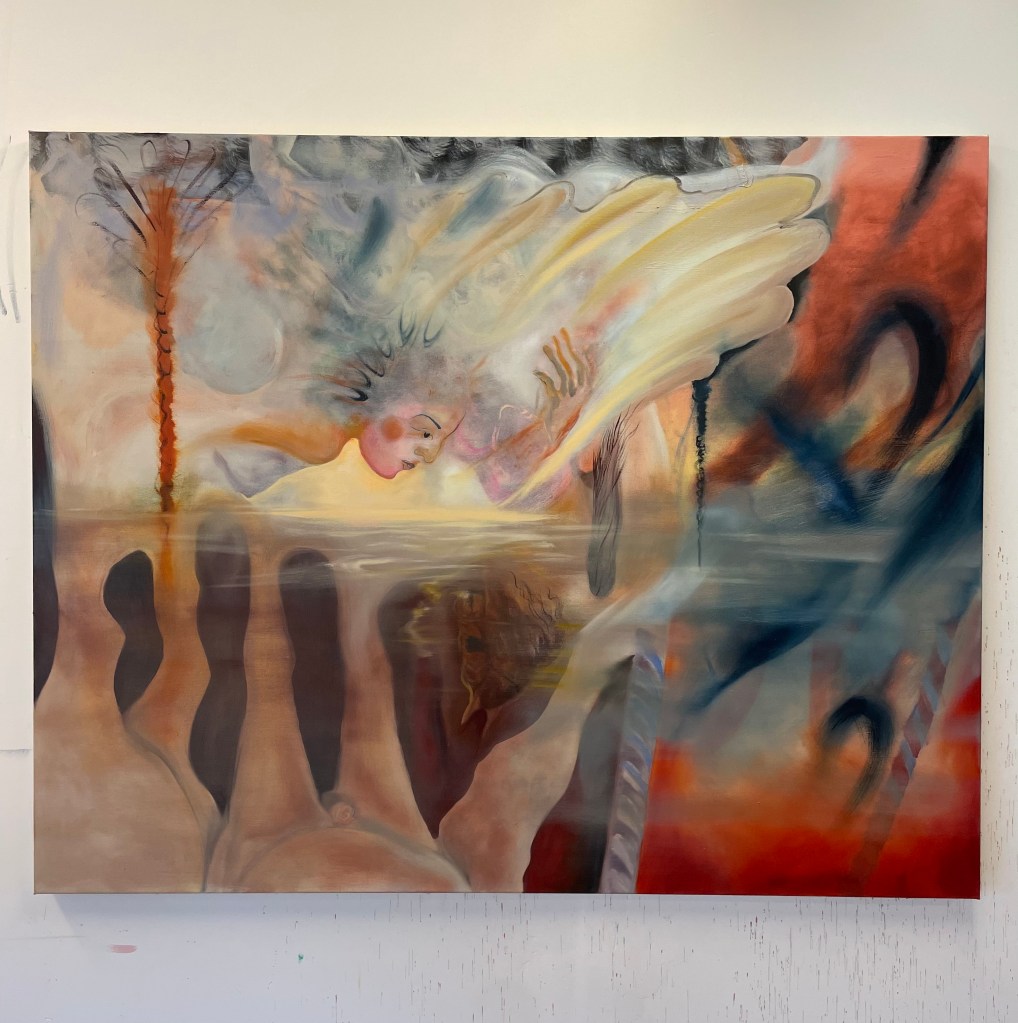
AM: I think certainly a lot of the frustrations of work get fed into my paintings. For example, this painting here started off upside down, and this white bit was a tablecloth. It started when I was thinking about us being there doing this hidden work. I think a lot about work that isn’t visible. So the painting is kind of dressed-down, and it has these heads peeking out from underneath the tablecloth, and it’s being dragged by horses. A kind of food-chain of work, painting the idea of labour. Then I saw that the painting wasn’t going to work, so I turned it upside down, and now the meaning is slightly different. But it definitely started with that frustration of work. I don’t really mind it, to be honest. I’m not hoping to be a full-time artist anytime soon, so I don’t really think about whether my work would change. I’d like to think it would become better because I’d have more time, but then also it might become really boring and repetitive.
MC: I think that can often happen, especially when artists get representation.
AM: I feel like it comes with pressure. I think that if someone makes it big-time really young, then its hard. The gallery will tell you, this is sellable, don’t change. So it’s harder to get away with changing your practice. Mentioning Albert Oehlen before, he’s had so many different bodies of work which look entirely different, and he’s been pretty successful all the way through. I don’t know if that can happen to people nowadays, because the market is so brutal, and yet you’re always in such a fragile position. So, in a way, I’m quite happy with myself in the sense that I’ve had time to develop my work for years and years without any success. And if I were to make it now, I’d know what I’m doing.
MC: I do get that, and it does seem that such a huge part of what goes into your painting happens in your head when you’re at work, so it’s not like you’re wasting your time. It’s all going into your painting.
AM: So the two names. I feel like all the people who are my age are all out of reach, outside the UK. Do you know Okiki Akinfe from the Bomb Factory? I like her and the way she talks about her work is interesting, so I’d say her. There’s also this other woman in this block who I’m friends with as well, Freya Tewalde. I would say her as well.
MC: Great! That’s three names, perfect. And they’re all people I can talk to. Thank you so much. I’m looking forward to seeing what comes next.
 Milkteeth
Leave a comment