
MC: I’d like to ask you first: What is your story of becoming an artist? When did you first start to call yourself an artist?
VW: That’s a good question. My grandad, he was a farmer but he also did a lot of art projects. So I grew up doing art projects with him – paintings and watercolours. And then I went to school and always really enjoyed art. Then I went and did an art foundation. I had a really lovely tutor called Darren Harris, and he gave me a lot of inspiration about painting, and honestly was so complimentary about the way I handled paint. He was like, you need to go and really investigate this, I think it would be worthwhile. And I didn’t really know what else to do, so I went to Camberwell for uni. But if I’m honest, at Camberwell I really fell out of love with painting.
MC: Maybe because painting had been pretty unpopular there?
VW: Yeah, painting’s not very cool! Everyone else was doing cool sculpture and photography, and it was just a bit difficult trying to make things that I really enjoyed – and finding the reason why I paint, which is always a recurring theme. Then in 2022 my first big series got paid for by a gallery in LA. They had a lot of excitement for my work. That was really the first point where I’d sold paintings and was living off the money from it. And I was kind of like, OK, maybe I’m a painter now. I don’t really call myself an artist – I always call myself a painter.
MC: So the act of painting itself is very important to you. Have you ever tried to move into any other medium?
VW: All the paintings are based on poetry. And I do really like photography – taking photos, especially on film. But I always find that there’s such a disconnect between my painting and my photography – I think because my photography is people-based, and whilst my paintings are somewhat narrative-based, they’re so expressive that they don’t really correlate. I tried to investigate that a few years ago when I was in uni and had less funds. I mean, printed media is more accessible than doing these giant paintings. But I just found that it became very collage-y, and I don’t like collage very much in my work. I’m also really terrible at sculpture! I think my brain is very 2-D orientated, and as soon as I have to think about the other side of something, I just kind of get overwhelmed.
MC: Tell me more about the poetry side of it. So when you’re creating a piece of work, do you write poetry first? Where’s the starting point?
VW: I’ve always written poetry. A lot of it is written on my lived experience, as a way of processing what’s happening in my life if I ever feel a bit overwhelmed or confused. A lot of my poetry is very automatic. I wouldn’t say it’s surreal, but it certainly has strong metaphors throughout it.
MC: What kind of automatic techniques do you use?
VW: I always just write a poem, and that’s it. I never really do any revisions, and sometimes it’s just lots of different words on the page. Like free writing. I think when I’m painting and I want to paint a piece about a specific narrative, I always find it really useful to have a poem from that time next to me. I’ve found it’s a nice way to revisit myself in a past tense.
MC: It’s interesting to hear you talk about your work as a narrative about your own life, since that is what your poetry is based on. Are they self-portraits, in a way?
VW: They could be. The work tends to really shift – sometimes it’s heavy on figuration, and at other times it’s completely abstract, which is where it’s at now. But I do like playing between the lines, with that figuration, that body element. I do think that with the gesture of the paintings, I hope, there is a sense of narrative in it.
MC: There’s definitely a sense of the body in your work – even if it’s the body of you painting it, because you can see the physical effort that you’re putting into these things. I think it’s something to do with the scale.
VW: Yeah, because they’re so big. People always say that they feel a lot different in real life than when you see photos of them. I think they have a very life-sized impression.
MC: And the colours are so much more vivid when you see them in real life. Very all-encompassing. How do you feel about your work being illustrative? As you are illustrating poems, in a way? Would you ever display the works alongside their poems?
VW: Yeah, I’ve recently opened up this conversation, because I’m part of a poetry collective and lots of us are different types of artists. For all the paintings, the title is normally from a line of text in the poem – perhaps a shortened-down line. So I kind of enjoy the playful sense of just providing a couple of words and a painting and seeing where people’s minds run to, organically. Versus if I was to present a whole anthology of poems around a painting, it kind of admits too much about myself. Someone once said that I hide behind my paintings a lot, before I began to publish the poems. But now I like to publish the poetry separately.
MC: Yeah, you don’t want people to be sort of lining up the painting next to the poem and drawing parallels.
VW: Assuming things about it. I also think that, because the paintings are so big and the poems are so small, it might look quite silly.
MC: I was going to ask you about the titles, actually. Your work really reminds me of Lynette Yiadom-Boakye, who was at the Tate about a year ago. Figurative paintings of imaginary people in imagined environments. She’s a poet, and she considers her titles to be the final brushstroke on a work. How do you consider titling your work?

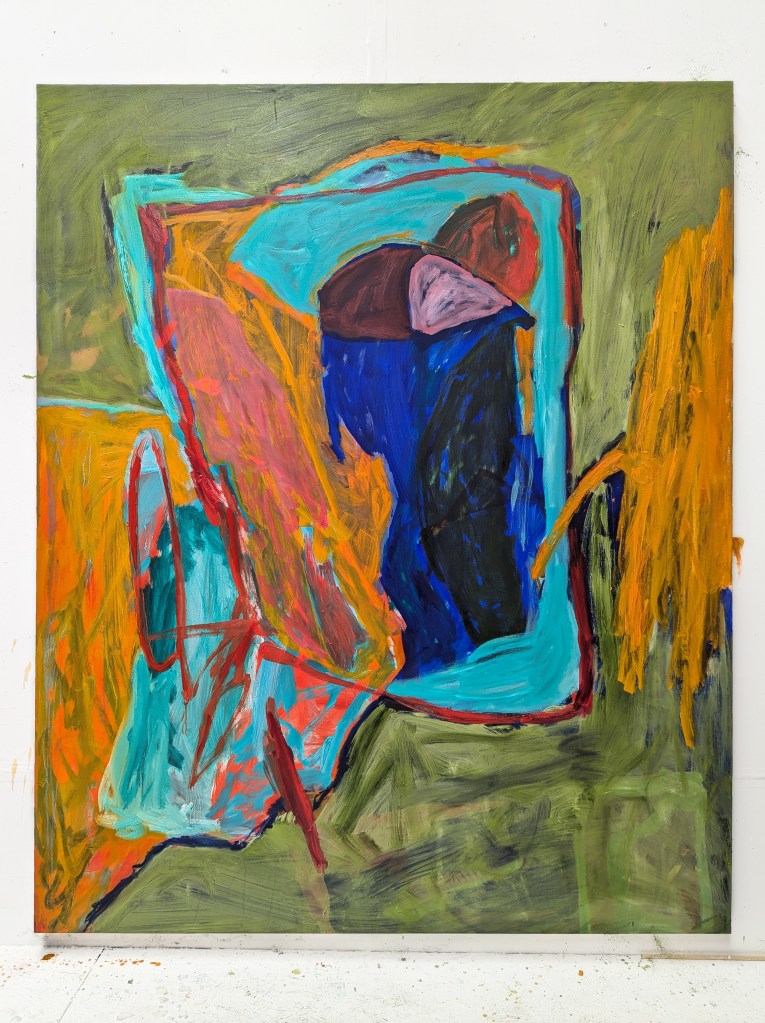
VW: Normally I’ll have a loose idea. This painting is called ‘Trampoline Town’. I wrote a poem a few years ago about my childhood, and I always wanted to paint a big painting about it, but never felt quite ready. So, started this piece reflecting on the poem itself. I always put a little bit of masking tape on the side, and I’ll write the name on there. That changes a lot – as the painting develops, I’ll change the title. For this one, it went though almost the entire poem, because at different points I was emphasising different moments of the poem. But then, one of the paintings over there is called ‘Cut Up at the Lady Crossing’, which is just a line of text from a poem. I saw that written down on its own and thought, I’m gonna do a painting just about that. So it kind of varies, depending on the personal element, and how much I relate to the poem. Some of them are a bit silly and goofy, whereas some are quite personal and about past things that have happened.
MC: I would like to talk a little bit about some of your previous work. Your style has changed a lot! It’s gone through a lot of iterations. I’m thinking back to the works you were doing which had a lot of thick paint on the canvas, and they’re almost a Romantic style, a nod to Turner maybe. Lots of blues and greys. Could you talk me through the different iterations your painting has gone through, and how you’ve ended up here?
VW: I’ve always painted, but I’ve always questioned why I paint. I have a lot of envy for people who can just paint, and there’s a really important reason as to why they paint – maybe it’s to process past traumas, or they’re really political – they’ve got some sort of reason for doing it. But I’ve always struggled on why I do it – do I have enough purpose to do it? So I think a lot of my painting style changes depending on how much I’m focussing on this. I think the paintings you are referring to are from a really heavy research point. I did an art history MA for a bit, and I was doing a lot of reading, especially about Romantic and Classical painting. I think that very subconsciously came into my own painting. Like, this is what good painting is, quote-unquote, so I must paint like that to give me a reason to do it.
I do like those paintings, I think they do link with my relationship with being from the countryside in Chippenham, being in open spaces. That stark change in lifestyles from growing up in the countryside and then living in London. And then also that longing for open space.
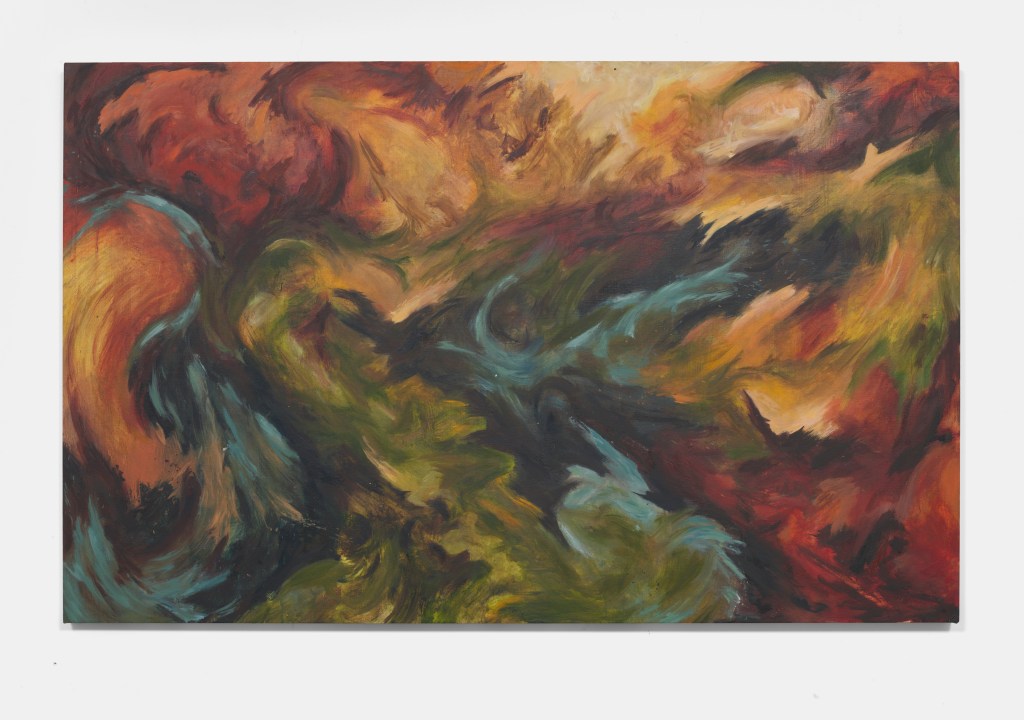
MC: I see a lot of the Sublime in those works. A lot of standing on the edge of cliffs looking out to sea, looking serious.
VW: Sublime was a very big word when I was at uni. How to paint the sublime, and how you could have a contemporary approach to it. Because I think we no longer have the terror that comes with a Sublime experience anymore. We know too much, there’s no mystery anymore. So at what point are you painting the sublime? I think for me, it’s that recurring confusion still – that even though we do know so much, I’m still just a person figuring things out for herself. So I think my style has now changed because I think it’s slowly becoming a lot more me, rather than reflecting on lots of different sources and research.
But I still enjoy those paintings, and think they’re quite lovely. Those were some of the first 2-meter-sized paintings that I did. It was nice to play with the compositions, the physical gestured space you can do whilst painting on that scale. It was very frustrating to figure out how I wanted the surface to move around. I guess with these ones here, because they’re so ‘push-and-pull’ in terms of the shapes, it’s more of a happy process.
MC: So the series you did where the canvases were quite blank and the painting was sketchy – was that a direct reaction against the more Romantic ones? Did those come straight after?
VW: There was a bit of a gap in painting for me – I was moving studios and changing from working full time to full-time painting. I found that change really difficult, because you have this romantic vision – oh, I’m in the studio, I’m going to paint all day and then go to the pub. But then actually it’s more like being sat in a white box for five days a week on my own. When I first came to this studio, I was really trying to follow on from that series you just mentioned, that was very country and movement-based. I was getting really frustrated because I felt I had no relationship to the paintings I was making, and I was getting so upset by being here, annoyed, questioning why I was doing it. And so I took all those paintings down, and stretched fifteen meters of primed canvas, and for about three weeks I just painted. Paint what is on your mind, what you’re struggling with, why you’re doing all of this. And what came out was a very sketchy series in terms of the actual marks, but a very honest series. That was why there was such a strong contrast between the series.

MC: What kind of a journey was it from that to this current series?
VW: I think I definitely needed the last one, but I think this one is more fun. I’m still trying to play around with why I’m painting, but also to try and enjoy it a bit more. Because I love painting, it’s one of my favourite things.
MC: These works have so much depth, and it does feel like the most figurative you’ve been, just because you have a very clear background and foreground. Whereas previously, things were very unified on one plane.
VW. Yeah – I also got very bored of doing the last series, because there’s only so much you can do before a painting where you’re keeping the white background is done. I wanted to continue them, but felt like I couldn’t. But the two series do relate. I’m just enjoying filling in the gaps a bit more.
MC: Here in the studio, I’m looking at your cryptic wall of sketches and words. I’m assuming these are fragments of your poetry here? I was wondering if you could talk me through the process, from start to finish, of you creating a painting? I know you mentioned that you always have at least six going at once. How much preparation do you do?
VW: Normally I’ll get an idea about something from a visual image that I like. Normally if I’m at home I’ll just sit in my kitchen and write a lot, and often when I do that I’ll come up with an image – that this shape would look nice, add in a few lines… Sometimes I’ll do little sketches at home, and I’ll bring them into the studio alongside one of the poems. Another thing I like to do is to write out one of the poems on an A1 piece of paper, mull it over a bit and find some automatic gestures for my sketches. And then sometimes I’ll just start. Just throw things down.
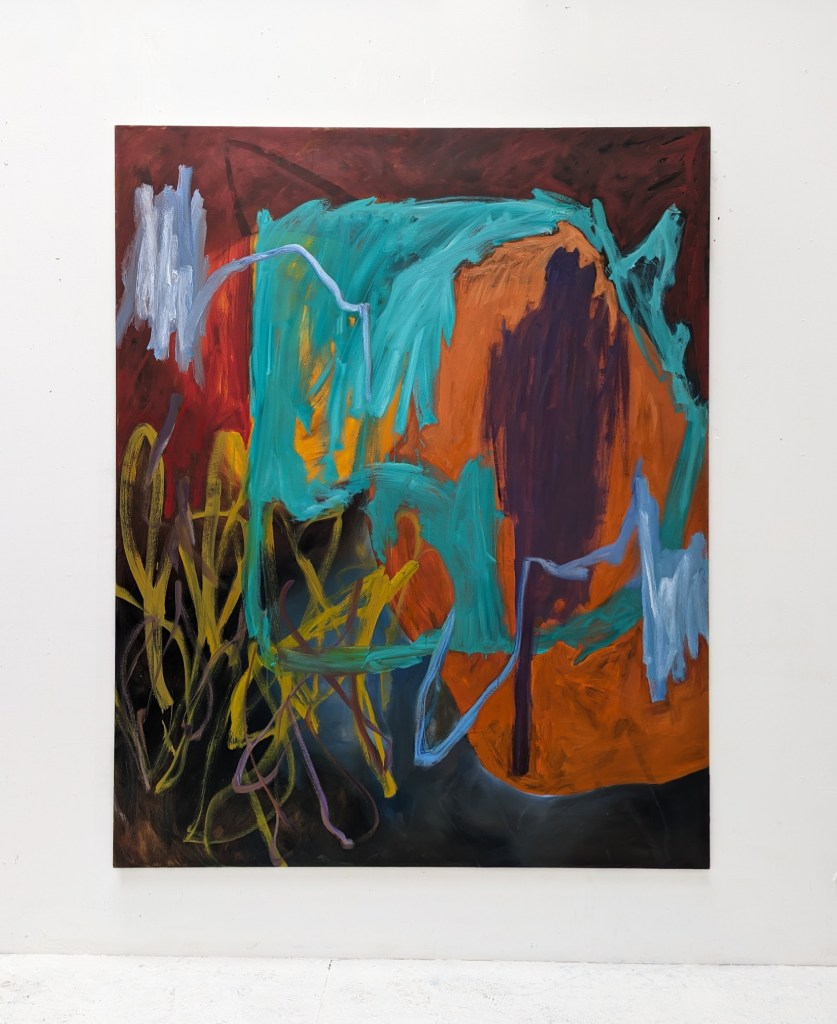
It definitely varies, but as I build them up so much they always look different by the end. Apart from that painting there – I call it ‘Scream Silently’. That started out originally when I was trying to be really rigid with how I worked the process. I always think painting is just about controlling a load of variables, and if you figure out the variables then you can consistently make paintings on the theme of something. So I did lots of sketches like this and I painted them onto that canvas. I think I did six of them. But they looked like some sort of superhero advertisement – I don’t know why, I just kind of hated them. I think it was the glow. So I just wanted to paint over it – that idea of hiding behind painting, because this one has a personal story behind it. Now I think this piece is finished, but it feels quite awkward compared to the other ones because I’m hiding that original image in it.
MC: I think that works well though – there’s a tension in it which, if it’s a personal piece, reflects well. I like the glow as well.
VW: I’m calling it my Star Wars glow! But I repainted the bit at the bottom so many times because I couldn’t figure out how to push some back into the distance with these yellow marks. So that’s one of the most formulated paintings I’ve done for a while, but I actually really enjoy it when I just start something and see what comes out.
MC: When you’re imagining what the painting will look like it is already formed in terms of colour and shape, in your head? Because I was asking where your inspiration comes from because I was wondering whether you perhaps see a scene from real life and translate that into the abstract? Or does it come to you immediately abstract?
VW: It’s normally about that relationship of shape and colour. How they’re interacting together. So it could be figure-based, but in my head it looks like a blob. I really enjoy lines that go backwards into the canvas and then come back through. I just paint it how I see it in my head. Like with this one – I remember seeing that blue against the red somewhere and thought I really like that. I’ll just see the general line-work and colour that I want to do.
MC: Do you always work in series?
VW: Pretty much. I think I paint quite quickly compared to most people. Although with this one, I started this painting about 5 months ago, and it was massive. And I took it down and rolled it up – that’s what I do if I don’t like a painting, look at it another day. And then I bought it back out. So the actual physical painting time is not very long, but the time between layers is quite long. So sometimes they do take ages. But I know, at every stage, what the painting looks like. I know how I painted it. When I look at other exhibitions of abstract paintings, I love to figure out how they’ve done it. Even if I’m frustrated by a painting, I’ll still get it out and think about it. I do find it interesting – what changes when an artist stops and starts.
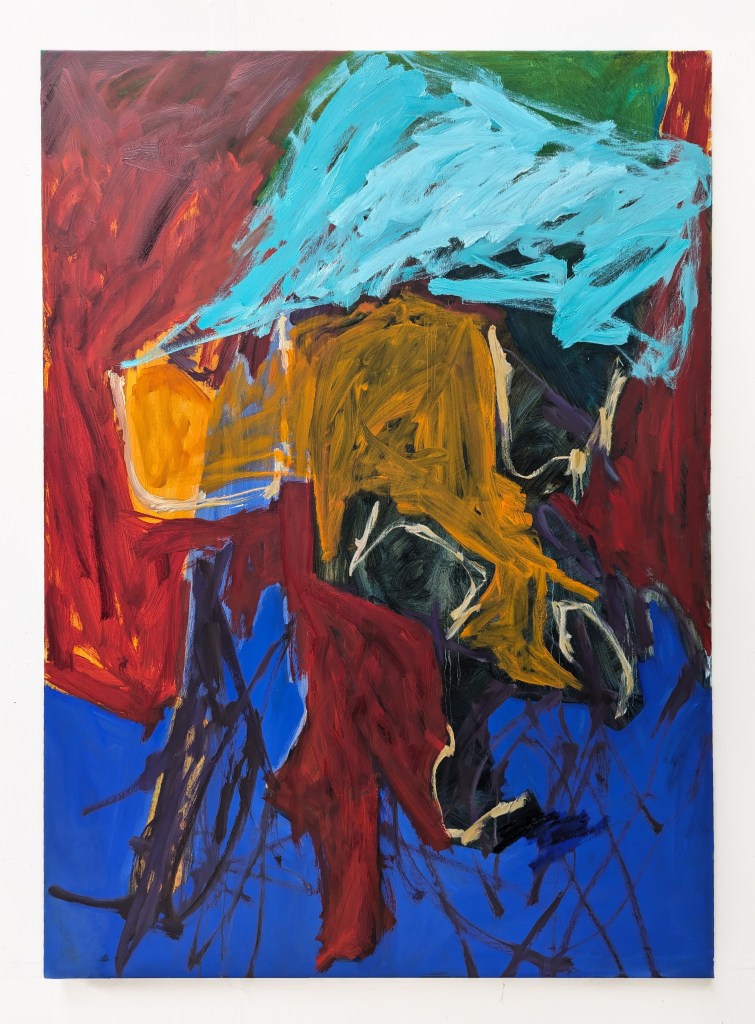
MC: I guess it links to how, for you, painting is a very personal experience. So you’ve got to be in the right head space, and it takes time for that to happen.
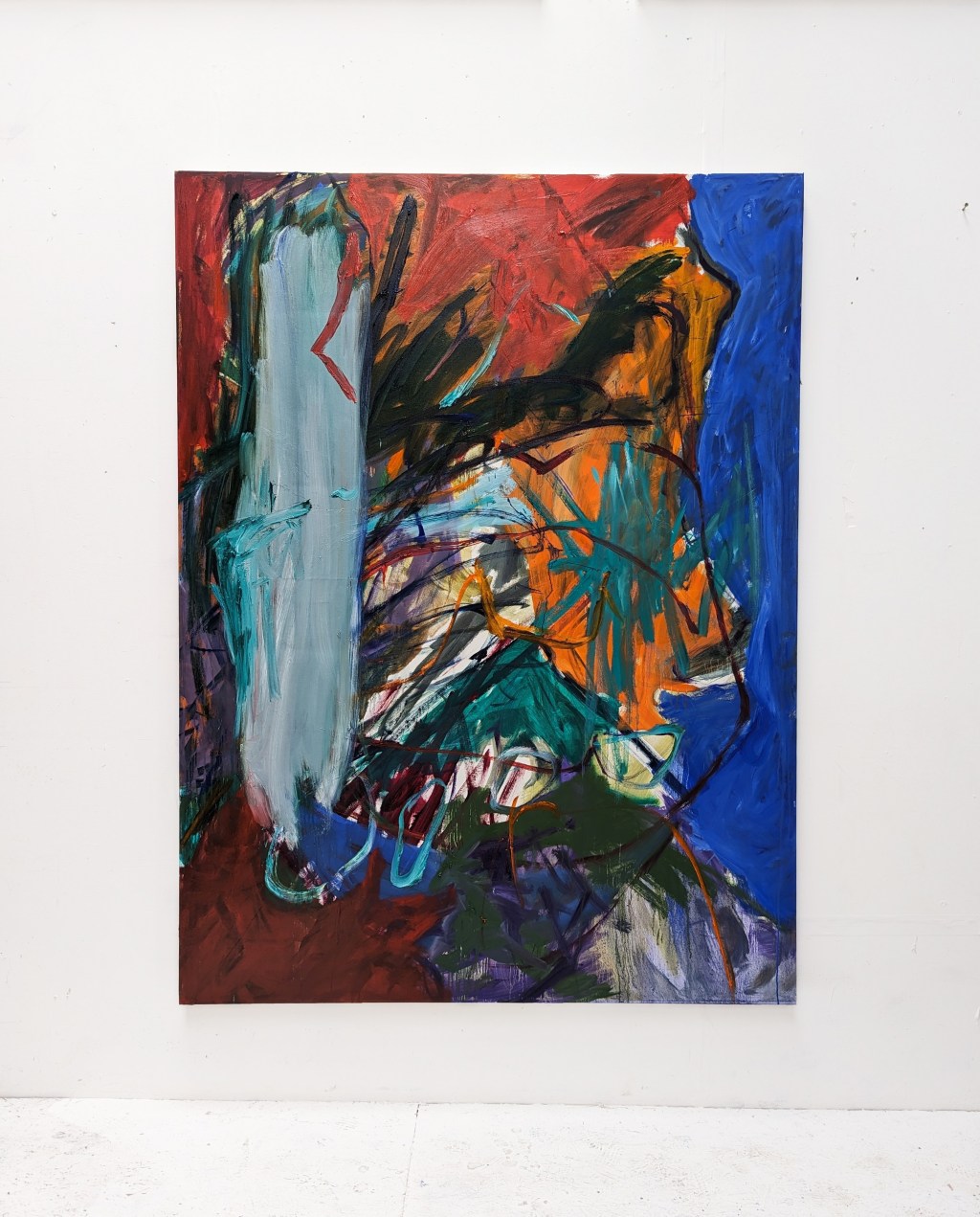
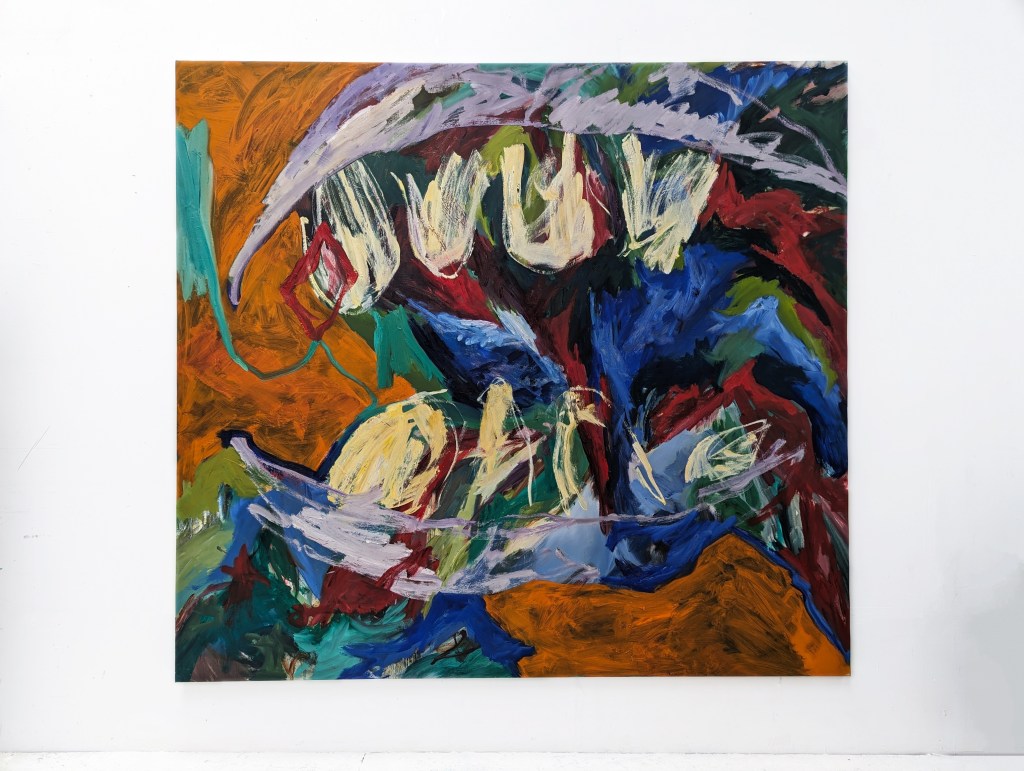
VW: Yeah, true. When I first painted this one, it was end of winter and really dark and depressing in here, so the whole piece looked really – meh. And now it’s summer and the lighting is good again, I’m really enjoying the murkier tones. The original image was this giant red form going one way, and this grey one coming down the other way. I put some liquid masking tape over the edges of them and did a background, because I was trying to play with that sketchy white background versus filling it in. So there’s these hard edges which you couldn’t really do with a paintbrush, which I wanted to keep. That’s the inside of a mouth, and it goes down to his toes.
MC: You’ve mentioned a few times in this conversation that you are looking for the reason why you are a painter, and that’s the main driving force behind your actual painting. Have you decided? Do you think it is necessary for a painter to know?
VC: I think I have realised why. I think it’s the one thing I can make sense of. I always get very overwhelmed by what is happening in the world, what we’re supposed to be doing, what’s right or wrong. I always find that painting is the one thing I have full control over. It’s a really nice friend to have and always come back to. Even if at some point I decide that I don’t want to sell work and be professional painter, I think I’ll always paint.
MC: Do the confusions of the world go into the paintings? Do you process them through painting? Or is painting more of an escape?
VW: When I’m painting, I don’t think too much about what I’m doing, I just do it. I’m usually thinking about what is on my mind. So I do think that I process a lot of my relationships and my position in life when I paint, and my frustrations with that. The studio is a really good process space and reflective space. I often find that if I have a good day in the studio, I’ll walk out feeling very positive and peaceful and level-headed.
MC: And do you think it’s necessary for an artist to know why they’re an artist?
VW: No I don’t think so! As long as you enjoy it, do it. Because it’s nice, because it’s fun, and it’s not harming anyone.
MC: This leads me to the question – how do you navigate being a London-based artist today? Obviously its tough out there! I know you said that you were working full time, and now part time. Is it hard to get into the painting head-space with all the stresses of living in London and so on? How do you feel about the ethics of being an artist when it’s so tough to make a living otherwise?
VW: I think it’s really annoying how at a certain point, as an artist, if you want it to be a full-time thing, you have to learn about how your product can be monetised. I think it’s a really hard thing to out a price-tag on anything you make. If you buy a painting, you’re not just buying that one – you’re buying the years prior, all the training it took to get to that point, as well as the investment that person has put in themselves in having a studio and living in London. It is very tough. I think I’m in a good position, because I can make works so quickly, it can get out the door quickly if there’s a buyer for it. So I can pay my rent, or pay my studio fees. But it’s not really fun to have to do that. Especially going to art school – I really thought it would teach me how to be an artist and sell my work, but actually it didn’t do any of that. So you have to pick it up on your own, and usually make a lot of mistakes with it.
MC: So to ask you my final question. Which is to ask for three name – contemporaries, people who have some kind of accordance with your work, people that inspire you in a particular way.
VW: I am going to say… one of my painter friends, Reuben Sian de Gourlay. Our work is visually very different, but one of the amazing things about Reuben is how he talks about painting, his work ethic – his passion for painting. Then the second person is probably Vanessa Jackson. I was able to visit her studio last year actually, and she talked through her painting processes. Her processes are very different to mine because they’re so geometric and revised. But it was so interesting to see her interaction with colour theory on the canvas, and that really turned my head in terms of how I’m using colour. Then a third one… I’m going to say Henry Baker. He’s an American painter who did his MA at the Royal College. He does these really interesting sun paintings. I think what I enjoy about Henry’s work is the surface of it, because it’s such heavy paint application – but it’s interesting how he utilises oil paint to not look like oil paint in a certain manner. I think those three.
MC: Thank you so much for talking me through your work, it’s such a pleasure to see it in real life and in your studio!
 Milkteeth
Leave a comment