

MC: I’d like to start with you telling me your story of becoming an artist. When did you first start to call yourself an artist?
SP: For me, since I was young, art was the subject that I would do well in, compared to my cousins. We grew up together in my grandma’s house, although they are much older than me. I could sketch and draw from a young age, and at every group project at school they wanted me to do the drawing. Since that was my strongest subject, I grew more confident in it, and when I was asked what school to go to, I chose art school. Even though people were saying, what are you going to do after that? But since my parents didn’t object, I managed to get in.
MC: I read in the exhibition flyer that you studied some of the discourses surrounding gender and the decorative arts, and was wondering if you could talk about that a little bit? How has it fed into your practice? I can see you have a very decorative style, with these vintage pastry moulds as a motif.

SP: The research really came after I started collecting the pastry moulds. I recall an interaction with another artist at a contemporary ceramic craft show in Singapore, when I was choosing between two pieces to buy. And he said, you know, I prefer this one because that one is a bit too decorative. It had some drawings and things on the top. And that got me thinking, why would he say ‘decorative’ in such an ostracised tone? Then that made me wonder about my practice in general, in the beginning when I was more inspired by Japanese minimal, sculptural works, just flat white or black. I also think about the minimalism trend – not just the minimalism movement in art history, but the minimalism trend in interior design and the way you live your life. Like that Japanese lady, Marie Kondo. These days, the minimalism ethos is still very strong. I guess that’s why decorations are still being ostracised. And then I went to research that and I realised that there’s more to it.
I never before saw ornamentation as something that is gendered. My grandpa wore batik shirts, that Indonesian design – the men wore very ornamental clothes. I never thought that the woman was the decorator of the house according to the Western part of the world, those histories. It’s not that in this region women weren’t doing that – they were. Women were mostly stationed at home because they are the child-bearer, therefore at home most of the time. So those histories which linked to the woman’s role is something I researched after I began collecting the pastry moulds. I did not start collecting them because of this research. It was that, as I got more money to buy more moulds, things just started to get more decorative and colourful. Then I realised it’s very important to research on ornaments, on why it is being ostracised in the art and design world.
MC: Did these ideas influence the piece ‘the ornamented knife confronts the pure, unadorned moon’? I read that it represents purity, the moon-shaped vessel with this total lack of ornamentation.
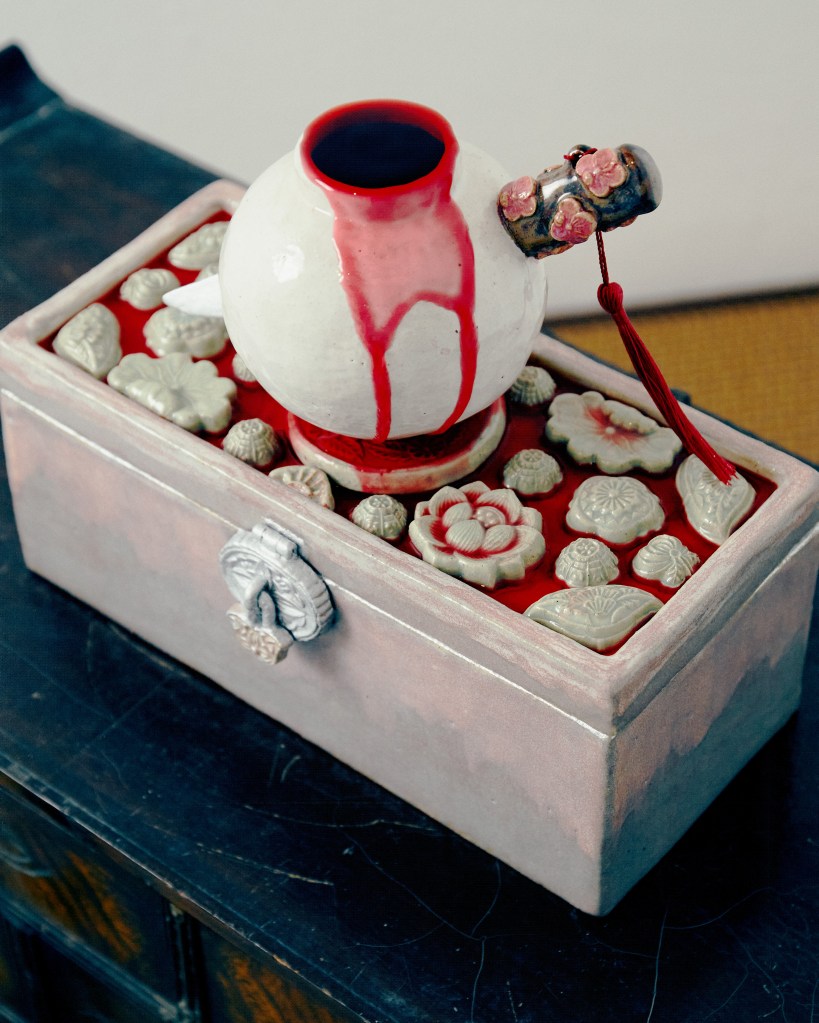
SP: I think the unadorned moon speaks to how Korea is not as affluent as compared to Japan and China, so their wares are more closely linked to that kind of look – white, minimalistic. I may be inaccurate about this as the less luxurious look is often regarded as the Korean ethos of simplicity due to their Neo-Confucianism beliefs in the Joseon Dynasty. But then, yes, my titles do show my input, my focus on how the knife is ornamented and the moon is not. The moon jar symbolised purity according to Neo-Confucianism beliefs in Korean culture, and at the same time, this knife symbolises the chastity and fidelity of women. It is given to the woman to protect her purity. But then it is being ornamented. So it is very contradicting, and that is something I want to point out in that work. But it’s not only on the title – it possesses way more layers than that particular explanation.
MC: It’s beautiful. I’m interested in the way that you balance form and function with the political aspects in your work. Because when I came to the talk that you gave at Yeo Workshop, you were going through the different aspects of your practice, and you separated them into very clear, distinct categories – functionality, socio-political and cultural. These three strands which make up your work. But for example with this work here, ‘Burning Bridges, Bleeding River’: the tableau on the top of it is very political and cultural, and it’s decorative because it’s a fountain, but it is also functional because it’s in the form of a box. I was wondering how those aspects work with each other in your work? Is it political to be utilitarian? How does the ornamentalism effect the functionality, and vice-versa?
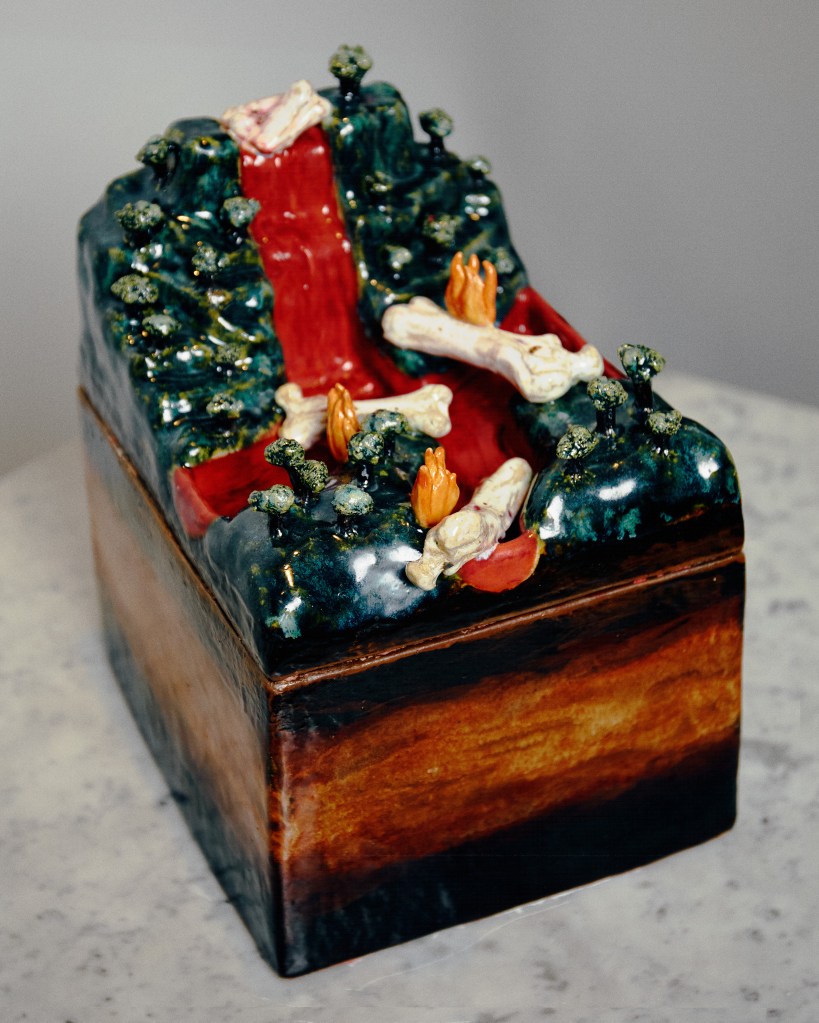
SP: The functionality is mainly because I am a ceramic-maker – a person who looks at functional objects more often than any other practice like painting, for example. In ceramics, you see cups, plates, pots, and many other objects which are meant to function. And we learn to use ceramics to make those functional objects. Also, I suppose my obsession with vintage stuff – I go to shops where I look at those curious objects. In the past there were lots of fun objects, more focused on how funky the shape is. Like weird teapots and things. Nowadays things are really plain. These things make me want to make functional objects. So if this can’t function as a fountain, it is still a box.
MC: This work, ‘Burning Bridges, Bleeding River’ echoes the series of works you have in this exhibition exploring broken bones and the idea of civilisation. Can you talk about the route that this idea took through your work? Essentially, you’re talking about the idea that the evidence of the root of civilisation is a broken femur bone which has been healed, showing that someone has looked after the injured person and nursed them back to health. You take a cynical view of this…
SP: That one really came about because of encounters of social media. I am someone who, like a lot of my peers nowadays, can’t leave my phone or social media because it connects you wider than your own social circle. This idea about civilisation is the kind of stuff I see online, that I read and then questioned. I find it problematic, and I have my view. It seems too perfect, too sentimental maybe. But I think what attracts me to this kind of story is that it is very visual – the image of the bone itself is something I can work on. Story and a strong image are very important for my work.
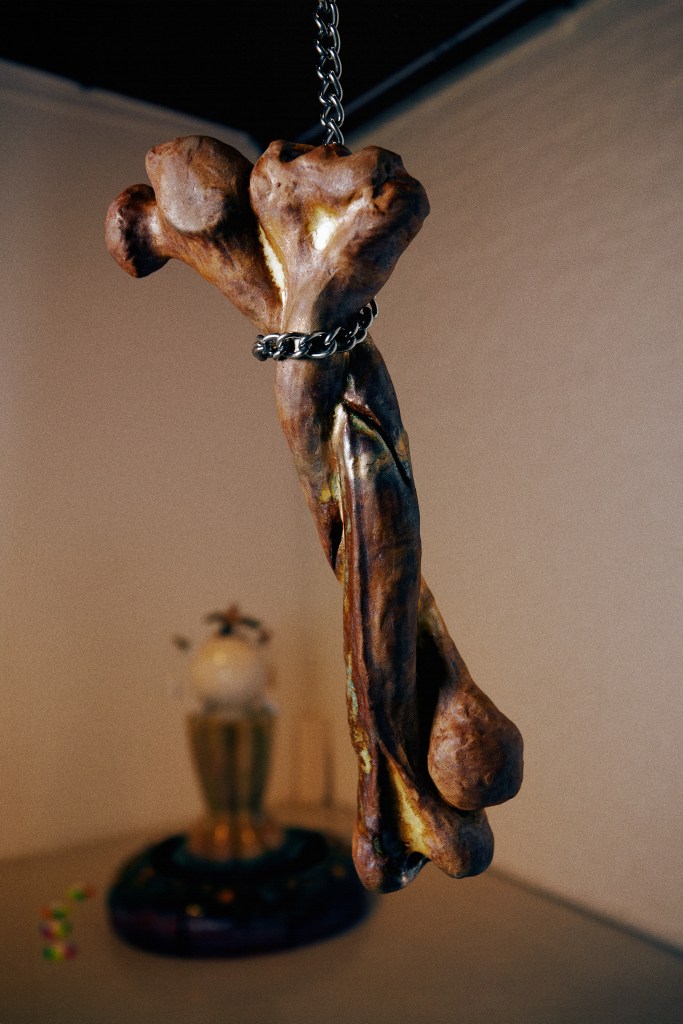
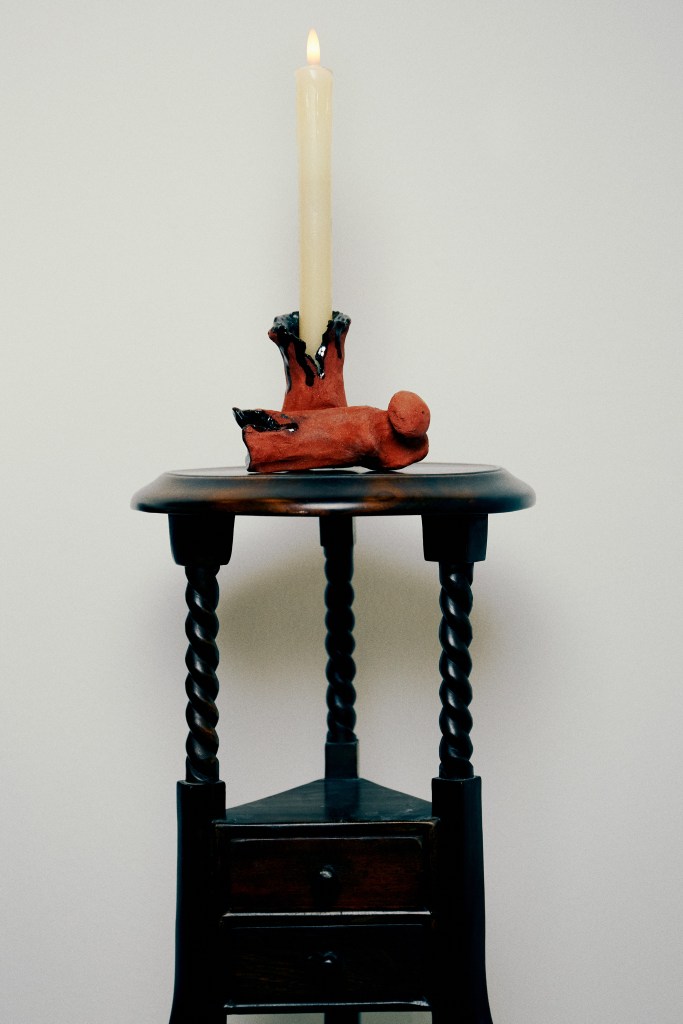
MC: I was going to note that you have a lot of work in the exhibition which is focused on violent or sometimes gross imagery. It is interesting to link this back to the idea of ornamentation, and things being pretty – contrasting that with gross things like bile and blood and gallbladders, and these candlesticks shaped like broken bones. How do you feel about the off-putting aspects of these stories, and putting them into this traditionally pretty medium like ceramics?
SP: I’d never thought of that actually. I think that things like bones and the gallbladder are also decorative, to me! So I never really thought of it as very different from a decorative piece. Because, for example, a candle-holder is a curiosity object, a collectable. But this is something I can go and research about – can things considered gross be used for decoration? Like kitsch?
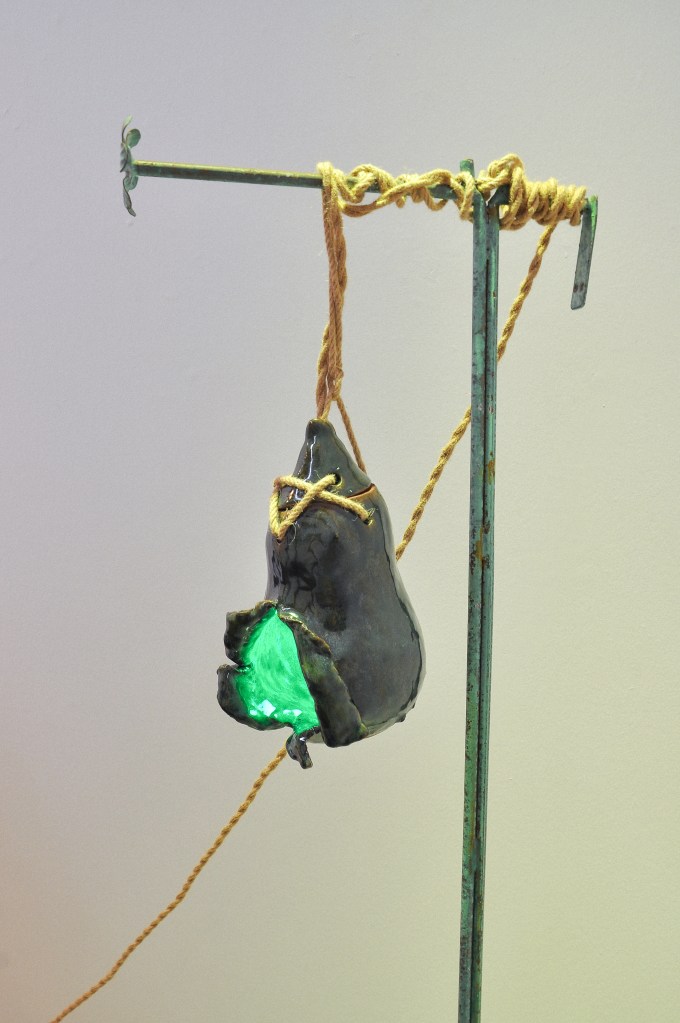
MC: It’s interesting, especially with the way this exhibition is curated – you turn the corner around this beautiful wooden screen, and you’re confronted with this strange object, the gallbladder. And it’s not until you read the story that you realise that it’s actually quite an off-putting image!
SP: I suppose because of that story, the way I present it is quite different. Because there’s the delicious lips and the delicious tongue. So everything is kind of gross but also delicious. The two sides of it.
MC: I wanted to talk more about the story that you are drawing on in this work, and others – the story of King Goujian. He was captured and tortured by his enemy, and when he returned to his own homeland, he tortured himself by drinking bile from a gall bladder in order to maintain that level of anger which would allow him to one day get revenge. And in this work you are linking this to the kind of martyrdom of lots of salary-workers, when they boast about how many hours they work and how difficult their lives are. Do you think this is a particularly Singaporean trait?
SP: I think it’s a city-people thing. Singapore, because we are a very small country, it’s not like in many countries where you can go to a suburb. There are only so many places you can run to and have breathing space. So I think, especially growing up in the city, there is no way to escape except flying to another country or driving to Malaysia. So I think the feeling of ‘work, work, work, work culture’ – it’s very strong here.
MC: How has that affected the creative scene here?
SP: When I talk to people in the art world, they usually say how bad the scene is here. Especially the collector scene, because the collector is the one who helps feed the artist and helps feed the gallery and keeps the whole ecosystem healthy. But I think that is not very strong here, because people are more into the science, the finance, the math. As a country we are not as willing to put in as much funding and resources into the arts as into other areas, so the arts here are not at their full potential.
MC: It’s an interesting thing, and one of the reasons why I love art – it is something that exists only for itself. It’s not made to be productive; it just exists. That’s an interesting argument to have when you’re creating work that is functional as well as beautiful and meaningful. How do you feel about that in relation to your own practice?
SP: Unfortunately, I think about the money quite a lot. I suppose my making is not that anti-capitalist. Maybe the subjects that I talk about, the social problems, are anti-capitalist, but the work itself has to deal a lot with the very practical aspect of things. How some things sell better than others. This first show in the gallery is very important, because I just got represented. But as a young artist, if your works do not go down well commercially, how are you going to move on? Who’s going to show you further?
MC: Of course, this is something that all artists have to go through to some extent. But I do feel that it can curtail experimentation and doesn’t allow for mistakes, which are important for the development of a practice. So, in that vein, can I ask you what is your process, from the initial conception of an idea to the endpoint? Do you do a lot of experiments, maquettes, prototypes? You mentioned before that you don’t really sketch…

SP: Only very occasionally. With this nine-tailed fox, there is a prototype because it is the most complicated form I have ever created. There’s the clothing, and then how the clothing fits with the tails. So I needed to make a small one. The fountain, too, I made one very small. But I didn’t really follow my prototype – it was like a rough sketch in clay form. And none of the rest had sketches or prototypes. I just start. Whatever is on my mind already, I just imagine how it is going to look. Because it is quite straightforward – like, I know how a cake looks, or how bones look. With the fox, I had to twist the form of the Confucius body and add the nine tails, so those needed a bit of extra help. A cake is just a cake!
MC: I guess it really shows through the playfulness of your work – it feels experimental and fun. The colours that you use. It’s not overly considered, which is great and adds to the dynamism of the works. I was wondering if you could talk me through this work over here, with the highlighters – ‘Inferior Me, Inferior Me Not’. I feel like it is the most complex conception in the whole exhibition. It’s the most installation-based piece, with the ladder and the actual highlighters scattered all over the floor. How did this all come together, and what was the starting point?
SP: All along I wanted to work on the message ‘No-one owes Singapore a living’. As I grew up, having this message shown to us at school, every year. The highlighter came about just a few months ago. The idea has been in my notes for a few years, but the form didn’t come to me until much later. Initially I wanted it to be a wall-work, just text with no form. But somehow this flower-shaped highlighter just popped up into my mind. It’s also another nostalgia thing for people born in the 90s. All my peers remember this flower highlighter given out by the school. The reason we brought in the actual flower highlighter into the exhibition was because my curator said to me that no-one would recognise this form. So I ordered a lot, and I put them on the floor. Because I have the fountain nearby, and I wanted to make it sort of like a natural garden. And the ladder is just from my own collection. I just loved the ladder and wanted to bring it here. And my curator asked me to bring it along as it would say something about social climbing. Then I decided to place some pieces of the highlighter works on the ladder. They were originally made to hang on the wall, six pieces in total, and the caps of the highlighters originally made to be placed on the floor, were then placed on the ladder as well.
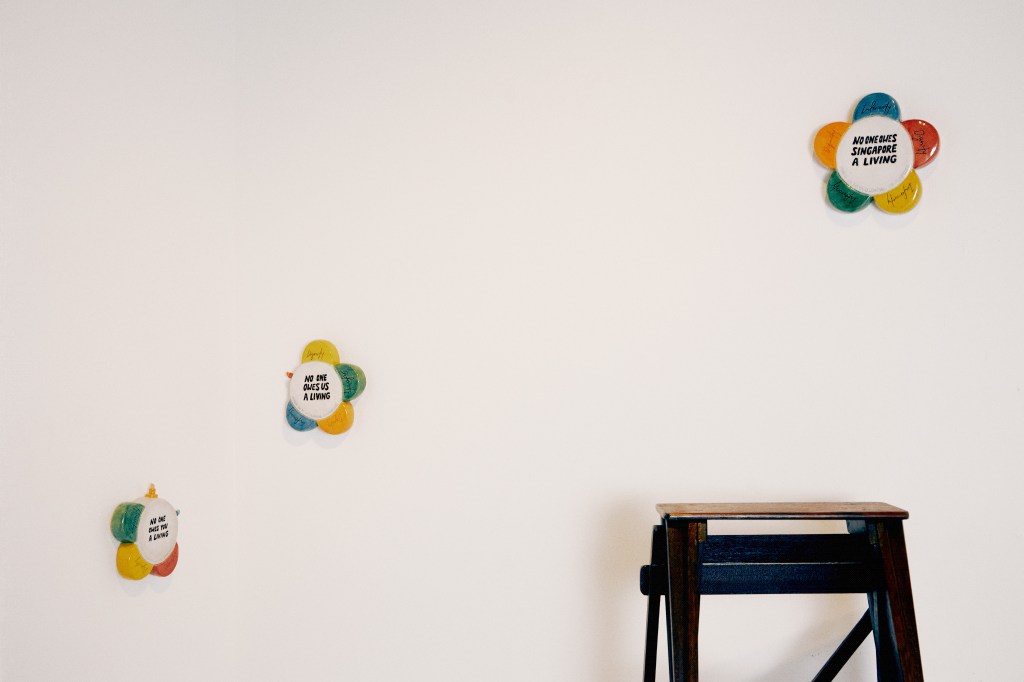
MC: And all the highlighter-shaped wall pieces have variations of the phrase ‘No-one owes Singapore a living’ written on them? What is the signification of changing the wording of that phrase?
SP: The actual phrase, written on the highlighters from the school, is ‘No-one owes Singapore a living’. And ‘no-one owes us a living’ appeared quite a lot during messages given out by the Prime Minister. It is also their party core values under ‘self-reliant’. It talks about not relying on the welfare state. The original meaning wasn’t what I was taught. The politicians must have assumed that it was very self-explanatory to put it as one of our six national education messages, but I don’t think it is because I don’t know what it means! It’s very confusing.
MC: It’s very much like in the 80s in the UK, when Thatcher said something along the lines of ‘there’s no such thing as society’, meaning that it is down to you as an individual to sort yourself out – at the same time as she was cutting the welfare state. Do you think that this neo-liberal idea is still in place here?
SP: Yes, but they put emphasis on helping one another when they say this. It’s funny – you want people not to rely on the state, on welfare, even though the money for welfare comes from the people. You don’t want any reliance but yet you need to help one another. You might as well just not talk about it, let this thing run. It is pushing the idea that people shouldn’t ask for help, even if that’s not the intention. The original intention was basically to say that we should not become a nation with no incentive to work hard – that’s their view, their worry. But if you go down to the ground, people really do need that extra push. I still wonder how, initially, this attitude came about – ‘no one owes Singapore a living’. I think it was because of Singapore’s separation from Malaysia. Because initially we were Malaya, altogether, but after the colonisation we separated, and tried unification but failed, therefore the emphasis on self-reliance. And also, we glorify colonisation, compared to other pre-colonised countries. The close ties with Britain are perhaps why the issue of state welfare reliance is dealt similarly.
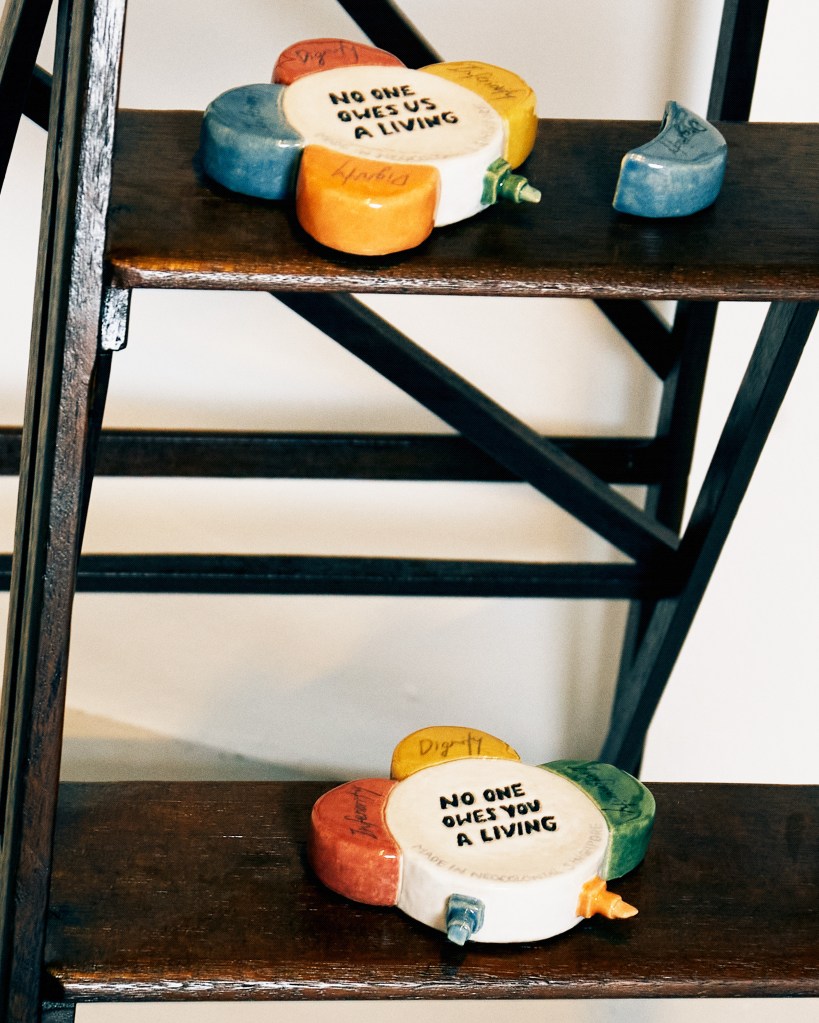
MC: Is that why you added the ‘made in neo-colonial Singapore’ note to the highlighter pieces?
SP: That is actually inspired by a sociologist who wrote some books that I read before, or some historian who talks about these things. They mentioned this ‘neo-colonial Singapore’, when talking about how we treat our neighbouring countries. Singapore is buying sand from other countries for landfill. So we get sand from Malaysia and Indonesia, which erodes their coasts, and we put it here on the edge of our coast. Because they need the money, and we’ve got the money – but we don’t have the land. And then we have migrant workers from other neighbouring countries who are much poorer, and we exploit them. They don’t live a life with dignity here in Singapore. This is how Singapore behaves as a neo-colonial country, after the colonists left. We are now the colonists in this region. That’s why I put ‘made in neo-colonial Singapore’ on the work.
MC: You got the idea for that phrasing from this vintage silver box which is part of your collection, right? It says ‘made in occupied Japan’ on the base. Has this idea made its way into any other of your works?
SP: It led into ‘BTO Already’, which is this image of King Kong and Godzilla fighting amongst the HDB apartments. That work says ‘Made in (Taikun) tycoon-occupied Singapore’. It just gives an extra critical layer.
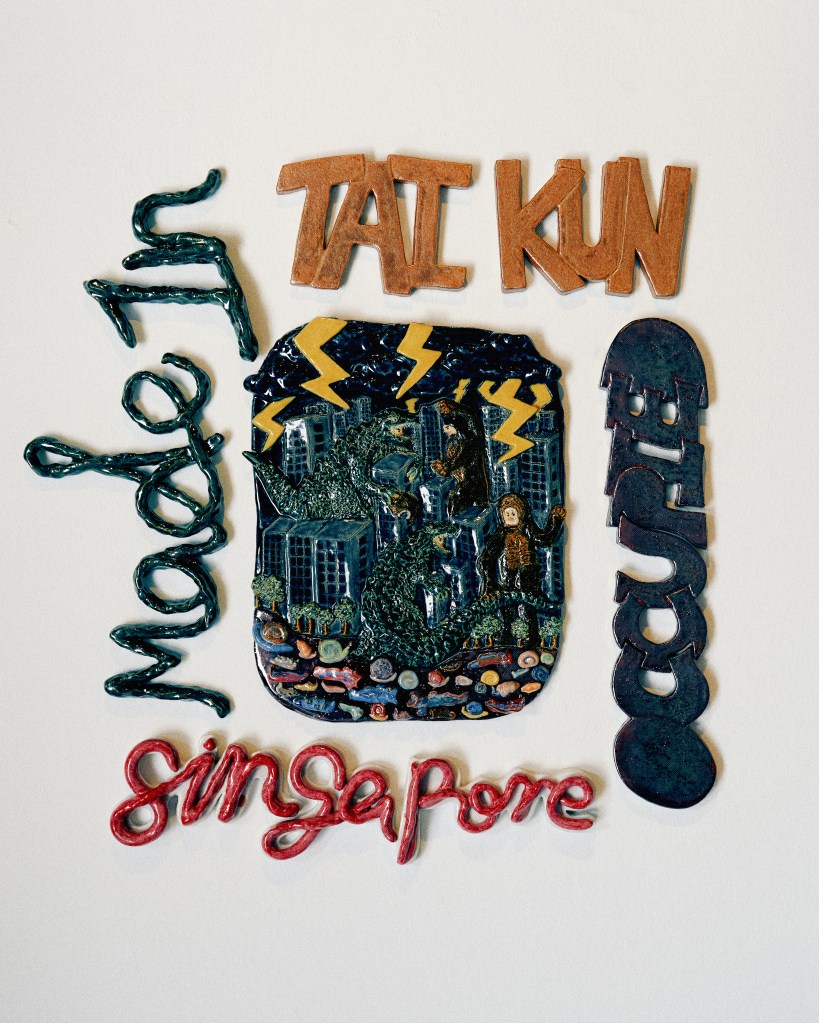
MC: That’s fascinating. First of all, it brings to mind immediately the phrase ‘made in China’, which, in the UK at least, is short-hand for mass-produced and badly made. But when it comes to this unique ceramic piece which is made by you, an artisan, talking about these issues – it creates a whole new perspective on these ideas of labour and production. I would also like to talk more about your collections. You mentioned that outside of your practice, you collect lots of furniture and vintage things, as well as the pastry moulds which you use in a lot of your work. I know you said you had to stop collecting furniture because of lack of space. But what does collecting mean to you?
SP: I suppose, honestly, I can only think that it is a privilege to collect, because of the lack of studio space here in Singapore. Even the fact I managed to get this much is a privilege. I find it quite ridiculous already. Other than that, it really is an obsession, starting with the pastry moulds and leading to the furniture. I got interested in all this because they are very different to the furniture we find now in our homes. In Singapore, most furniture is very Ikea.
MC: It reminds me, again, of the relationship between functionality and beauty in your work. It’s interesting how all the works in this exhibition are presented on top of the beautiful vintage furniture, with all the curly bits and flowers.
SP: It’s just so different, therefore new to me. Sometimes I collect things because they are vintage. There is an actual value given to it because it is rare. But other times, it’s really about how different it is to the things I see every day. Therefore, I’m attracted to it and I want to have it. The history of how things in the past were more decorative and now they are just practical. Honestly, to designers, this change was to do with democratising these things. Because the decorative stuff takes time, therefore not a lot of people would have access to them or be able to afford them. I understand why everything has become basic and functional. But I think it’s important to preserve this decorative stuff. Actually, this furniture is from Singaporeans’ homes, meaning that they don’t want them anymore. They switched from older furniture to new furniture, switching the whole style in their house. They want plain, they want minimal. So, these were collected from their house at a much cheaper price.
MC: Its interesting, I thought it would be a sign of privilege to have them in the house. Maybe people don’t want to be seen as being privileged in that way?
SP: Not so much in Singapore. Maybe that’s just something from the Western part of the world. When I was researching about ornamentation, I couldn’t really get a lot about that history here, specifically regarding fear of ornaments concerning gender and class. I read a lot of stuff which is not really related to us – because we were colonised and therefore the art, design and craft history we learned was very much coming from the Western world.
MC: That’s true. How do you feel about calling yourself an artisan, an arts-and-crafts-person, in this context?
SP: In Singapore, ceramic exhibitions are mostly showing plates and pots. But that’s not the case elsewhere. I think generally people elsewhere are less surprised when they see non-functional ceramics in exhibitions as compared to people in Singapore. It is quite common for people to use ceramic as an art medium, and it has been used in the contemporary art world for decades. So to many people, seeing my show is very refreshing and eye-opening for them as they are used to seeing ceramics as functional vessels.
MC: The perfect time and place to have your first solo show! Congratulations on that – it’s a very beautiful show. It sounds like you have benefited from a strong relationship with the curator, who has had quite an influence on the flow of this show. What has been your experience of working here at Yeo Workshops with the gallery and curator?
SP: Because this is my first solo show, I didn’t know what I was supposed to do or what the curator’s job really is. What do they really do? But it’s not too far from what I imagined it would be – you talk to them about your ideas and they help you write, and if you have any worries you ask them for help. It’s like a consultation with a lecturer at school. Because they have all the ideas, and they look through all the different art practices in a very in-depth way. So they work well with ideas. For me, I needed a curator because I really needed someone to help me write. I’m not very good at expressing myself in writing. He helped me express whatever I shared with him very clearly. That was very important for this show because there are so many short stories. Not all shows have a different story for each different piece of work. This one was very heavy.
MC: Do you think that collaboration is important within the life of an artist?
SP: Yes, for example, this solo show, even though it’s my show, I have to work with the gallery director and curator. This is also a form of collaboration. Getting to work with people like them who have been in this field for so many years, it’s an honour to see things very close to how they see them. It’s a huge encouragement for me. It’s like… your way of seeing is being confirmed. Of course, the opposing viewpoints during the collaboration are important as well, it will allow the project to evolve into a more impactful and thoughtful one. Collaboration is a great learning opportunity for me.
MC: It’s great – that everyone confirms each other’s confidences and beliefs. That leads me to my final question. I would like to ask you for three names of contemporaries, other artists who inspire you and have some kind of influence on your work.
SP: I think giving three names is very hard, because I don’t get a specific influence from any artist. Because nowadays with social media, I follow thousands of other artists, and I love all of them. And you see how I look at objects not in the fine arts world for inspiration. But artists I really admire in Singapore… recently I really love Esmond Loh. His paintings are very eery, uncanny. I realise that maybe I’m interested in that because that’s my line, my taste, I like strange stuff. So I really like his style of storytelling. Also, Yang Jie. This morning, I just reposted one of his works. It’s kinetic work. It’s one of the reasons why I make fountains, because I want elements of movement in my artwork. I like kinetic artwork. More recently, I just bought some prints by Noyona Biswas. I think her digital works are crazy good. And she also has a cool personality. A lot of spiritual things, towards the dark side. There’s one that I bought and I put in my studio and I got quite scared. Because I worked until very late, and I felt like the eyes were looking at me! I’m intrigued by the feeling of spirits in her work.
 Milkteeth
Leave a comment