
MC: Perhaps we could start by you telling me your story of how you became an artist?
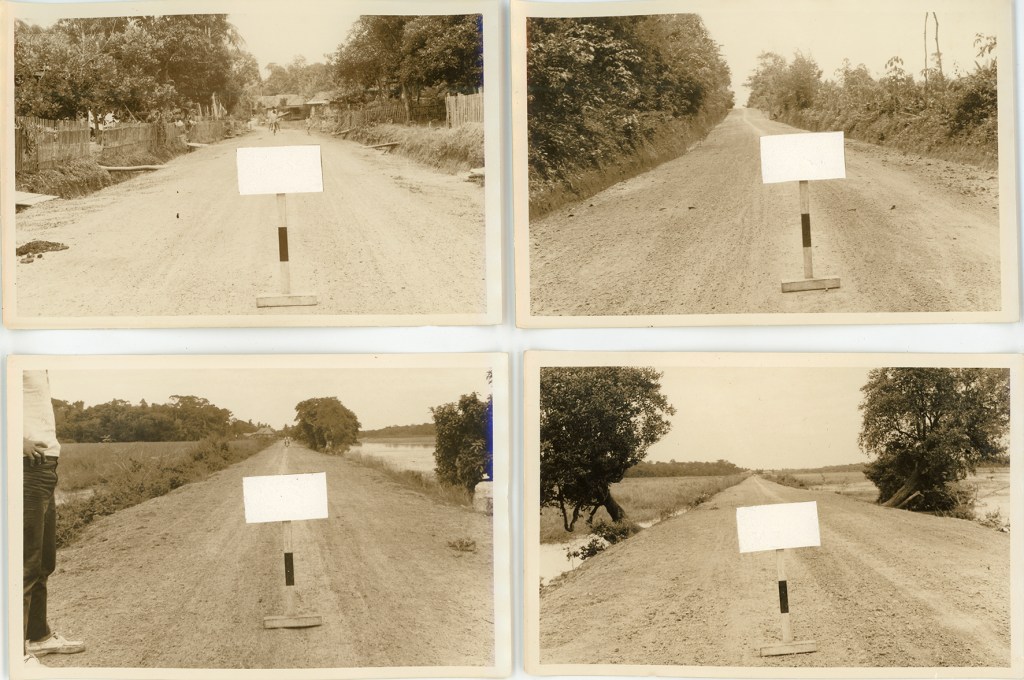
YKP: I studied photography at the Indonesian Institute of Art in Yogyakarta. I entered the university in 2005, and in 2010 I entered an internship in this place, Ruang MES 56. It is a collective of artists in Yogyakarta. In 2011 I became a member of MES 56, and I think at that time I trusted myself to be an artist because I had that environment where I could learn from other members. I helped with planning the programme – we have a gallery, so we organise exhibitions, discussions, screenings, things like that.
MC: How many members were in the collective when you started?
YKP: Fifteen, something like that? Now it’s more, twenty-eight or twenty-nine. It is all artists working with photography or film – or, like my work in Ubud, using photography as part of an installation. So, not only photography.
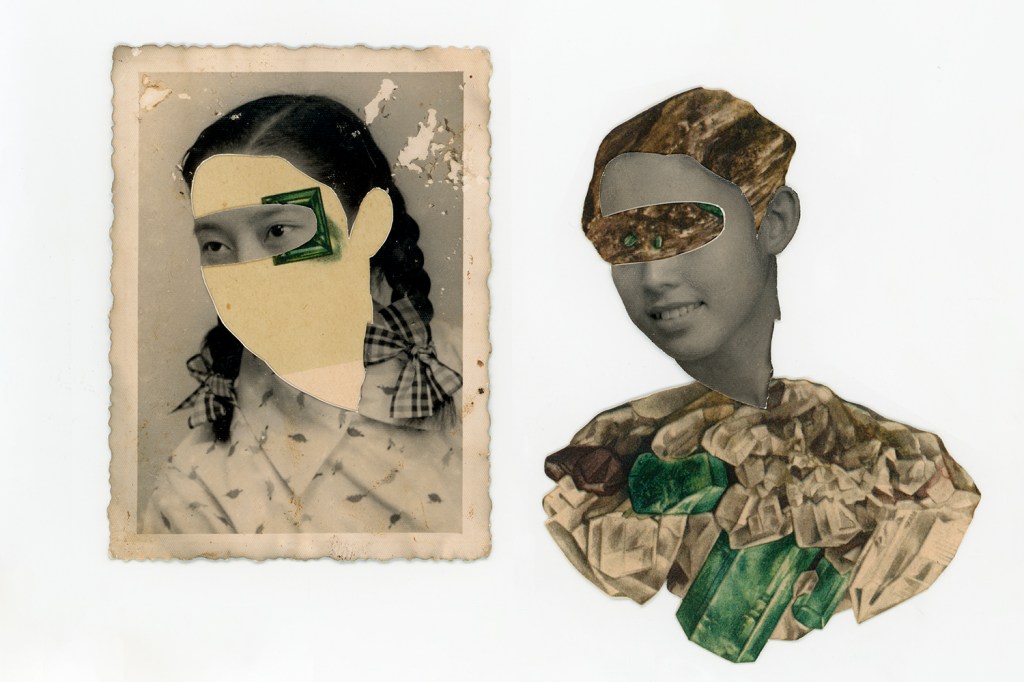
MC: Maybe we could talk a bit more about the works which are on display in Ubud right now, which are the collages combining old photographs and crystals. How did the idea for this work come about?

YKP: I did a two months residency in 2014 in a place called Bumi Pemuda Rahayu – maybe forty minutes from the centre of Jogja, with more of a village feeling. That was the first time I did a residency. Going around there, I found a river called Oyo River, and it made me nostalgic because when I was a child I really liked stones. During my residency I came again to those river places to find the stones, and I made a simulation of the landscape. I think about looking at the landscape not only in the wider view, but also if you see the stone, you see the colour and texture of that nature. You can see similarities in the form and colour of the stone to the larger landscape. In these works, people can see the details of the stones because I use a magnified view.
I made that work again in 2024, a lot bigger. In 2022 I had found a small book about stones printed in Leipzig, Germany. It had images, and the illustrator is named Hans Lang, who is also an artist. I was impressed with the images, because they were actually manual drawings but very realistic. I made appropriations of the drawings, using it as materials to make new work.
At that time, I was also collecting old photographs and making many series from that method. I think that old photographs, anonymous photographs – they don’t really have a history. They are not related with anyone, because I found them in the second-hand market. The family of the person must have already forgotten it. There is already no story behind them. So my purpose is to make a new story of them, a new narration. For that project, the narration was about the stone and the human.
MC: How do you connect the two? What is it about the stones which allow them to fill in the narrative for these anonymous people?
YKP: It’s about how I create the collage. The story is that the stones have mystical or spiritual qualities, like meteorology. In this way, it is related to humans, because sometimes the stone or crystal can make you feel more confident, or give you charisma, or good luck. So in the anonymous portrait photographs, the stone becomes a mask or shield. It is protective, like armour for the person. It is not only fashion, carrying the stone. You can see that the human and the stone are brought closer. So, at the Indonesia Berturtur 2024, I presented this work in two series, related to each other.
MC: It’s very caring, like you are looking after these people who have not been looked after, have been forgotten, in a way. Giving them protection. Do you do a lot of research in your practice?
YKP: Not really direct historical research, but I trust my intuition. First impressions are important, and I commonly use that as a starting point in my work.
MC: So when you find one of these old photographs, you are not interested in finding out the actual identity of the person?
YKP: No, I am just collecting many photos, and if I have a reason to do so, I just open my collection to make a new story.
MC: I’d like to ask you more about the form that you are using, which is collage. How did you first start to use collage in your work?
YKP: I have always used collage, because sometimes one image is not enough to talk about something. Each collage is completely different, because they are talking about the fragmentation of another thing. Like a compilation of things. I like this way of talking through collage-making.
MC: In your work you are really embracing things which are fragmented. You are not trying to make things complete, you’re allow them to remain fragmented.
YKP: History is not a complete story – not fixed, not one truth. But I like small and personal stories.
MC: Does nostalgia – your personal story – have a big effect on your work?
YKP: Not really. Before the pandemic, I did not really expose my identity or personal details about myself because… I don’t know. I am Chinese living in Indonesia, I am Christian. If I talk about that in my work it would be too exotic, I think. It’s like a foreign perspective, or diaspora perspective, which is not interesting to me. But during the pandemic, I made something about my identity because I just didn’t care. I did some photography, some drawing. Not really for showing, just for making.
MC: Could you talk me through some of your previous projects?
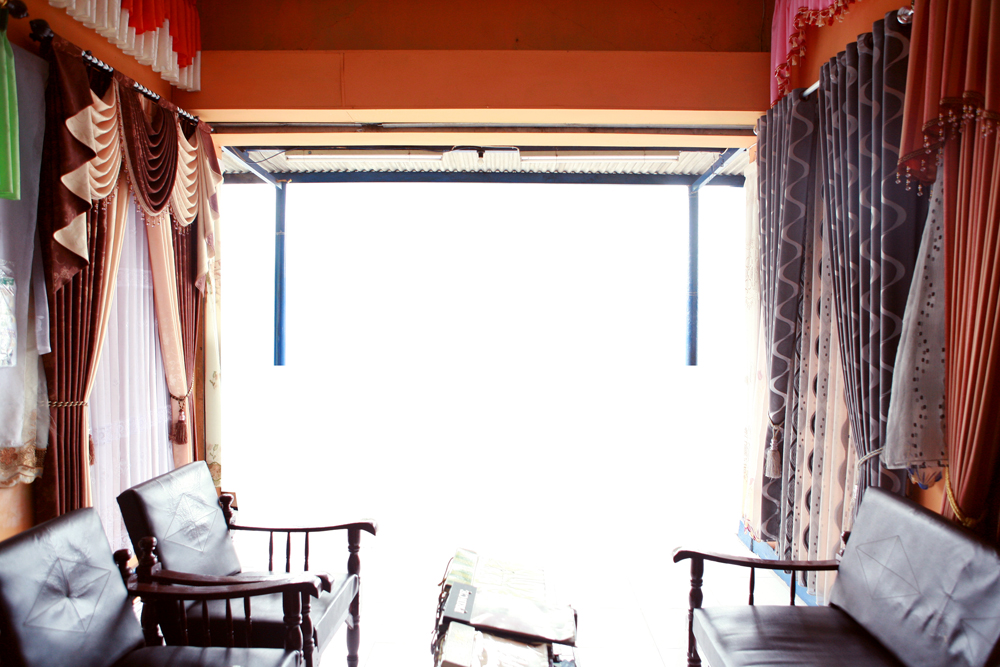
YKP: Ok. In 2012, I made these works, interior scenes. The concept is that often people see everyday life in the same frame. For example, with the seller of birds, or inside a shop, these common views – it is all seen through the same frame. So, I cut away the inside of the image so you can see only the framing. These shops are so typical of what you will see in Jogja. I also cut the shapes out very hard, with very raw edges, because the objects in the shop are always changing. I hope that people will pay more attention to what they see every day.
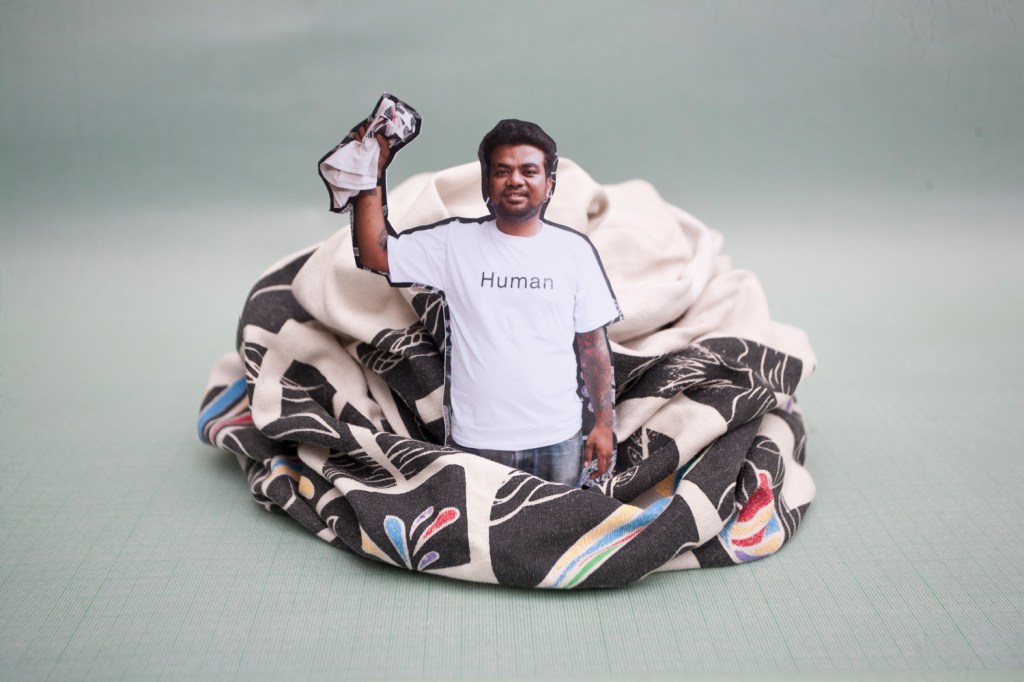
This work is from 2014. The concept is that we are differentiated by the things we use. Human differences come from what we use. So I made a t-shirt with the text saying ‘human’, and I found people from different backgrounds to exchange their clothes with the t-shirt. I explained the concept of my works, and asked that, if they accept it, they exchange it with my t-shirt. The photograph would be taken in the same pose, printed, and then photographed again, to create the effect that the t-shirt is bigger than the human. I do not always use digital effects. I like manual, analogue things. My collages are also analogue. I like the cutting and sticking, it’s a different feeling.
MC: Do you think that art has an important role in helping people to connect with each other?
YKP: I really like relational aesthetics. Before the pandemic I used that method to explore my art. The aesthetic is focussing on the relation between the artist and the other people. So, the value is not only in the artwork, but also in the connection, the communication, the physical things. The participant also has a voice. He is not a model – the t-shirt becomes part of his daily life. I see it as a collaborative work, not my personal project.
MC: So, it’s almost a performance methodology. But the pandemic put a stop to this style of work?
YKP: During the pandemic, I produced more and more collage because I couldn’t do this relational aesthetic method. It was a very important time for me. I felt the need to question myself what is important to me, asking again if the relational aesthetic is always a physical thing or not.
MC: This is an interesting lens through which to view your anonymous photograph series with the crystals. Of course, these people cannot play an active role in this work because they are lost, but you are trying to give them an agency or authority of their own. So, it is relational.
YKP: That project started during pandemic time. And before, I never had a long project but due to the pandemic, I could. I still like the relational aesthetic, but I am wondering how it can work now, after the pandemic. It is different now. Before, art was a reason to connect with other people, always. But right now, I am more questioning myself. It is a more reflective time. I need to find a way to be an artist now.
MC: I wonder how much the experience of being in a collective affects your work. Do you collaborate a lot?
YKP: I think a collective is all about collaboration. We are running a programme, and we sometimes make work together. I have a lot of outside influence. During the early time of my career, it was difficult to find a reference for my methodology. But in this place, it is the 90s generation, and they have many references – the DIY method, the staging, the series. I started by learning from the collective, not the campus. I am learning more organically.
This work is from 2015. I did a two-week residency in Jakarta, and the curator had a site-specific project brief in Senen Market, a very big second-hand thrift clothing market. The relevance is that, often, the clothing sent to Indonesia to these kinds of markets do not fit with the Indonesian culture or the weather. So, in these works, the model is the clothes seller. I make a curation of the clothing, and also put some images in the background to parody the type of clothes. You can see how it would be too hot for this kind of jacket in Indonesia, and how this kind of dress would not be good for Indonesian women who wear the hijab.
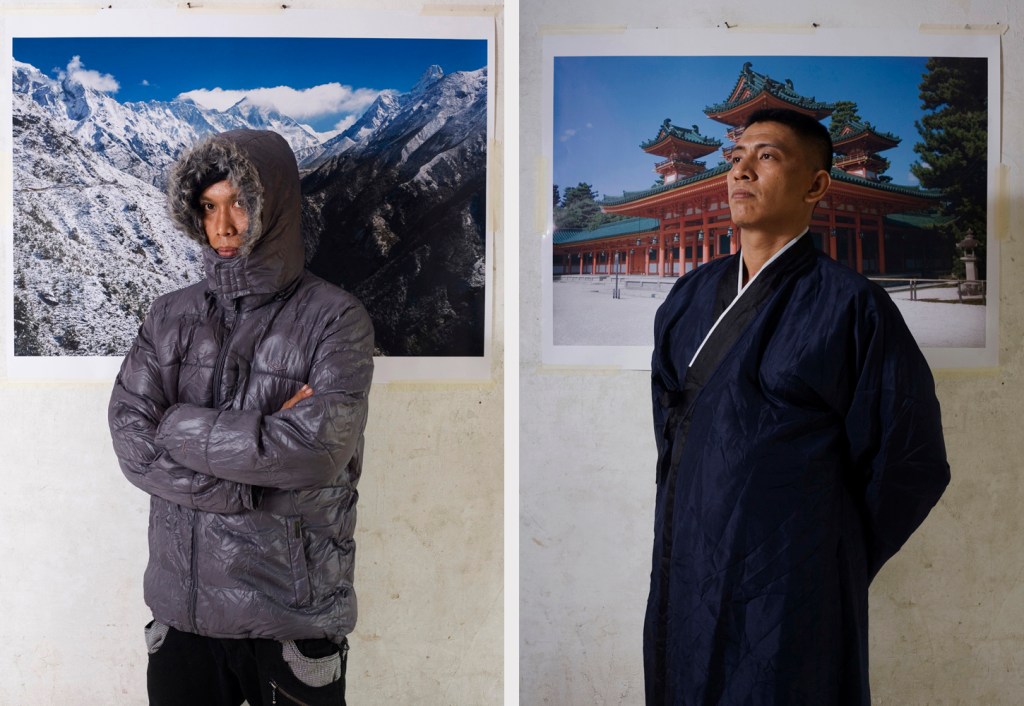
MC: I see – so for example, he’s wearing a snow jacket, with a picture of snow in the background, when of course a jacket like that would actually be pointless in a tropical country like Indonesia. This kind of incongruity draws you in. The models are very deadpan.
YKP: I took pictures in this place, this market, and exhibited there too. And after the exhibition, I gave the images to the sellers. They are very natural.
MC: I would like to ask you where you would like to see your work going in the future, practically? What skills would you like to develop further? Is there a long-term project that you would like to try?
YKP: Because of the pandemic, I made a kind of visual diary. I need to continue that practice. Responding to photos, making a drawing. Sometimes I make it, and it matches with the theme or curation of an exhibition, but sometimes I make it just for me.
MC: How would you describe the art scene in Jogja, and perhaps in Indonesia more widely?
YKP: It is a very big art scene here, with many circles. For example, in Jogja, some institutions are very close and make programmes together. Other places, in other geographies, with other artists – they have different art tastes and different audiences. So, I think it is very rich, and not only one circle. Also, tradition is very strong.
MC: This is a theme I have noticed here: there is a balance between dealing with the old traditions – the carvings, the batik, the pottery – and the desire to not be defined by those traditions. How do you feel about that? Do you feel that there is an expectation to make work that deals with tradition?
YKP: I think that now I am more respectful of tradition, because sometimes I feel bored by contemporary art. You just see the same thing being said over again, with no historical connection with the person. You can see many examples in the contemporary world. It is of course the same with traditional work – they say the same thing, but they have strong values, and deep memories and historical connections with humans living here. Many people do this work because they have respect for the culture, not for personal gain or money or anything like that.
MC: That’s an unusual perspective. People usually feel that tradition is boring because there are many examples of it – it’s ubiquitous. But I agree that things that have a long history have so many different threads going into them – it’s not just one line, but a million different lines converging.
YKP: Especially in Indonesia. We have many, many traditional cultures. In Java, for example, you can find more than twelve different identity groups or cultural performance types. So many. And they also influence each other.
MC: For my final question, I’d like to ask you for three names of contemporaries, other artists who inspire you.
YKP: That would have to be my collective, MES 56. I was born in here and studied and learned in here. I like Erwin Wurm, an Austrian artist. And I like the Japanese artist Koki Tanaka. He makes a lot of video-performance, and uses everyday objects. Just in one or two actions, just a simple thing, but I always understand immediately what the action or object means.
 Milkteeth
Leave a comment