
MC: I would like to start by asking you what is your story of becoming an artist? When did you first start to think of yourself as an artist?
MM: I think my answer will be the same as other artists – we always wanted to be an artist since we were a kid. We always liked to draw, that kind of thing. But for me, it was my survival strategy when I was a kid. I was always feeling bored, because my parents always worked. They were trying to survive, and trying to make a better future for their children. So they would leave me to play alone, and the way that I would play would be to create something like art. When I became an adult, people started to question me about a job. When I started to study in art college, I realised that this will become a job that I won’t be bored of and never give up. Beside that, since in high school I always spared time for drawing – I always went back to the drawing habit, creating things. I thought, why not be an artist?
When I jumped into the pool of the art world, I realised that this job is quite eye opening. When you see art, you learn how to consider its beauty. So, I learned to see the beauty surrounding me, and furthermore the beauty in my life. To see the world more clearly, to see life as a bigger picture. It’s not about getting money or getting famous.
MC: Looking through your website, I can see that you have a lot of work based around the everyday object. Where does that interest in the object come from?
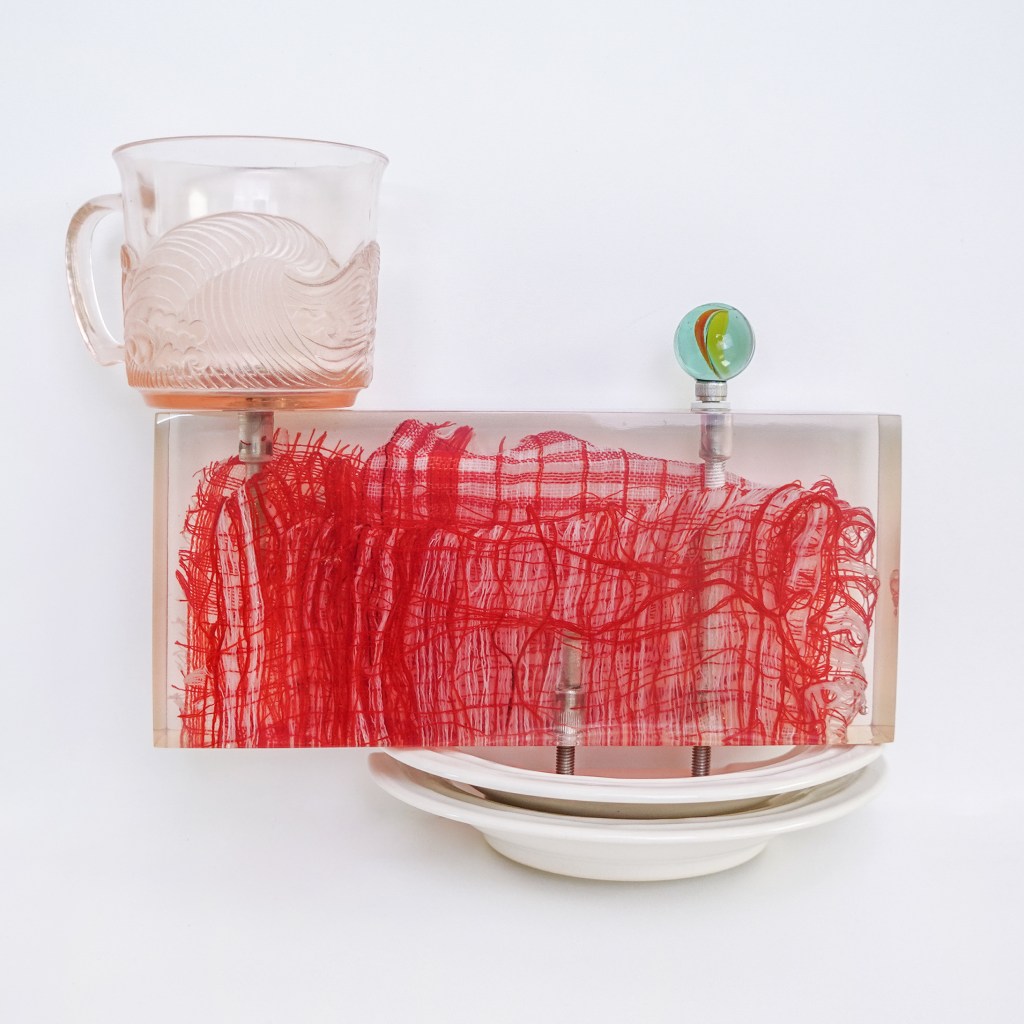
MM: It is related to the boredom that I mentioned before. I always feel bored, but I feel that boredom is also healthy – it opens the imagination, the feelings, it’s a kind of meditation. I think it reminds me of my childhood. I would always try to find the imaginative possibilities of every single object in my house. Like, how to play with a plate or a bowl or imagine some image from cracking on the wall. I often use domestic objects in my works, because it could represent home and family. As Asians, I want to show that family and culture is very important.
Also, when I became an adult and became a wife, I realised that we often abandoned domestic objects, even though they are always in our house and we use them every day. But sometimes we don’t think they exist or are important. Maybe because it’s not expensive and everyone seems to have it in their house. It’s the same as how we treat people who are related to the domestic fields; domestic worker, housewife, maid, etc. Maybe they aren’t famous and don’t have great salaries, but their existence turns our house into a home.
MC: Yes, it’s a role that involves not only hard work, but also involves a lot of the imagination, heart and soul. Is imagination important to you, then?
MM: Yes. When I start to imagine people as an object and vice versa, and see the relation of one object to another, I start to see the bigger picture of this society. Imagination is not about picturing an image but also opens the possibilities of the way we think. It considers many perspectives thus making us more empathetic.
MC: It’s nice to allow the object to speak for itself. These things have lives and histories of their own. I think a lot of artists who work with found objects find it a challenge to take a step back as a creative ego and to let the material itself take control. Is the materiality of the object is important to you?
MM: Yes, really important. Material and image of the works are always comes first, before the idea. It’s like, the instinct has to work first and then the reason we can dig up later. The interesting thing is, after Covid, I start to feel anxious. I went to the therapist, and she asked about family problems, friends and social problems. I answered it generally. Then she said, maybe you can find your problem if you can symbolise your friends and family as objects. So during that session, I was symbolising people that are close to me as a domestic object. Then my therapist pointed out maybe my problem is within the home, because I was quite attached to the objects within my house.
It sounds simple, but using these objects helped me to describe these relationships more objectively, and I could see the bigger picture. I think that’s why I use the domestic object more often in my works, because I’m comfortable with that method. It could describe the social condition, the environment that I find myself in.
MC: That is so interesting. When you are creating the composition of your works, then, are you thinking of the objects for stand-ins for people in your life?
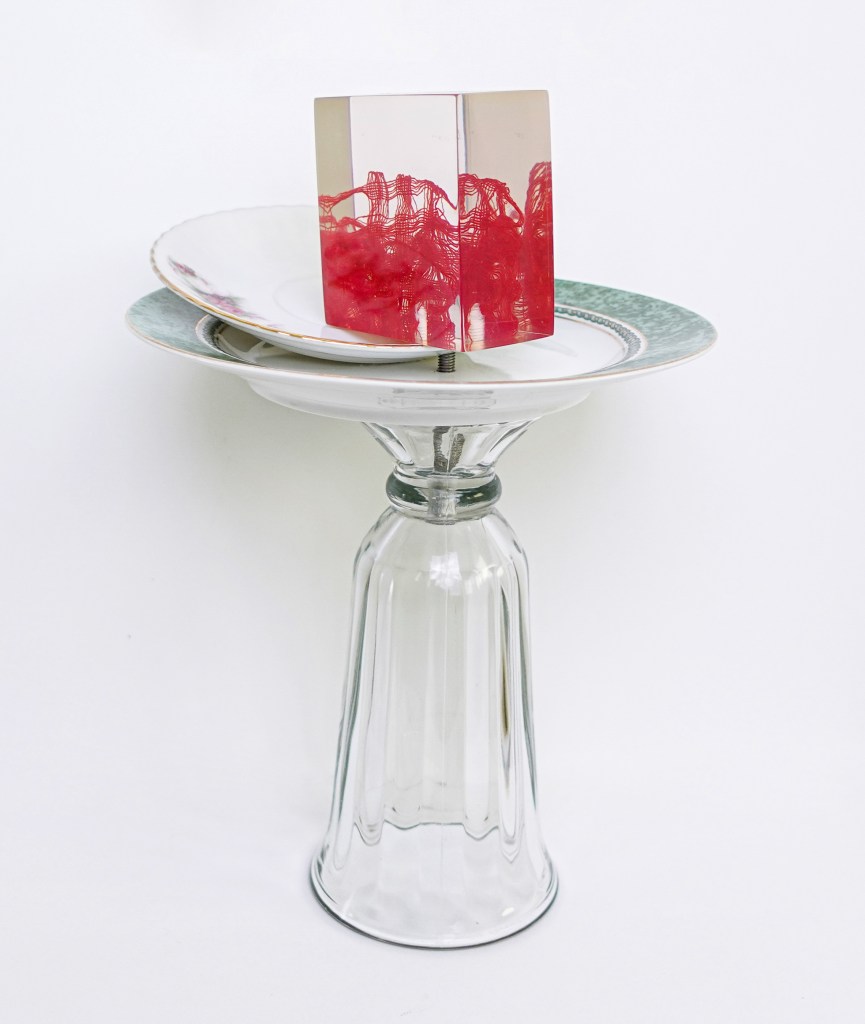
MM: Yes. the composition also describe the condition that I want to emphasize. In some of my works, I place things in a slippery condition. There is a statue, there is a plate, they are almost slipping. It is because I want to show that the condition of domestic workers is literally slippery – there is no contract, no insurance, small revenue.
MC: Your work is both material-led, and entirely symbolic, and can be read in such a layered way. One thing that you are known for as an artist is using resin to hold objects in time. Could you talk a bit more about the idea of preserving things?

MM: I used to like resin. The idea of using resin is to preserve. I think resin as a three-dimensional material has many possibilities. You don’t have to always use the positive and negative method – like casting the object and creating the mould. When I realised that resin begins as a liquid, I thought that I could explore other possibilities of making art with it. I can pour it onto clothes and make a shape from it, or use it as the surface of two-dimensional art.
However, after a while I realised that the process of using resin has created toxic waste. And I’m quite attached to the material, so when I realised that the resin was toxic I gradually stopped using it – except in recycling the old works. Some artists are quite extreme with their use of material. But for me, staying healthy and respecting the environment is more important. Eventually, I found that the idea of preserving could be realized in many ways.
MC: You have quite a caring attitude towards the things you are making, as if they were your children – part of you. But this idea of preserving things to keep them safe… is the urge to preserve something that you still maintain?
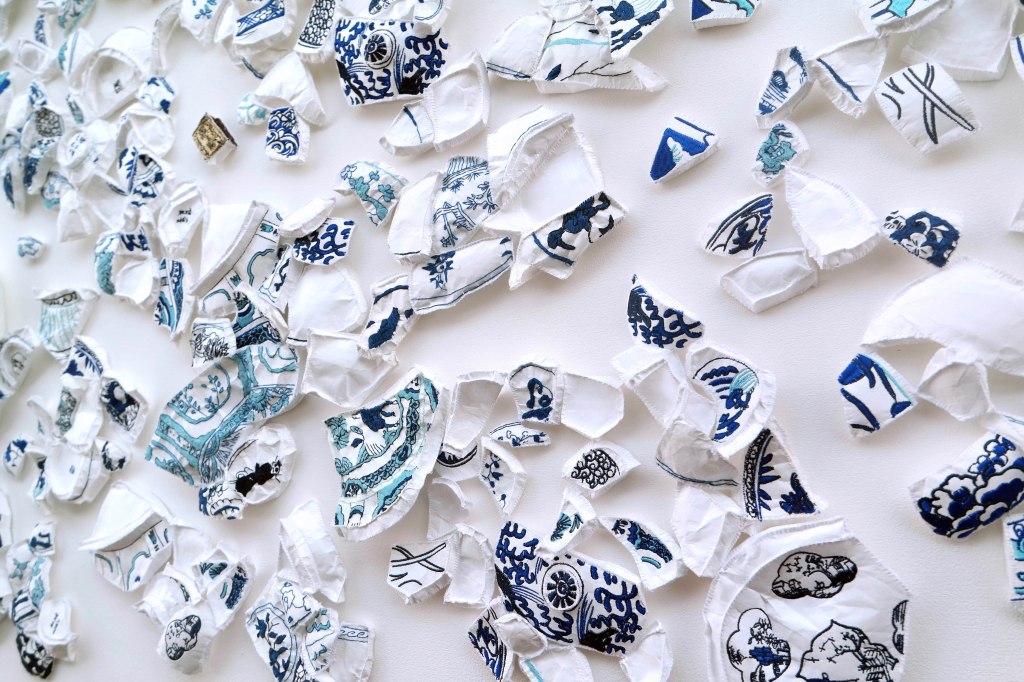
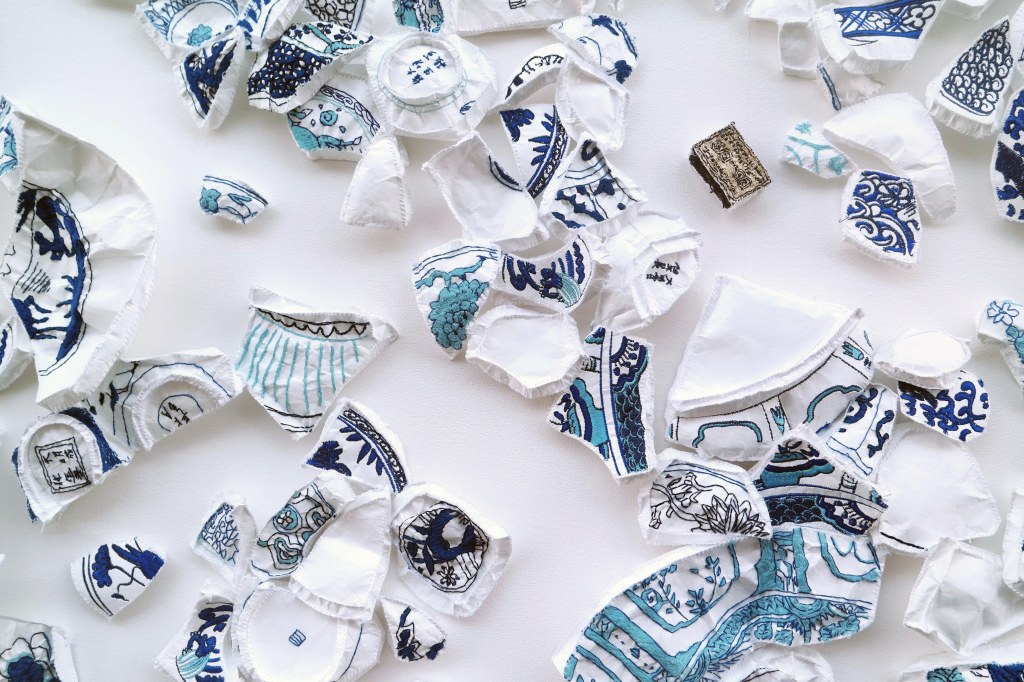
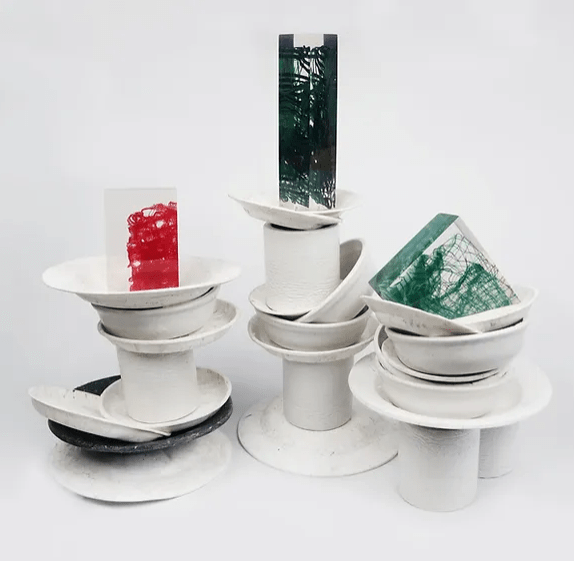
MM: Recently, I like to replicate the object to preserve the visual and idea. I want to make people confused when they realise the object is not the actual object they thought of. Like, I have works which look like broken porcelain, but they are actually made from paper. I want the audience to start questioning why I need to replicate these objects. Questioning how the material correlates with the object. I don’t want people to just rely on my description, I want them to use their imagination like I did as a child. In this way, the possibilities will be more rich. So I would say that the urge is to share the experience and idea of the object with the audience
MC: I would like to ask you about one of the largest works you have made, the installation with parts of chairs and other furniture with shards sticking out of them. What was the thought process behind that work?
MM: I want to show how it feels to be threatened by a small creature. As humans have threatened other creatures by destroying the environment.

MC: It has a destructive look, like a bomb has gone off inside a living room. Chairs with missing seats, picture frames with only three sides, that kind of thing. Like the aftermath of a disaster.
MM: Humans have done such things to other creatures, and I hope by flipping the position, will make us more empathetic and more considerate to every creature.
After this work, I created a series of mini beasts. I’ve always been interested in butterflies, although I’m scared of insects. The series of mini beasts goes back to my childhood again. When I was trapped in my house, my parents didn’t allow me to go outside often because it was too dangerous without supervision and they had to work. So I had to build my own imagination to survive from boredom. I would always play in a particular room in my house where the wall was cracked and there was a lot of stains. When I looked at this wall, I always imagined insects moving around, instead of it just being a crack in the wall. Have you ever been in the restroom with marble tiles, and you start imagining things in the pattern? We don’t do that now because we have mobile phones! I guess being bored is healthy
I told my gallery that I want to keep displaying this mini beast series, even though the concept is not strong, because I feel that my childhood is attached to it. After this work, I always showed the butterflies as a strong pattern in my work.

MC: I think it is a strong concept. This idea that the mini beasts were there for you as a friend during lonely times as a child is quite moving. Also the idea that they are living inside the walls of the domestic space – your home, the four walls which keep you safe and also represent you as a person. The idea that this domestic space is being permeated by the outside, other creatures. It’s both a scary concept and also hopeful, saying something to me about breaching the boundaries of the individual.
Can I ask about the latest work on your website? These geometric-formed photos based on a trip to Japan. Each photo has two sides, and they are behind a kind of screen which blurs out the photo. This idea of the multiple small images seems to be a motif which you return to often. Could you explain how this work came about?
MM: This is two works from when I had a residency in Fukuoka. It has a lot of shrines and temples. Shrines are for Shinto, and the temples are for Buddhists. When I found out that there are both Shinto and Buddhists in Japan, it reminded me of the Confucianists and Buddhists in Indonesia because my parents are Confucianist. I feel like I cannot differentiate the Buddhism and Confucianism – and I think if you asked the tourists in Japan, they would not be able to differentiate between the Shinto’s and the Buddhists because the temples and the shrines look the same.
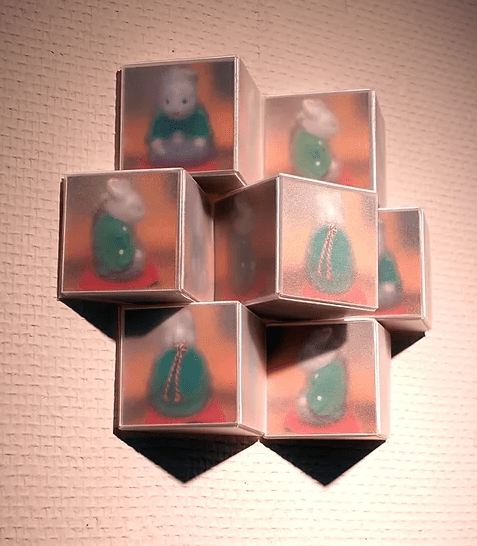
I wanted to know more about my parents’ religion because they didn’t teach me everything. They said, oh, it’s just some old religion – you can search for another religion for yourself. But later, after my residency, I found the answer to why they did not want me to know everything about Confucianism. Basically, Confucianism is older than Buddhism. In Confucianism and Shinto, they cherish nature. In Shinto they still pray for nature, stone, forests, stuff like that. Then when the new religion came, Buddhism, they welcomed it because they just cherished everything.
When I tried to find Shinto people that I could interview, it was difficult because there isn’t really anyone left who has the Shinto religion. It’s the same with Confucianism – it’s rare to see people with the Confucius religion in Indonesia. I found the reason is that both Shinto and Confucianism want people to adopt the attitude rather than the religion. In Japan – you know Marie Condo, the cleaning lady from TV? She’s always thanking the object after using it. That’s really Shinto. So the people in the Shinto shrines said to me, we don’t worry about other religions because Shinto’s attitudes are already inside the people in Japan. They have respect for nature, for the object, for everything around you. I think that Confucianism, too, is inside my attitude already – not my religion.
So in these works, I am trying to create two sides because I want to show that there is both the spiritual and the worldly. Sometimes in religion we tend to separate the spiritual and the worldly. But when you pray to God sometimes, you ask for worldly stuff – please God, I want to be a manager, I want to have a house. Stuff like that. So I wanted to show that the spiritual and the worldly cannot be separated. That’s how I see Shinto and Confucianism, and Buddhist too. They say that it is OK to ask for those things, because we live in the material world. And these beliefs are part of our lives.
MC: It’s a really interesting way of looking at the rest of your practice; your explorations of materiality, the domestic, the objects. I do agree that religion and the spiritual can sometimes be best understood through objects – the worldly context of our lives. Not just abstract ideas.

I also think it is an interesting take on being an artist. I think people tend to think that artists are very disconnected from reality, off in the spiritual realm. It’s a particular stereotype of Asian artists that we hold in the West, based on our unformed ideas of Eastern religions and cultural practices. All exotic, orientalist. But you are challenging this. You are challenging this one-note perspective. You’re not rejecting either side, you let them exist together.
MM: They both can exist, and I think we just have to find a balance.
MC: Can I ask you where you see your practice going in the future? Is there topic you would like to work on more, any ongoing projects?
MM: I think… I have described how I am using domestic objects. But then I got married, and actually I am pregnant right now. And I realise now that I can’t really understand domesticity until I am a mother and a housewife. So it’s a big pause for me, but I will start to experience being a domestic worker myself. which led me to be more patient in process rather than instant result. And I think it will also be beneficial for the process of making my artwork.
Sometimes I feel like a hypocritical person, you know – talking about the domestic worker, when actually I have a helper in my house. I feel like I have to experience it myself. Also, to maintain my career, I am starting to open up the possibility of collaborating with my friends. I think that, as an artist, you don’t always have to create things all by yourself.
MC: Do you find that the art world in Jakarta is a supportive network?
MM: Yes. In Indonesia there is a term ‘gotong royong’ which means helping each other. This is quite strong especially in Yogyakarta, which is why you see a lot of collectives there. If you ask how to create a career as an artist in Indonesia, I can only say that it is because my friends helped me a lot – not only artist friends but collectors and gallerists. We help and support each other. I think the reason why I have not left this job, even though sometimes I have had no money and no future, it’s because I know I have friends that can help me.
MC: That leads me on to my final question, which is to ask for three names of artists, friends, who have inspired and helped you.
MM: I could give you many more than three, because all my friends are so talented! Ella Wijt, Kurt Peterson, Maharani Mancanegara, Widi Pangestu, Hendrian Irfan, Ipeh Nur, Natasha Tontey and many more
 Milkteeth
Leave a comment