
MC: I’d like to start off asking you about your story of becoming an artist.
AXY: In 2017, I pursued my Bachelor of Arts in Fashion Journalism at Central Saint Martins in London and it was after the first year that I dropped out of school. I had to figure out what was next for me and upon returning home, I first worked as a writer. Photography came quite naturally after. I have always been surrounded by family or friends who are photographers or documentary-makers of sorts. I remember not being able to find the sort of images I wanted to complement the articles I was writing. I started making photographs because I could not find the image I was seeking.
I started out as an artist in 2019. Liza Ho, founder of The Back Room gallery, invited me to exhibit my photography works. It was group show called ‘Small Works; and I was exhibiting alongside different Southeast Asian artists. That was how I was introduced into the arts and I have not stopped practicing since.
MC: In that show you were exhibiting your photos? What kind of photography were you doing at that time?
AXY: I started off making still life photographs. They were mostly object-based photographs, mostly using objects from my grandparent’s house. I grew up surrounded by different ornaments and small objects around me. You could find teacups, trinkets, decorative wooden boxes and vacation souvenirs that my family would bring home from a holiday. I started combining these objects with fruits and vegetables. Looking back at it now, I had intentions to depict home and it was a way to pay homage to my grandparents.
MC: It seems that objects are very important to you. Looking back at your work, I can see one still-life photography work called ‘family portrait’, where it seems like each object is represents a person.
AXY: After being away and returning home again, I started to think about the hierarchy of an Asian family. I was thinking of the different and specific roles every individual holds within a family.
MC: You use archival images quite often in your work. You seem quite linked to the past, especially your own family history. A lot of your works use old family photos. I was wondering how you first came to integrate those into
your practice?
AXY: I started incorporating my grandfather’s archival family photographs right after the pandemic. During the pandemic, I had a lot of free time at home. I was stuck at my grandparent’s place and one evening, I stumbled upon this stack of family photo albums. My mum was there too. When you are stuck at home for long, I remember being quite hungry for new imagery. There was only so much that I could consume and find on the internet. I started going through my grandfather’s pile of archival photographs individually. I went though everything and the first thing I noticed was how well documented it was. These photographs which were made 50 years ago but they were so pristine and well-kept. Almost perfect. Each photo album was arranged by colour, dated and arranged a certain way by my grandfather.
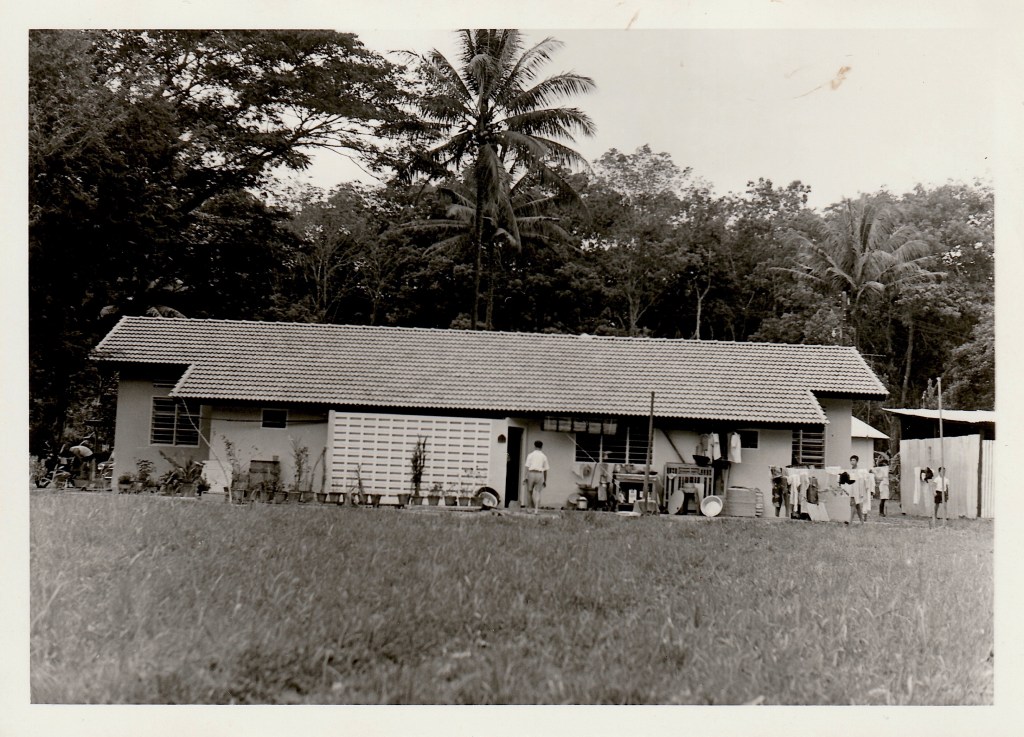
Photo by Goon Kok Woh, my maternal grandfather.
MC: So your grandparents were like curators, archivists and historians at once.
AXY: I think so. My grandfather was still fully abled when he was archiving our memories. I just knew that he spent a lot of money and time printing, labelling in his room. No one really knew what he was up to. It was after 2023, that my grandfather had a stroke and had minor symptoms of dementia. Looking back at it, I felt that he
was preparing to have people look at his photographs in the future.
MC: He was also perhaps preserving the memories that he would not be able to keep hold of himself. Do you think preservation is important?
AXY: Yes it is. Now that I have been using these photographs for some time now as materials to create work. Initially, I was emotionally very attached by the idea of preserving the old. I was also insisting on making sure that it was as is. But with distance and in time, I am hoping to move on from it. At some point, I realized I was going in a circle, in a loop. I was not moving forward. The past is the past — I am here now and how can I get to the future?
MC: There’s something very nostalgic about your work. It feels like the memories of being a child, something about the gingham pattern, I think. It reminds me of school. Are you a nostalgic person?
AXY: I am an incredibly nostalgic person. But I do realized that when you making art, there are parts of it which can be very gimmicky. There are plenty of visual cliches on nostalgic things. I try to move forward and learn to reflect.
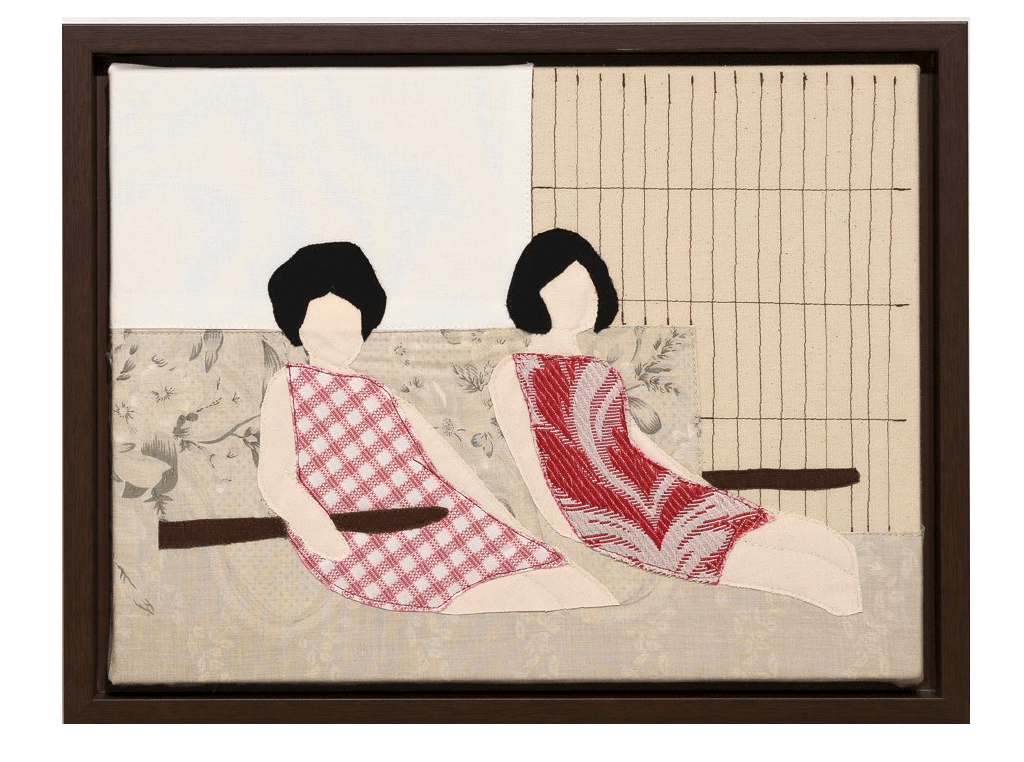
Domestic Textiles (cotton tablecloth from 1980s, cotton shirting fabrics, cotton- canvas,
linen fabric, cotton-polyester mixed fabric topstitched with cotton threads)
35cm x 26.5cm.
MC: I think there is a risk in making works about personal nostalgia that it becomes harder for other people to relate to. It can sometimes feel like an indulgence. But your work is about memory in the wider sense, in the historical or political sense. Your work has talked a lot about colonial histories, and what it means to be Southeast Asian within this context. Could you talk a little bit more about that within your practice?
AXY: My practice explores themes of ancestral history, knowledge systems, reconstructed memories and looks into the broader contemporary crises of the displacement of people, languages and cultures concerning Southeast Asia. I also do think a lot about the consequences of time and the emotional circumstances of colonialism. My grandfather’s archival photographs were a starting point. I still get quite emotional looking at them. I can’t help looking into the past and comparing it with the present. What was different in the past and what still remains? Politically, economically, emotionally. I think about these things in the form of a non-linear
timeline.
MC: I suppose you are using your work as a way of bridging that distance. I agree with what you say about how the personal photographs hit the hardest, because you visualise these big historical changes, like the colonial period, in one grand sweeping gesture, you don’t think about the lives lived in between.
Let’s talk a bit more about your medium, as you are now moving
from photography to textiles. What was the impetus here?
AXY: My interest extends into the vernacular aspects of material culture which has allowed me to embrace materials as carriers of intimacy, trauma and violence that transcend beyond generations. I was mainly making photographic works from 2019 to 2021. In 2021, I was selected to participate an 8-weeks long online residency programme by Open Books (Wales), The Godown (Kuala Lumpur) and the China Academy of Art (Hangzhou), curated by Lienne Loy. The programme pairs Malaysian artist with other artists from Wales, China and India. I was paired up with Sue Williams. She was a mixed-media painter based in Wales and happened to be a lot older than me. The programme took place online during the pandemic and we had a final exhibition together at The Godown.
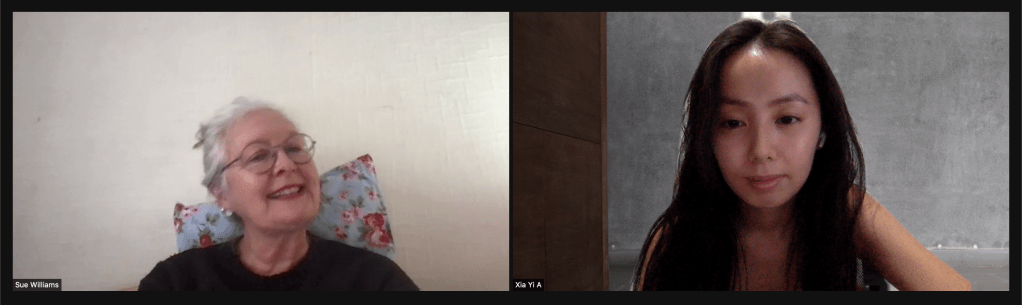
It was a really exciting experience because Sue and I had to call each other at least once a week as part of the residency structure and program format. She was in her sixties or seventies. Because of our age gap, cultural and generational differences and by being in different stages of our art practice, we had different ways of thinking
and looking at art, life and everything in between. Despite this, we found many similarities with each other in the midst of uncertainty and worldly chaos. The experience opened up more possibilities for me to want to try different mediums. This was when I started making mixed-media based works. It really helped to expand my medium.
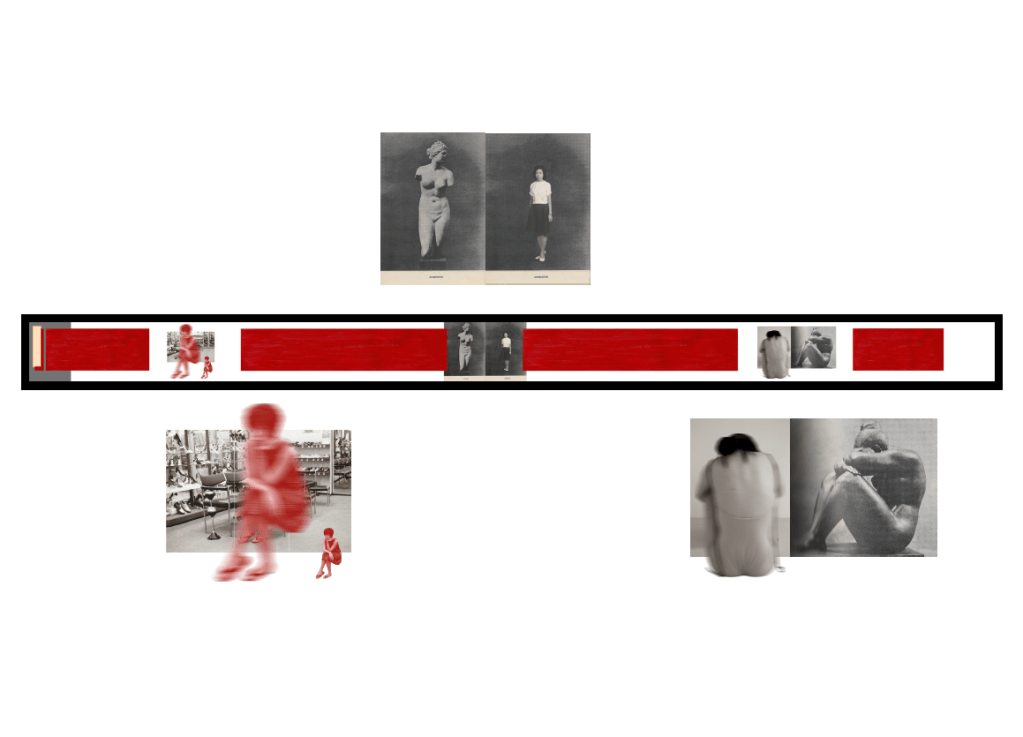
Mixed media with rice paper on Chinese folding book, 308cm x 20cm.
It took me 6 months to a year to transition from photography to textiles. I grew up surrounded by textiles. My parents works in the textile manufacturing business, so it’s almost like a second language. I played a lot with Pantone and fabric swatches when I was younger. I used to be given fabric scraps and a pair of fabric scissors to play with. I did not understand a lot of it until I started working in fashion but now everything makes sense. During the one year period, I had the opportunity to try a lot of different methods of reworking textiles. I find myself gravitating towards the pattern-making process when you are able to deconstruct and reconstruct a piece completely. I find myself playing between collaging and patchwork-making.
Early on, I would try to stay completely away from photography but now I think its pretty much inevitable. By using domestic textiles from home and combining commercial textiles, I find a beautiful contradiction of the fast and the slow. The domestic and the industrial scale. I would find lots of domestic textiles such as
tablecloths, handkerchiefs, bedsheets, curtains and old garments sitting in my family’s cupboard for 20 years or more. Each yellowing and decaying with time and humidity.
MC: Domestic textiles are such a good link to the past, talking about bridging that gap. Even the way that they are made is passed down through the generations. You are very focused on the domestic space. You mentioned the fact that both you and your collaborator artist were both women, and that was your point of connection. I feel like textiles are a point of connection for women – the creation of it and the use of it in the home. Like a secret language between women. You have depicted women and girls in your work…
AXY: I don’t think the depiction of women and girls in my work is intentional. One of my works titled ‘Girls Day Out’ was made in 2023 for a group exhibition called ‘Ways of Seeing’ with CULT Gallery. The work came about when I received a really lengthy email from an aunt who has migrated to Australia. She wrote a letter explaining our family tree and ancestral history. She was one of the girl depicted in ‘Girls Day Out’. It was made based of one of my grandfather’s archival photograph and I thought the photograph had the sort of imagery I wanted to depict. I did not realize that it connected early on. There was a narrative I wanted to play with. I
wanted to incorporate her letter but I didn’t know how. The letter ended up being my guiding point.
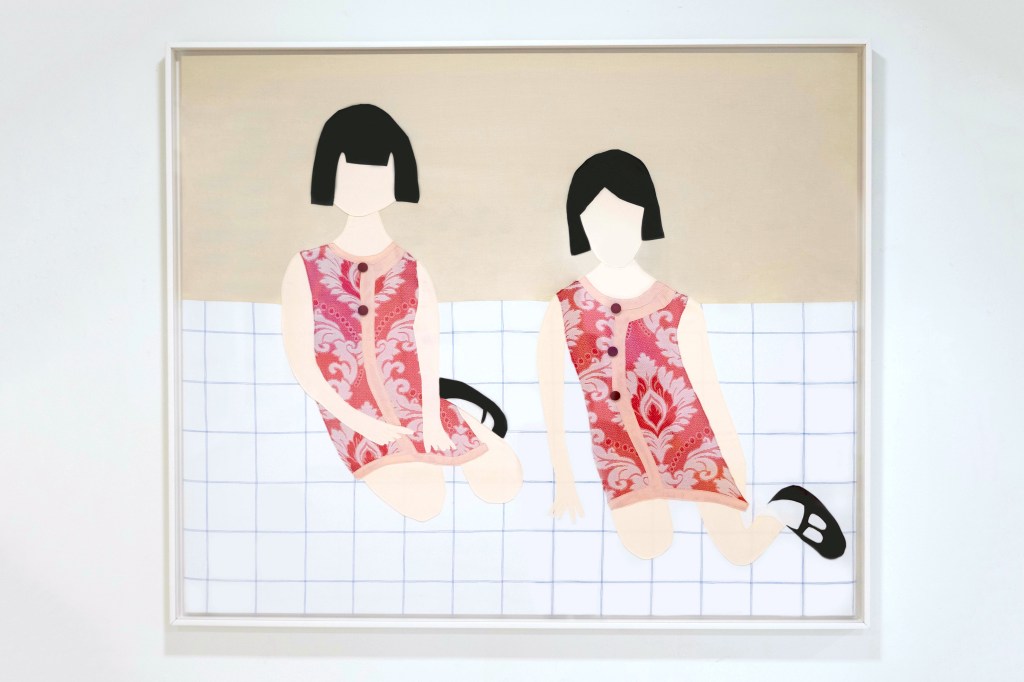
Domestic textiles (cotton fabric, cotton- polyester mixed fabric, curtain lining fabric, cotton
fabric covered buttons topstitched with cotton threads), 112cm x 135cm.
Photo courtesy of The Back Room.
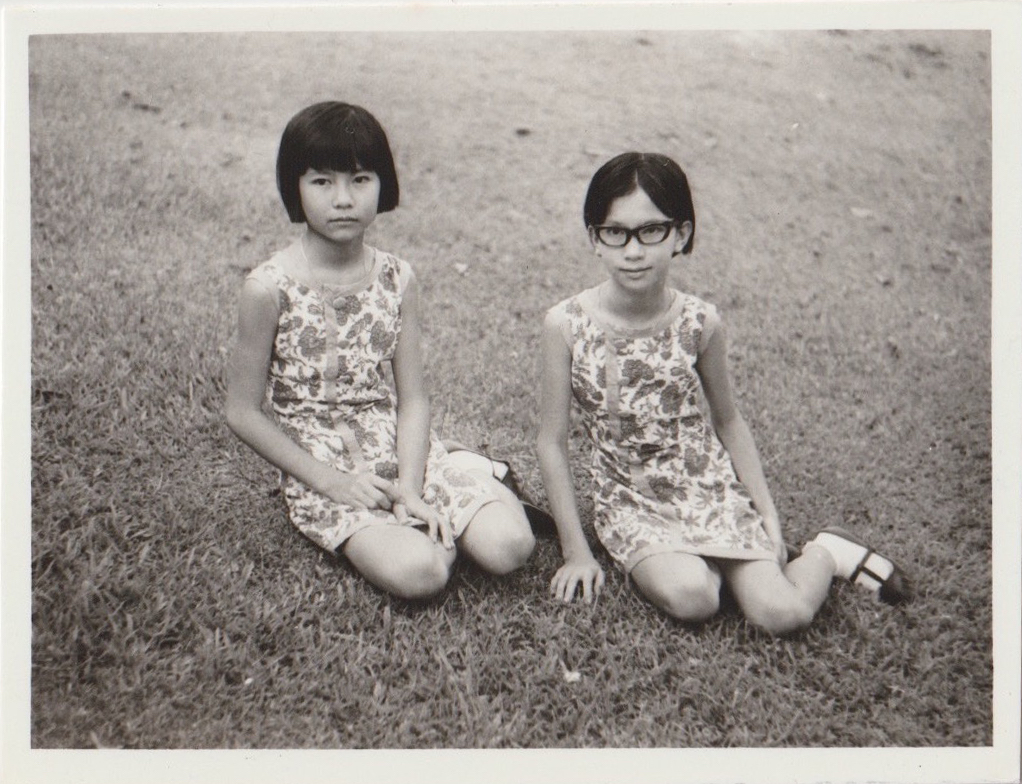
Photo by Goon Kok Woh, my maternal grandfather.
MC: From this conversation, it is clear that you are extremely aware of your own family history, mostly because your family are so keen on documenting their own past. But that contrasts with the wider history, the national or colonial history, which is a narrative that erases the little stories. How do you feel about the idea of representing histories which have no documentation?
AXY: Having a properly documented family and ancestral history within arms reach. I think it makes me wonder about those who spent their entire lives searching for family connection and family stories. Mine was given to me just like that. How do I make use of it? Do I completely disregard and start fresh?
MC: Do you feel a pressure to work using this history?
AXY: In some ways, yes, and no. I am very attached to it, maybe because I am very close to my grandparents.
MC: I see. Since we’re here in your studio, I’d like to ask you what the process of creating a work look like for you?
AXY: Usually, I start with a certain type of materials. My textiles are categorised by colours and textures. Lots of scraps, mostly used or discarded. They carry a certain type of smell too, they smell old.
MC: Do you use the materials as a starting point, or do you usually have an idea already in mind?
AXY: Early on, I would chose the material first and then I ended up making purely abstracted works which focuses mainly on the materiality. With better understanding on how the material works, I eventually shifted to using the photographs as material and reference. The works for ‘Inventory of Intimacies’ with
The Back Room, there were 6 works and each were based on different photographs. There were no specific reason to why I selected those photographs but I just knew each of them carried visual contexts related to categorisation and systems of knowledge, books particularly.
I wanted to keep refining the works. I used the same techniques and the materials were used as a colour palette. Maybe this coloured fabric will work in this part of the photograph and then this brown thread to create some form of contrast, for example.
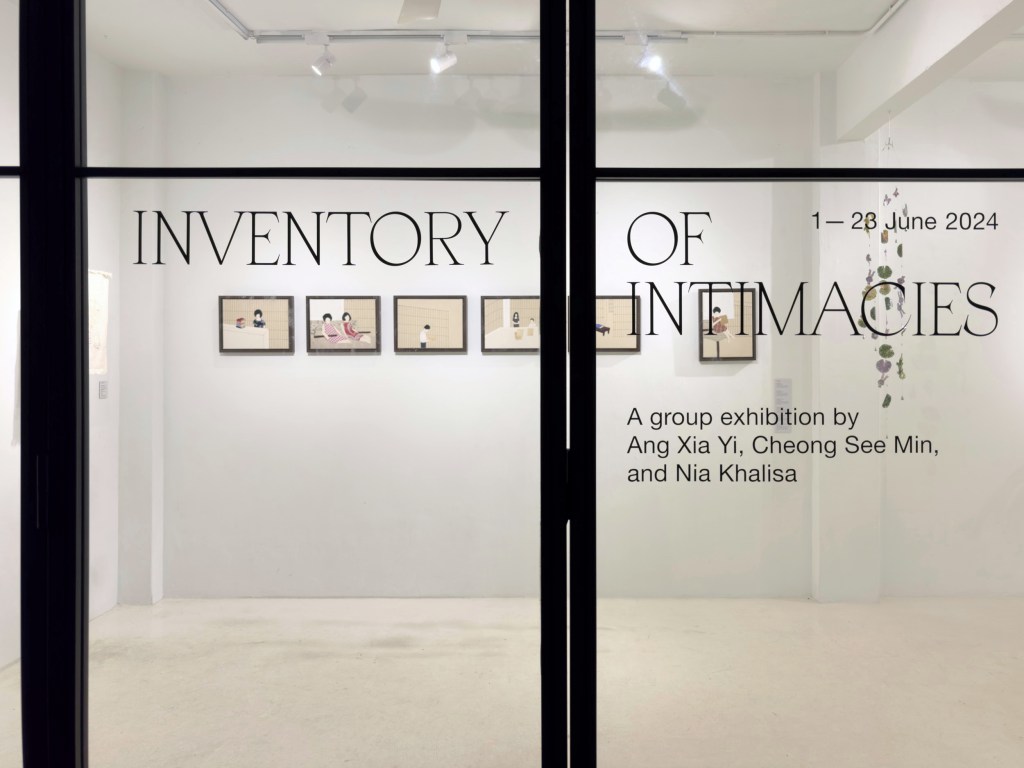
Photo courtesy of Kenta Chai.
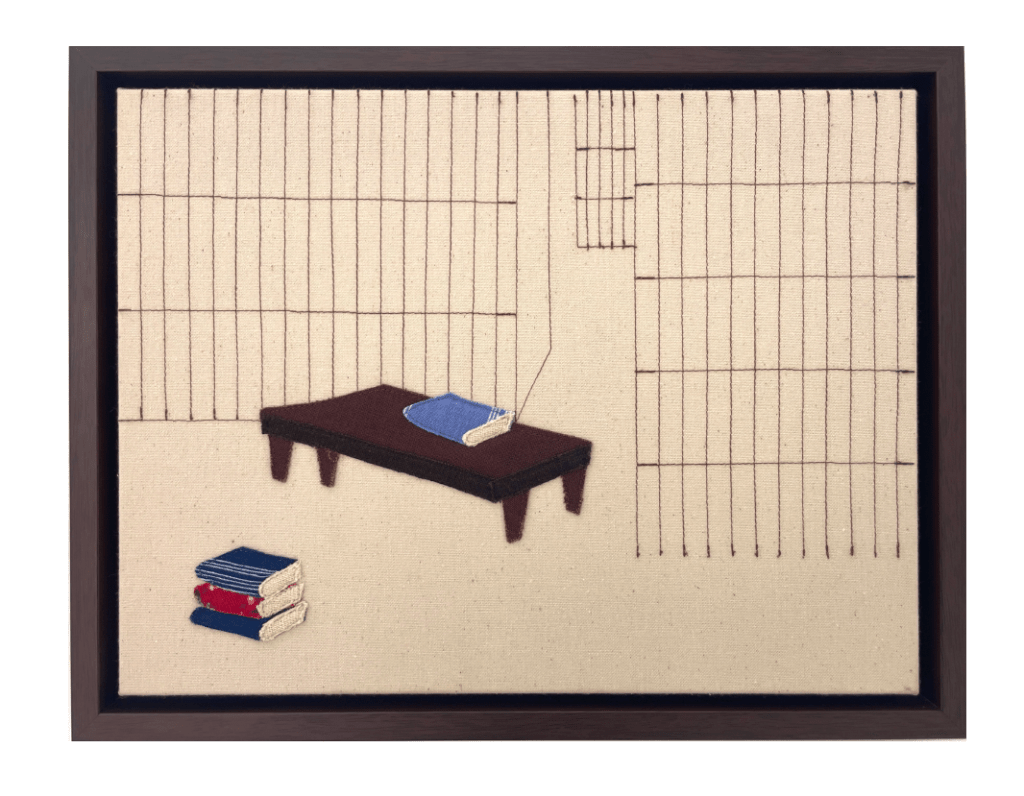
Domestic Textiles (cotton tablecloth from 1980s, cotton shirting fabrics, cotton- canvas,
linen fabric, cotton-polyester mixed fabric topstitched with cotton threads), 35cm x 26.5cm.
Photo courtesy of The Back Room.
MC: That’s a real change in attitude towards the material you’re using – going from a place where the material is leading you, to a place where you’re using it as a tool to create an image. I’m interested in your earlier works, where you were dealing with the materiality of fabric. Could you tell me any more about that?
AXY: When I was younger, all I would hear was about the production process of textiles, the business behind it and the people who would run it. My parents used to travel to China a lot for work before the pandemic. They used to send me images, for example, of an entire village in rural parts of China. Each village specialises in the production of t-shirts or socks. What a jarring thing to be looking at, especially when you are so used to looking at products as a ready-made and nicely packaged consumer products. That was how I understood materiality.
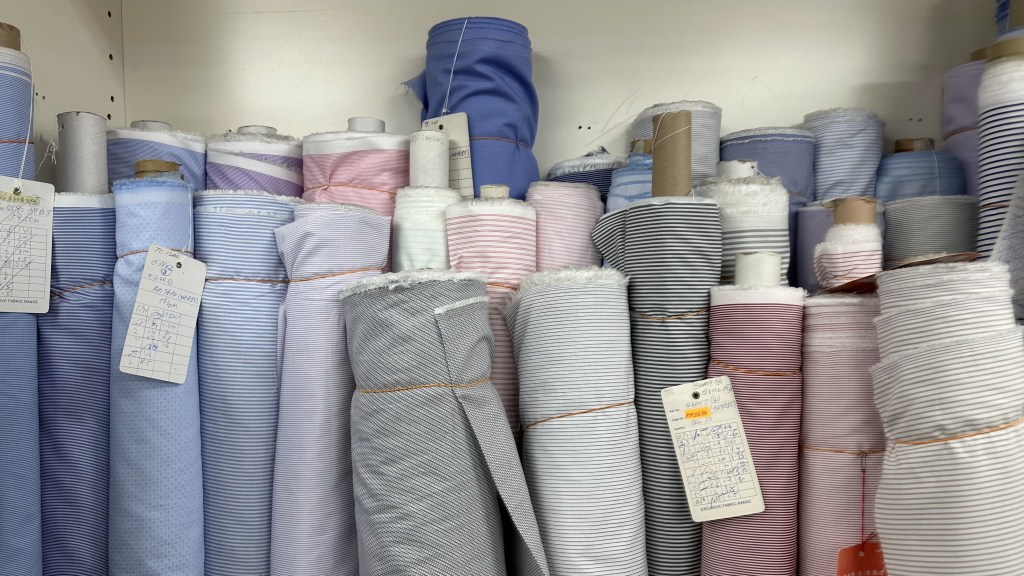
These imported from Japan fabrics are used to create formal work shirts and trousers.
It was mostly practical. It took a lot of experimentation and tries to understand how certain materials will fall into place. Sometimes sewing certain materials together wouldn’t work because one material will be too thick or the type of sewing machine does not match the material used. Its all an effort towards putting materials together and refining it until it reaches the sort of finishing I wanted.
MC: How do you feel about working in an area which is usually considered a craft rather than an art?
AXY: I am skeptical about the need to separate and create distinctions between ‘art’ and ‘craft’. As an artist who has been making textile based works, I sometimes find myself conveniently boxed as a ‘female artist ’ when there should not be gender
disparities. This was one of the many reasons as to why I was not interested to learn how to weave or sew initially, even though the concept and structure of it has always been interesting to me. The weft and the warp, the horizontal and the vertical. But to me, it’s purely technique and there is no story to it. With this train of thought, how do I put this back into my work? I need some form of justification.
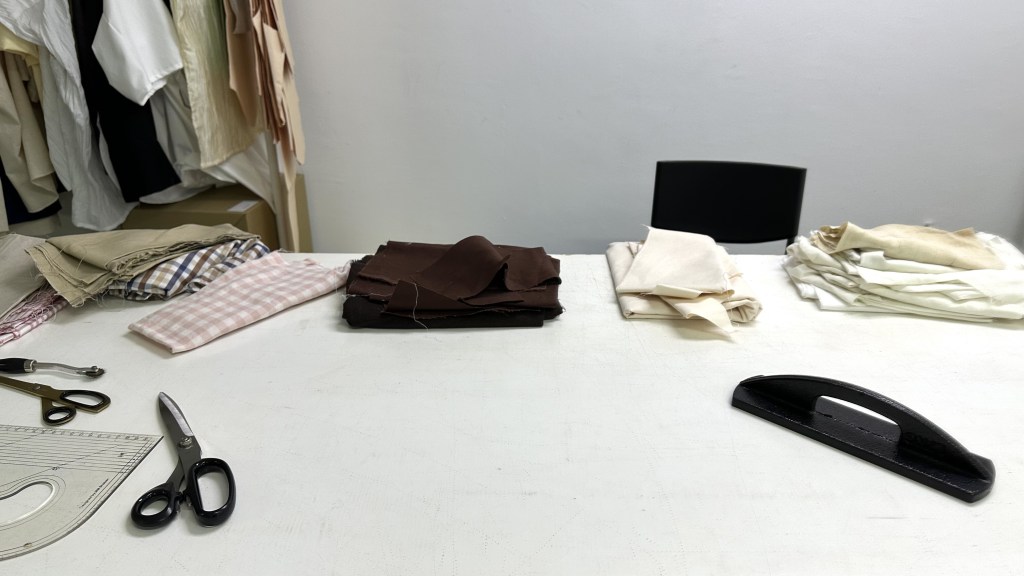
Shao fen is a really close collaborator of mine. She has been teaching me the
technicalities of pattern-making and assisting me with the making of my textile works for
several years now.
MC: I remember not long ago, when all the exhibitions were about women making textiles. And everyone was saying that it was radical, because it was women reclaiming this craft that’s been looked down upon… but it felt like, for a time, it was the only thing that we were seeing women do.
AXY: Louise Bourgeois is widely known but I do find that she falls into the same sort of trap too. Although, she creates works in all mediums. In Kuala Lumpur, there are still lots of woman-themed exhibitions held in conjunction with International Women’s Day. I still really despise them as an artist.
MC: Do you think about gender in your work at all?
AXY: Growing up in a household of predominantly women, I always thought that was how the world worked and when I stepped out of it, I realized what I had was actually a really special and safe place. Everywhere else is not exactly like that. So, yes, I had to think about gender. It’s there but I refuse to let gender define the work I
make.
MC: It’s just you being truthful to your life experience.
AXY: Some of the artists I looked up to were Louise Bourgeois, Simony Gill, Rachel Whiteread and Camille Henrot. They all happened to be women artists. There is something in their work which does not scream ‘I am a woman’. They just chose to
make work because that is what they would like to make.
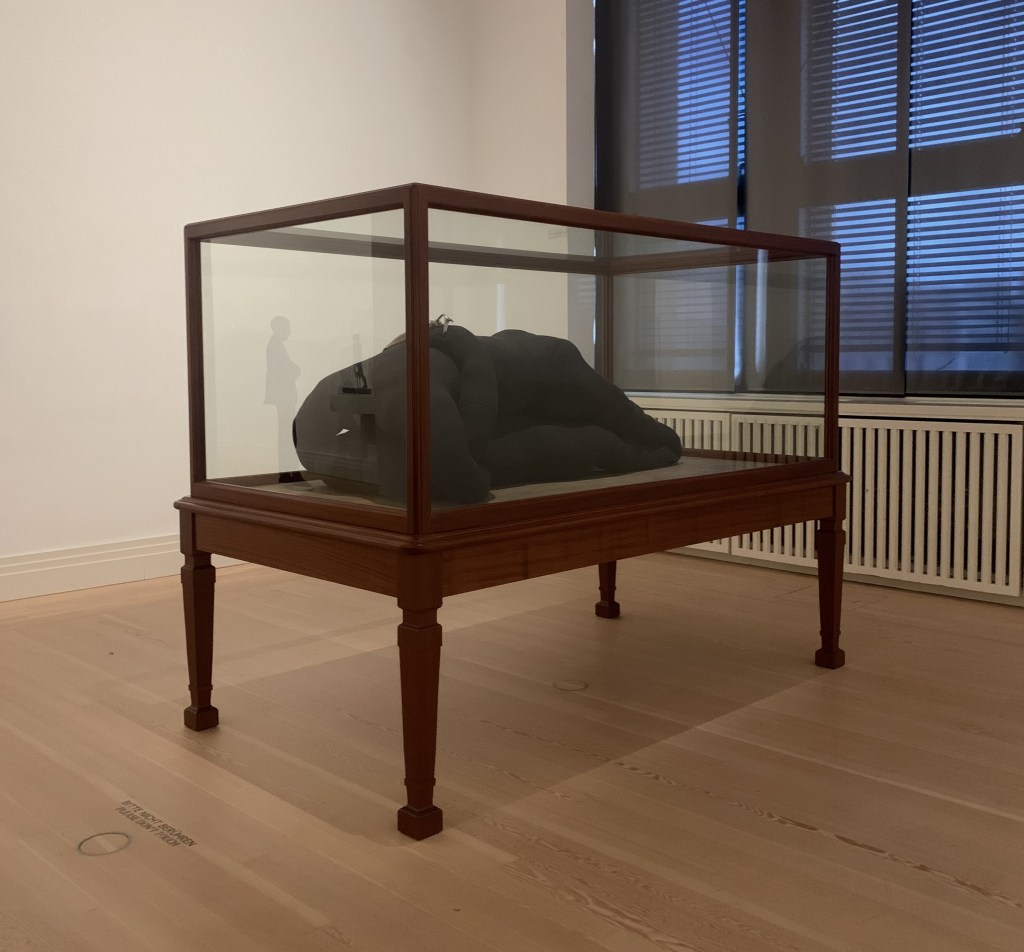
I saw Louise Bourgeois’ work at the Gropius Bau, Berlin, in 2022. I travelled to Berlin from Venice just to see her show and it was so emotional seeing them for the first time. Her works has always spoken to me in ways I can’t describe — for example, her anger towards her father and how she was always really angry about her father openly sleeping with the mistress of their family. You always see that in her work. And the idea of the mother as the protector, the spider. I see that in women. The woman in my life have always been the protectors. I have always been drawn to female artist, not because of their gender but because it made me believe that there is a possibility that I could be an artist too.
MC: Its nice to be able to talk openly about gender this way.
AXY: When I started making photographs, all I wanted was control. I found it hard to let go. I find myself wanting to control how the object is placed or how the light falls on it. Now with different types of materials and mediums, I am ok accepting if I messed up something in process. Maybe it is also a matter of age and life
experiences. I am different as a person now and I am learning to let go.
MC: I’m interested in your experience of the art ecosystem here in KL, in comparison to London – having experienced both.
AXY: The art ecosystem in Kuala Lumpur isn’t as developed as let’s say New York or London. There are not many galleries here in KL but there are names that you will hear constantly. There are a lot of artists here! Making works here, production-wise, is fairly cheap compared to Singapore. We’re so close geographically, but in Singapore everything is a lot more expensive. In Malaysia, people are able to focus on the physicality of making things, maybe because space is not as expensive here.
Whereas, in London, the arts are much more developed and well-funded. I used to spend a lot of time visiting the Tate Modern and Victoria & Albert museum when I was studying there. I remember seeing Rachel Whiteread’s monumental retrospective at The Tate Britain for the first time in 2017. The chalky colours and soft shapes of domestic objects. The smell of freshly casted plaster and resin will always be embedded in me. I wasn’t immersed at all in the art ecosystem when I was in London. I was merely an audience who happened to be there.
MC: To lead on from that, can I ask you to give me three names of artists who you know, who are in your circle maybe, who you have some kind of accordance with.
AXY: Nadiah Bamadhaj (ID), Minstrel Kuik (MY) and Chok Si Xuan (SG).
MC: Thank you so much for talking me through your work. It’s been so nice also to see the studio.
 Milkteeth
Leave a comment