
MC: I would like to start by asking you about your journey of becoming an artist. Was there a particular moment, or was it more of a gradual shift?
SW: When I was young, I had no plan to be an artist or make any artwork – I just loved drawing. I have been drawing since I can remember. I did not even study at art school, I studied science things until I was eighteen. Then, I thought to myself that I wanted to go deeper into the core of what I love to do, I wanted to know more. So, I chose to study fine art. At that time, I still had no idea how to be an artist, or even what art is. I just wanted to know more about this kind of practice. I just want to draw, to paint.
I was studying for two or three years until I had to choose my major. I chose painting because I loved drawing. I started visiting galleries and art spaces, and the more I went to, the more I started to know where I was positioned in the art world. There’s a lot of things I want to experience and explore. While I was studying that major, painting gave me a sense of purpose and made each day feel worthwhile. That was the turning point when my connection to art deepened into a true calling.

MC: It’s nice that you had the confidence to go for it as an artist even without that background knowledge about what being an artist entails. You have a very specific painting style, using oils. You are very technically proficient in this medium. So did you receive specific training in oil painting?
SW: At my art school, classic art is quite popular. They teach basic techniques of oil painting, but for more specific or individual techniques, it’s probably the same as for many people – you have to experiment and figure it out on your own.
MC: Why did you choose such a classical medium, given that the subjects that you choose are so contemporary?
SW: Because I had no idea what art is. The only thing I knew was how to draw, and oil painting is a very famous medium. All the famous artists that I knew at that time like Da Vinci and Picasso, people that non-art people know, they used oils.
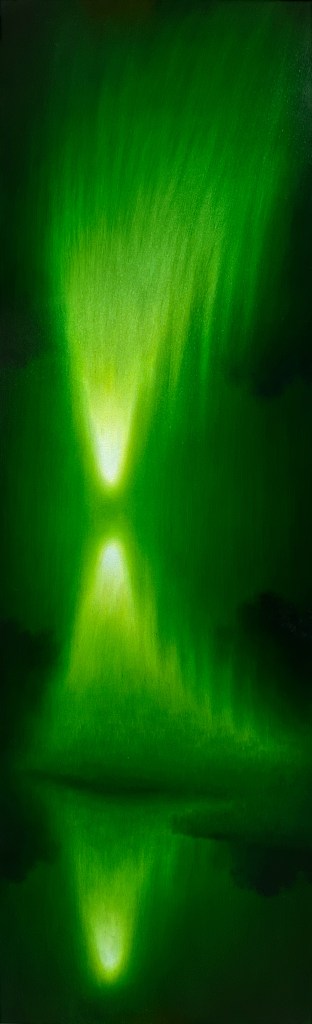
MC: Let’s talk a little about the subject matter you explore in your work. People say that you often deal with the cyber or virtual realm, and the RGB colour system. Your paintings often emulate a digital screen, that greenish glow. Why does the digital play such an important role in your work?
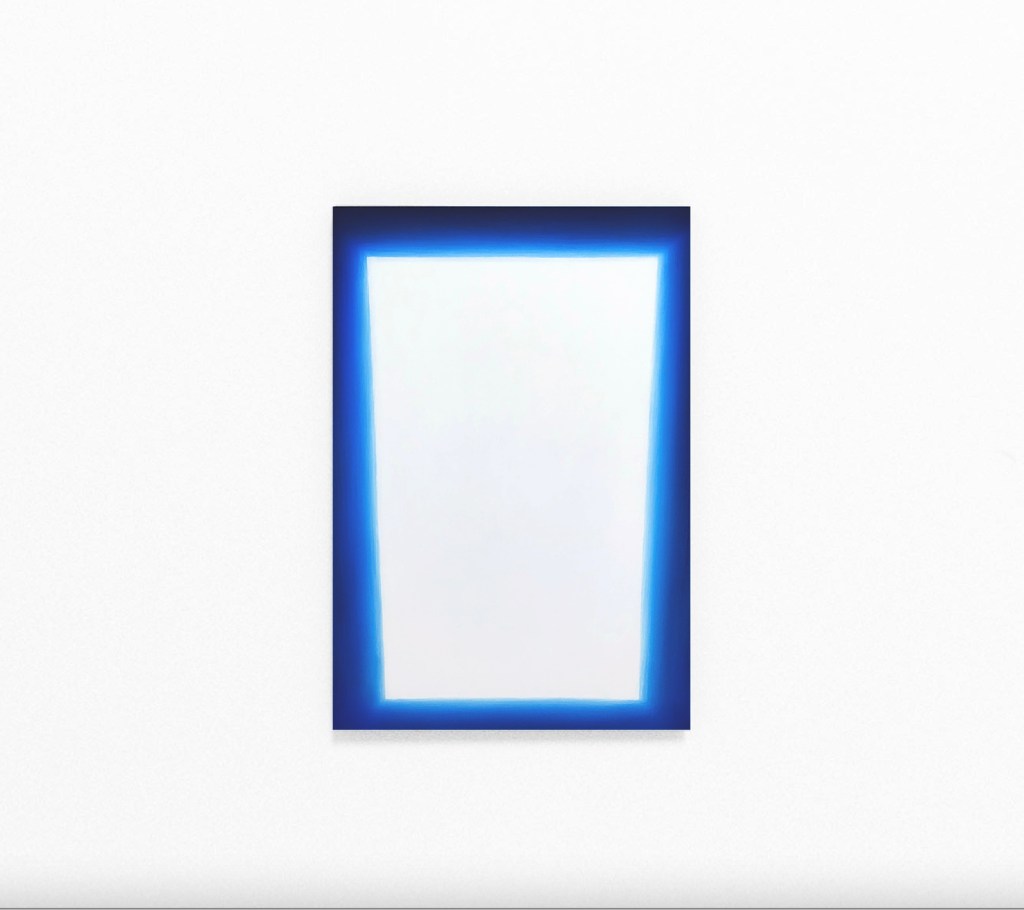
SW: At the time that I was trying to learn oil painting, I was learning how artists used to play around with light and shadow. I tried it in my own technique. My paintings became brighter and brighter, and I kind of liked it. I felt it was kind of unique, so I kept focusing on that area of my painting. RGB wasn’t something I focused on while painting; it only came into my work for a short time.
MC: What is RGB?
SW: RGB is a colour system that is used in the digital screen. It stands for red, green and blue. There is another system used in printing, CMYK. It stands for cyan, magenta, yellow, and key (black). The idea of RGB was a topic of my first talk session about the series call ‘The Square Deity’ in Singapore.
For me, the core of this color system is that the more you layer or mix colors, the brighter they become. This is the opposite of what we usually expect, and it’s similar to the way I paint. Growing up with digital screens, these colors became familiar to me and were simply part of my everyday environment. Later on, I didn’t use the term ‘RGB’ much, because it’s often misunderstood as referring only to red, green, and blue. In reality, mixing these colors creates many others as well.”
I had almost graduated, and then it was Covid and I had to go back home. It was quarantine, and I was on my mobile phone, scrolling a lot. I started thinking about my conditions – what am I doing? I was addicted to the mobile phone. I started thinking about the impact of the phone, social media – it has become like a new god to us. I came up with a new series called the Square Deity, where I started thinking about RGB colour. It’s the new colour of this generation. I mean, it’s the green of the trees and the blue of the sky, but in the digital era, there is this new colour that only exists in the screen. It has become part of our new nature.
This is a poem I wrote while thinking and making the series The Square Deity.
Timeless Touch
In the timeless field,
Where all places are as one like a dot.
How much time has flown by, I can’t feel.
As it does not exist.
Whilst the infinity is here, waiting for just the touch.
One by one, they are flying by.
Flowing and floating
In a rush and up to the sky;
To the past, the shrine,
Memory and eternity.
Falling up like an anti-gravity rain.
Yet, i’m sinking
into the endless rift.
Yet, There is never a displacement.
I’m already in the abyss.
Timelessly and unlocatly,
Keeping on falling,
Still
MC: Your work explores an interesting relationship to the natural world. You’re often looking at things like a beautiful lake, trees, the sky at night – Sublime nature – with this digital tinge over the top. Kind of a post-natural world. I’m also interested in what you say about the digital being a new god. Your titles often allude to God, a belief system, and spirituality. Could you talk a bit more about that?
SW: I grew up in a Buddhist family, and they taught me to observe myself a lot. It has become my automatic behaviour. I like to observe myself and see if there is anything from the outside that impacts my inner world, who I am, my actions, my body. I like to see if there are any invisible powers in our environment that impact our awareness. I like to see that environment as an invisible god – the sun, the society, the paradigms, the politics, powerful things.
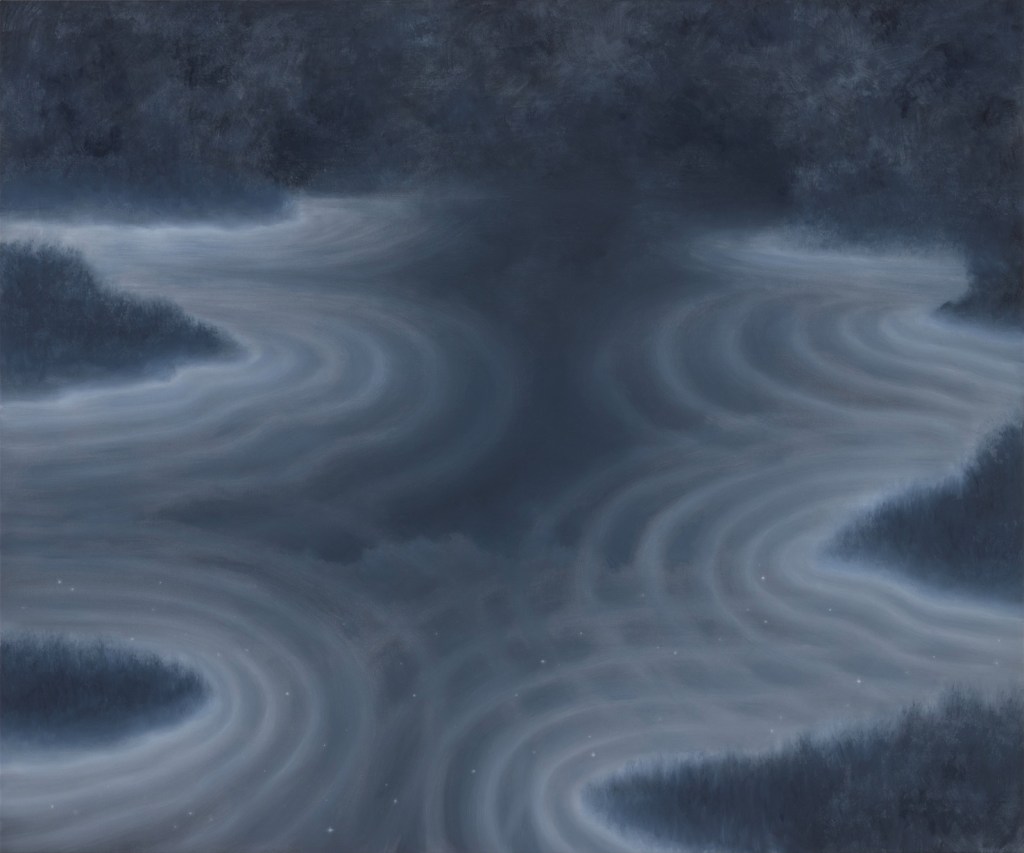
MC: A lot of your paintings show invisible natural forces, like your painting ‘Earth Breathing’. A lake with ripples like energy fields. Or others, showing the wind blowing onto a tree, or comets flying past. Intangible things, which cannot be seen but can be felt through their effects on the inner world. I suppose that the digital realm has screwed up our perceptions of the inner world…the inner world is now public.
SW: Now the digital world has become part of our inner world. My paintings visualise my inner world, being affected by the environment. With ‘Earth Breathing’, I was thinking of how we are sharing air, vibrations, with the earth and others. And how the earth isn’t just a still planet, but it is living, moving, interacting and breathing along with us. Since it is not a still object, it is more unknown, mysterious, but also connectable.
MC: One word which comes up a lot when describing your work is the world ‘Sublime’. What does the Sublime mean to you?
SW: To me, this idea is about something huge and endless, something too big for me to fully understand. It feels like my sense of self becoming absorbed into the same plane as everything around me.
There are two ways I often think about it. One is about how big and powerful the world around us is. Some of it we can see and understand, but some of it we can’t. This includes both the natural world and the modern environments we live in today. It’s a power that affects how we see what is ‘normal.’
The second way is how I perceive things and relationships. I believe that everything holds an infinite amount of what I do not know and cannot know. That includes people, objects, nature, and the universe. I believe that even the smallest thing carries this same immensity within it, even if we cannot feel it directly. We, too, are part of this network of existence, and the sublime exists within us as well.
My artwork might be a way of showing this sublime we will never feel in the connection between us and other things that may exist in our inner world.
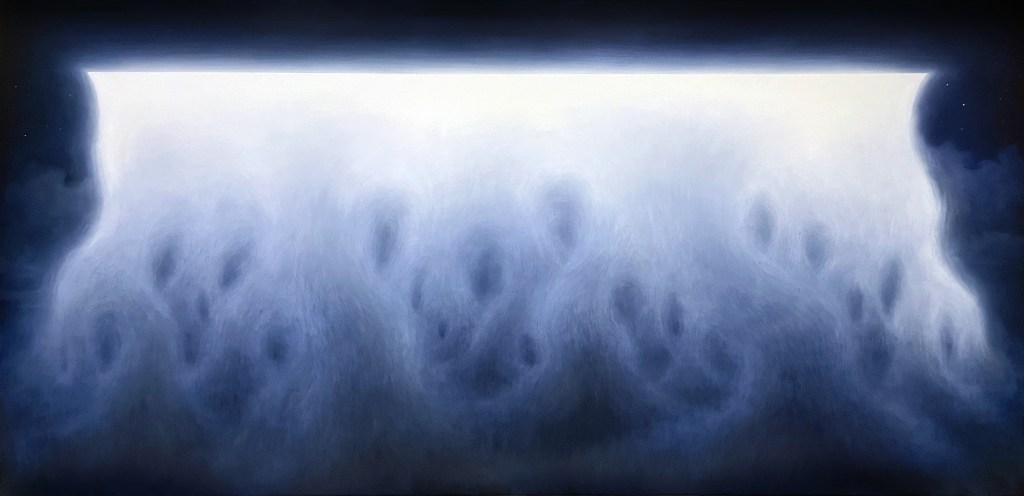
When I came up with the mobile phone series, the digital things, I was thinking that all the information inside the phone, inside the social media platform… it’s so big. Big data. It’s like we are facing a huge landscape. That’s my Sublime, in term of a powerful environment that influences the meaning of what we consider ‘normal’
MC: It is harder to feel the Sublime now, because one of the preconditions of experiencing it is that you have to feel some sense of the unknown, which created the Romantic terror and awe. Standing on a mountain ledge and looking down over a cloudy landscape and thinking, oh my god, there’s so much here that I don’t understand. But you can’t get that so much now because we kind of know everything. We have access to all the knowledge in the world on the internet. Everything can be grasped in a second.
SW: Exactly, I agree. It feels like that, even though there are still so many things that are not on the internet, and many more that can’t be recorded at all. The project I’m doing right now is about that idea – the missing Sublime, the missing feeling of connection with the universe, the earth. It’s also about the mobile phone, because I want to recover the feeling of the Sublime within this era of the mobile phone and the Internet.
MC: How are you exploring that visually?
SW: I’m making a new narrative, and I try to observe things around us and see them as part of the universe. Small things, like house electronic devices or our mobile phone. Viewing them beyond the duality of digital and nature but as a one fabric, the internet is part of the universe too.
MC: Could you explain to me your process of creating a painting, from conception to completion? Do you sketch?
SW: Mostly, the idea comes first. I will have an idea about the issues surrounding me, my problems, others, or society problems. And I carry the idea with me. I keep thinking about it, looking for connections wherever I go. I enjoy linking things together in a chaotic way, as it helps me see related things from different perspectives. I do some related research and sketching. I do it many times. I draw the same sketch over and over, making small changes each time. It takes a lot of time to sketch it until I like it, because it starts kind of blurry in my head. After I have my sketch, I start painting.

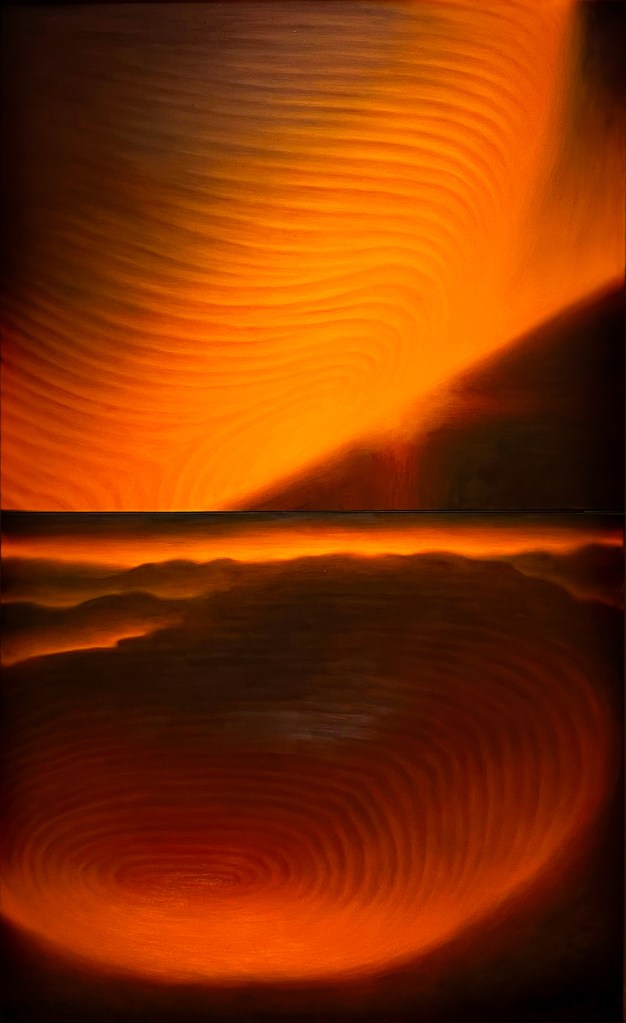
My painting process usually has three or four layers. The first layer is like a dead layer, a shading layer, volume of aura. The second layer is to make it more colourful and brighter embodying the the direction of the feeling and atmosphere. The same with the third and fourth layer.
MC: So it’s a process of turning up the brightness, almost, in painting form. That skill is amazing. Oil painting is usually all about subtlety, subtle gradations of colour and tone. But your paintings are just maximum contrast, blindingly bright with dark, dark shadows.
SW: See, I cannot do this technique in another medium. In acrylic, the paint dries too fast. This technique needs time to blend colours to make the bright effect. It is more convenient in oil.
MC: All of your works have some kind of bright light in them. Why is light the way you choose to present these ideas?
SW: Light is a symbol of God, as you know. Light in my work often represents the powerful environment and its influence on us, in a way that is similar to how people think of God. Like, we are all subjected to the sun. It is embedded in our DNA that we need the sun, we can’t live without it. That sense of how light affects us is very deep. In the series Square Deity, I mentioned that now things have changed – it is not the light from the sun, but the light from the mobile phone that we feel. Now the light from the screen reaches us more than the sunlight does.
MC: Do you have any techniques in your own life that you use to reconnect with the Sublime?
SW: Yeah, I used to meditate a lot when I was younger, but I wouldn’t actually feel the Sublime. And I didn’t go into nature a lot where the sublime feeling would occur. So, now, for me the Sublime concept did not come from immersing myself into nature or meditation. It comes from my observations of surrounding things, their connection to others and my surrender to the infinite unknown within them.
MC: Do you think there is anything culturally located in your work? Is there anything specific about living here in Bangkok which affects your work, or do you prefer a more universal approach?
SW: Not many but yes, there are elements in my work that are culturally located. Most of them come from the culture, stories, and beliefs connected to where I grew up, in the northeast of Thailand. Some of them exist subconsciously. Another influence that appears in my work is the culture of social media.
I often feel like we are all in the same country. I think the feeling and vibe I’m trying to do, it goes beyond country boundaries. I don’t really like the concept of the country, actually. But I like culture, differences of culture. I think that is beautiful.
MC: I agree, cultural differences make us all who we are. But it’s important to carry that information alongside the fact that we are all connected beneath these differences.

SW: In this recent project, I’ve been using elements from my culture more than before. For example, this one, called ‘Bai Si’ – it’s an element used in spiritual healing ceremonies. Usually it is made from banana leaves. I started to become interested in this cultural element, where before I had looked away.
MC: There’s something very old and traditional about your work, a wide-scaled sense of time. Something to do with the oil paint – you cited Da Vinci as your first artistic reference – as well as this idea of nature, on the grand scale, predating human cultures. But then, the visuals of the digital realm are very futuristic and sci-fi. It’s like you’re squishing temporalities together, in a way.
SW: People like to say that, and I do agree. But I don’t see these things as opposites or contrasts. Instead, I view and use them as part of the same continuous whole, not separate from each other, like one single piece of fabric. It is as if I do not care about the differences in time or age. Or in term of the contrast of beliefs and science, I often present them together or intertwined. To me, both are ways of setting the relationship between us and nature by creating abstract concepts like beliefs, truths, explanations of nature.
I appreciate this way of setting relationship. Maybe deep down, this is what I am expressing through my art.
MC: So the belief systems and philosophies of the past are just the same as the ones we now call science, just with a different face.
My final question is to ask you for three names of other artists who have some kind of accordance with your work, who you’re inspired by or who you just think are really good.
SW: First of all, Latthapon Korkiatarkul, His work is like a visualization or a concrete form of contemplation. It is philosophical in itself and does not rely on a language system.
Also, M.C. Escher is my favourite artist. I like the way he thinks, how he plays with the visual, our rational perception of reality.
The last one is Nawin Nuthong. I like his chaotic execution of his exhibition. So many information, many researches, many elements in each piece, it’s fun to think along with it, especially through the elements from internet and games culture that he often uses.
 Milkteeth
Leave a comment