
MC: I ask everyone at the beginning to tell me if there was a particular moment where you wanted to become an artist, and what was it?
GH: This is actually a really strange question, because it was my birthday the other week, and my Nana sent me an email about it. She was like, I remember when you were a kid, we would let you take all the toothbrushes from the house to paint with, and we wouldn’t have any toothbrushes left. And she said, I just remember you storming off once, being like, ‘I need to paint’! And I thought, that’s so Fleabag.
But, yeah, I can’t really remember, but I’ve also been lucky because my dad’s a painter and my mum – my parents met post art-school, through art friends. I’ve always grown up with it. But I do remember there being a point when I was applying for college, and there was a possibility that I could have applied to do a singer-songwriter course. And I got in, and it was a decision about whether I study music or art. Which is really strange, because I’ve just finished recording an album. It’s taken me a while to get round to being like, okay, I can do music on the side now. That was a point that I remember making a decision to be an artist.
MC: Like me, you grew up in Devon in the countryside. I believe that you were homeschooled, right? Do you think that growing up in the countryside in Devon, in a kind of isolated way, had a big effect on your work?
GH: Yeah, I was homeschooled, for about 8 years before going to college. And yes, I’m really surprised how there are so many people that I knew growing up in Devon who’ve become quite successful now, or are really dedicated to their practices, whatever they are. I think it’s because there’s so much empty space there, you have to fill your time somehow. No one has to tell you to make it. You don’t have deadlines or anything like that. It’s much more organic, I think, which is really nice.
MC: I can see that in your work as a kind of playfulness. It feels like childhood, right? Looking at your work feels nostalgic, even though it’s not my memories.
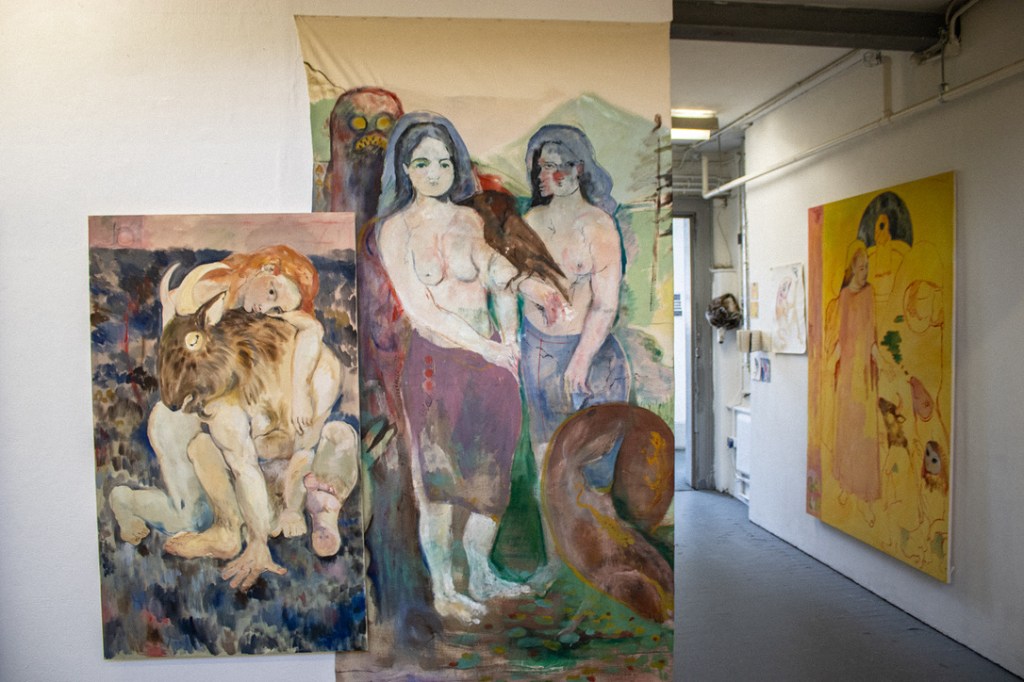
GH: Exactly. When I was in Devon, I do remember thinking that I’m never gonna paint landscapes, because I live in such an amazing landscape. Like it would be sort of silly to try and replicate it in paint. And so actually, since moving to London, it’s the first time that I’ve been thinking about that landscape and how I’m so estranged from it. I feel like the landscape is a good holding for these memories. But I also wanted to bring in the feeling of misremembered memories, where you’re not sure if it’s your imagination or not.
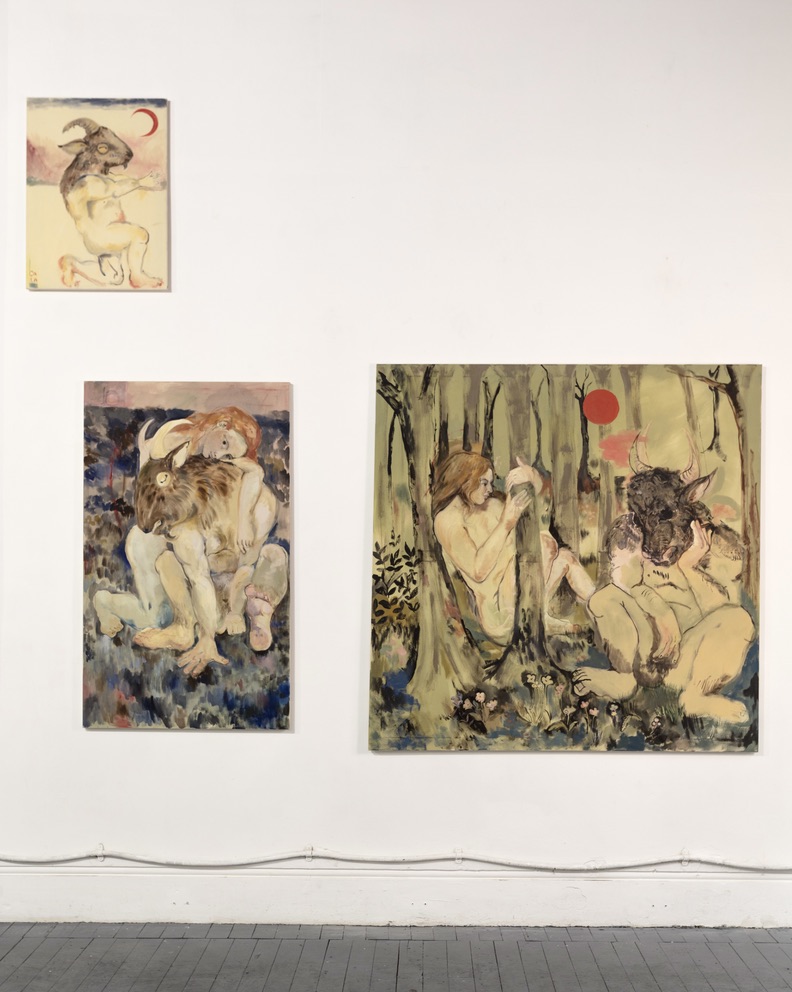
It’s like the Minotaur thing. I’ve been thinking about it because my dad made me a Minotaur when I was a kid – this bronze sculpture that was about the same height as me. It was in a sculpture garden, which is where his studio was, and it had a chess board next to it. And every time I went, I remember that he’d move the chess pieces in between me and this Minotaur. So you could play a slow game against it. It was a kind of merging of imagination and reality. That is something that I’ve really started to focus on. You can’t wait around for something magical to happen. You make it happen. And that’s what I feel like my practice has become.
MC: I know you use symbolism a lot in your work, especially animals. Traditionally, animals would always have a very strict place in the history of art – you put an animal into a painting, and it’s a direct reference to something moral. And I was wondering if that’s something that you’re exploring.
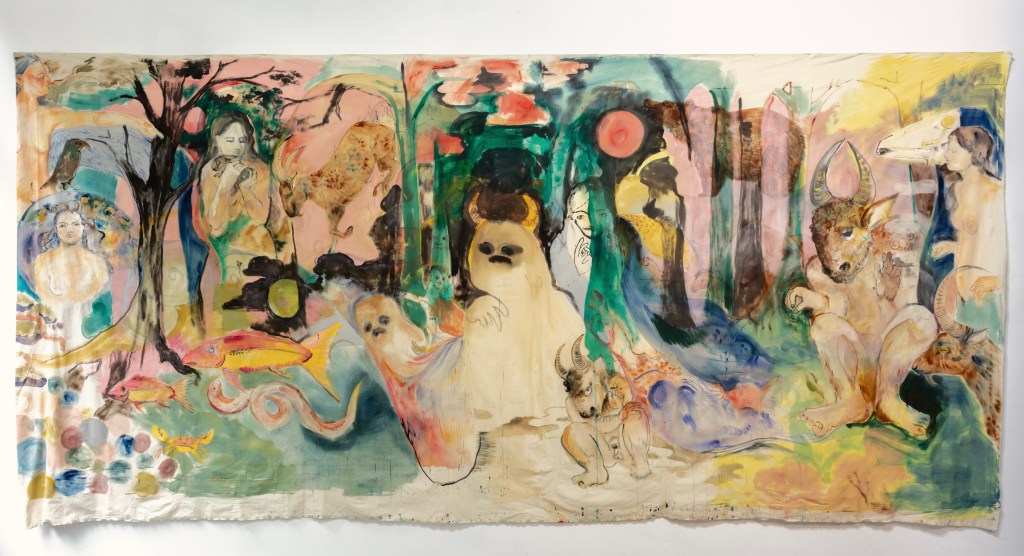
GH: I’ve been reading this book called ‘The Bear: History of a Fallen King’. It explores Christianity and the history of the devil and the bear as a symbol in western and European art history. The bear used to be worshiped as a god, and then Christianity was like, stop doing that. We’re going to turn him into the devil and make him morally corrupt, yeah? And I’m really interested in the pre-Christian idea of morality that wasn’t as strictly black and white as it is now. You could have gods that were both good and bad. Like trickster gods, or the Minotaur, which you remember as a monster
MC: That makes me think back to some of your older works, and you had a lot of carnival stuff. I was thinking a lot about the carnivalesque in relation to your work. It’s sort of turning things upside down – all social hierarchies and morality gets upside down for one day. Peasants become kings, kings become clowns, that kind of thing.
GH: Exactly. I’ve been watching this documentary series about Tudor lifestyles. And obviously there’s lots of pagan traditions, but also everything’s owned by the monasteries and they live under the watch of the church. But it’s really interesting to see the paganism seeping through. It seems very necessary to express these kinds of practices and to let people have these traditions. Otherwise they would probably have an uprising or something. There’s really necessity for it – like a release of pressure. I’m really interested in that feeling and the lack of it as well, here. There were things that I thought were super normal, growing up in Devon. You’d get all these folky traditions all the time. It’s just like normal to have, like, harvest festivals, scarecrow festivals and things on top of the stone circles. It’s very spiritual.
MC: I like what you say about this pressure valve thing – that you have to let these traditions come through as a way of controlling or channeling our human desires. I can see that none of your work here in the studio is particularly graphic. I’ve bought some of your work before, and it was quite erotic and quite violent! What you’re doing now, it’s much more symbolic. But I feel like those desires are still in there – those references to bacchanale or madness in your work. Sexuality is still there, but it’s more shown by the relation between a figure and an animal, or the flowers that you choose to put into the works, stuff like that.
GH: I feel like the rams and the goats I’m doing are quite horny! It’s so funny, with this painting I’m doing at the moment – someone came by the other day and said, oh! The figure is kind of beefy! But it’s interesting how little it’s commented on anymore. I feel like it’s just because sexuality has become more embedded in the work, it doesn’t need to shout so much. Without being so graphic anymore, my work has gone to the next step. And maybe it’s also just because I’m not a horny teenager anymore!
It is also to do with moving to London. Something I’ve struggled with is the constant feeling of being watched. Every day you have to go outside and choose what you’re going to wear and how are you going to present yourself. I’ve had moments when I’ve been walking in London and a bunch of guys have followed me down the street. It’s something I struggle with, this kind of inherent or obvious sexuality. And I think London has made it necessary to disguise it.

MC: Well, that’s the way that sexuality would have been mostly represented in art history, right? Disguised? I wanted to ask you about some of your influences, because I know you draw a lot of influence from Botticelli, Velasques, Mucha…
GH: Well this painting, I’m thinking about calling it ‘After Primavera’ – Primavera, the Botticelli painting in the forest, which I have above my bed. So the first thing I see when I wake up is that painting. It’s about springtime, but it’s also Troy picking the silver apple, and all sorts of other different references.
MC: What is it about these older artists that you that draws you?
GH: I was really lucky, being home-schooled and my parents being self-employed. We went traveling quite a lot in a van, and we travelled across Europe quite a few times. So I saw that painting when I was eight, and it’s really stuck with me since – that Botticelli in Florence. But I don’t seek out art history in that very specific way. It’s just been curiosity that’s driven me to it. Trying to figure out specific techniques. Seeking out techniques I’m interested in.
MC: What is the actual work of becoming a good painter?
GH: I think it’s a lot of trial and error, and it’s a lot of watching so many documentaries, just trying to find little clips of painters actually painting, so you can just see what they were doing there. How things work – that’s what drives my interest in art history. The technicalities, not so much the themes. Like, I’m not interested in whether this painting is about syphilis or not. Probably they were all about syphilis. People talk about that famous Picasso painting with the masks and the girls – like, yeah, I know it’s about prostitutes, but the interesting thing is that he added the faces on later, and he did in different stages. The process of making that painting informs so much of how we read it. So I really want to know more about his preparatory sketches.
MC: Are you a big sketcher? What’s your process for beginning making a huge work like this?
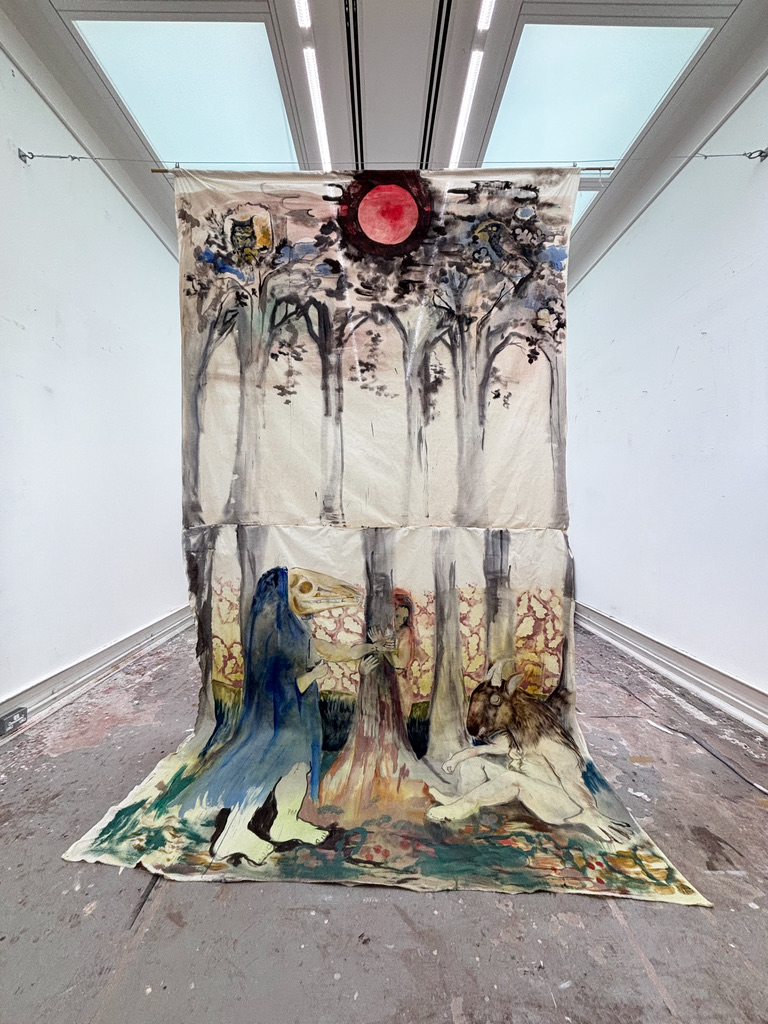
GH: Weirdly, it was the thunderstorm the other day. I felt really frantic. I had this insane energy, and my hair just felt like it was made of electricity, all my bones ached, and I literally did it most of the painting in one day, and then I went to sleep. The next day, my shoulder was in agony, because I’d done it in painting! I woke up at 5am feeling weird because of the full moon. I sound like such a weird spiritual hippy, but I can feel it in the wind!
So I woke up wanting to do a really tall painting. This painting is in two pieces, and it’s going to be sewn together, one on top of the other. I wanted to do really tall trees, to get that really high feeling. And then at the base of the trees, I want there to be the undergrowth, with all these other monsters living in the undergrowth. I didn’t do any drawings for this, because I’ve drawn everything in it before.
MC: I’ve noticed that in going through your work, you have certain animals that you always go back to, and things that you’ve drawn again and again.
GH: I mean, the goat thing started by going to Spitalfields City Farm, and I did a couple of drawings of the goats. And then I went to Cornwall. I was in a caravan, and there was one rainy day, and we couldn’t go outside, couldn’t do anything. So I just sat down with loads of paper to see what would happen. And it was like a combination of the thing that I just drawn – a very detailed, realistic drawing of a goat – along with just a very intuitive painting. I know how the figure works. Exeter College was really great because I did two years of life drawing every week, it was amazing. Drawing all the time, and knowing that your hand knows what something looks like because you’ve drawn it so many times, is really useful.
MC: For me, that would be the point where I’d be like, yes, I’m a painter! When I feel like I just know the shape of things. But you also have another side of your practice, which is illustrative, right? You’re a part of Komuna Collective, which is very cool, and I’ve bought works of yours which have been illustrations and posters. Are they prints or are they digital?
GH: It’s kind of confusing. No one ever seems to understand how I make them. So they’re pen or pencil drawings. They have to be very specific so that there are no gaps in the line, and then I fill them in colour in Photoshop. Then I can make gradients. I’m basically digitizing the same process of making a print, if that makes sense, because I was a wood block printmaker. So I’m trying to create a process as similar to that as possible, like in layers of mono – a multi block print, but in Photoshop.
MC: And how do these two sides of your practice inform each other?
GH: I used to see it as, you know, taking a break from one thing to go do the other thing for a bit. It’s also a lot more portable to work digitally, of course. So when I feel overwhelmed by all stuff that I’ve made, it’s quite nice to be like, that’s a file, that’s a JPEG. You know, it doesn’t need to exist physically until I print it out, because someone wants it.
But it has been received so well that part of me is thinking, okay, what if I just started introducing it into the painting, and to make the paintings look more like the drawings. To use colour, layering in the same way, and to bring in more illustrational qualities whilst still having that painterly feel, which is why I think I’ve started using more black lines and more blue lines in the paintings. Not very tonal, but they have this drawn quality.
MC: This question of illustration leads me to ask you more about the problems of artists making money. It’s lovely that yours was the first work that I ever bought for myself, and it feels important somehow that you’re making works which are small and affordable, but they still have that painterly quality.
GH: The drawing sales that we did at the Ruskin were an incredible opportunity for me to make money. Because there’d just be a weekend of making stuff, selling stuff, and one weekend I got enough money to buy a return plane ticket to Brazil. And it was really amazing to have that opportunity, over three years, to develop that side of my practice. I really prefer working that way in terms of making money, if I’m honest. People would get drunk and be in nightclubs and tell me, this is your work in my bedroom! It really got a bit overwhelming at one point, where everyone had one of my works in their halls. People were coming up to me and being like, it reminds me of home, or reminds me of this place in the world. It was lovely to get that direct feedback without it being diluted through gallery speak.
I was thinking about Margaret Keane – she did those big eye paintings. Did you see Tim Burton’s film ‘Big Eyes’? Her husband monopolized her work and claimed it was his own. But one of the interesting parts of that is that she was looked down upon by the art world because her work was so popular, because she was selling prints of her work. Everyone had one in their kitchen. I thought, this is fucking cool. Andy Warhol thought she was really cool. I didn’t like the snobbishness, that the art world didn’t think that she was very good because she was popular.
MC: Sadly, the art world looks down on illustration. But that’s why I’m a big fan of your work. It feels democratic, it’s print based, it’s illustrative. And, yes, it’s affordable!
GH: I’ve actually had arguments with people about the fact that art isn’t affordable anymore. My dad sold his paintings in the Affordable Art Market, which kind of doesn’t exist anymore. People aren’t making enough money to have a spare five grand, which was technically what affordable art meant. It’s a difficult time to be an artist in a system where you’re either selling work to huge collectors, the super-rich, or, like, having an Instagram career selling small prints for £50 each, because that kind of middle income doesn’t exist anymore. Some people look down on that as well, which is not fair, because everyone’s got to make work somehow. It’s really important to not undersell your work, but to still be profiting.
MC: I wanted to go back to some of the themes of your work. There’s one favourite that I have, which is an old one. It’s the little house that you made, your degree piece. I’ve noticed, going through your work, that there’s a theme coming through of houses, tents, caves, and masks as well, things that enclose you or hide you. I was wondering if you could talk about that a little.
GH: I remember how that all started. During my foundation, I really wanted to make a giant Kinder egg – so you could get inside it. It’s because of the woman I’m named after, Salvador Dali’s wife, Gala Dali. There’s a really great video of her coming out of an egg which I absolutely love. And then I never really got round to making it, but I was really interested in the aesthetics of interior artworks and murals and frescoes and just these really beautiful residences. Especially Charleston farmhouse, which was a big influence on the little shed that I made. But also it was my studio as well. I was working inside it. I was making work from it. So I was interested in the studio space as an enclosed sense of safety. And then I was interested in hermitages as well. Like Giotto’s paintings of hermits – they’ve always got the mountain landscapes, the little tiny houses in the background. So it’s kind of a version of a hermitage.
And then with the masks, it was interesting because I was noticing that I sort of pivot between being very introspective, like I don’t want to see anyone, I just want to hide away and make my own work, and then being like – this is like a group activity that everyone’s going to take part it, wear these masks, and we’re going to do this together. But then I noticed that when people wore the masks, they’d be really quiet, and very meditative. I’m just sort of making that but bigger – the houses felt like the masks, but bigger. I would go inside the house and be like, I was in there for like an hour and I didn’t realize, because my brain just felt quiet. And I was like, thank you! As an autistic ADHD girl, that’s the goal.
MC: Are you purely celebrating the parts of the studio life that you love?
GH: I think so. I mean, it’s an enclosure that you have control over, which is really important. Not to be too ‘sob story’, but I do think about the fact that technically I was homeless until I was five. We were living in a van, and then we were living with my parents’ relatives and stuff like that, until I was five, and that’s when we got our first permanent home. And all the things that we brought with us to make, basically, makeshift houses all the time. There’s something so precarious, especially in London, where the only constant is my studio. It becomes that makeshift home, absolutely.
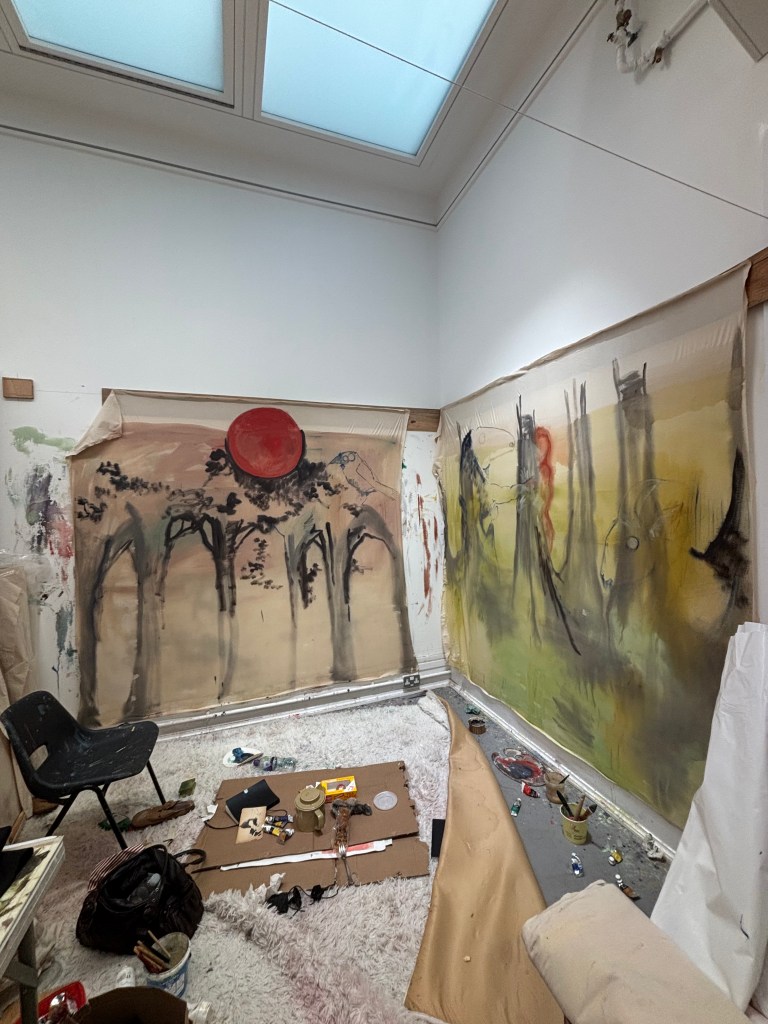
MC: The thing I liked about the houses was that had these images all on the inside and the outside, but they were all clearly nostalgic to you. So I felt that there was this homeliness from the fact that you’re surrounded by your own memories. That’s all you need, really.
GH: I feel like it’s the same with jewelry, where everything you wear has a specific memory attached to it. You have to imbue everything with a certain memory in order to make it feel special. It felt the same with the studio. With that house, I was painting it over about three months, so it was a real document of all the things I thought about for that stretch of time. A lot of memories in that.
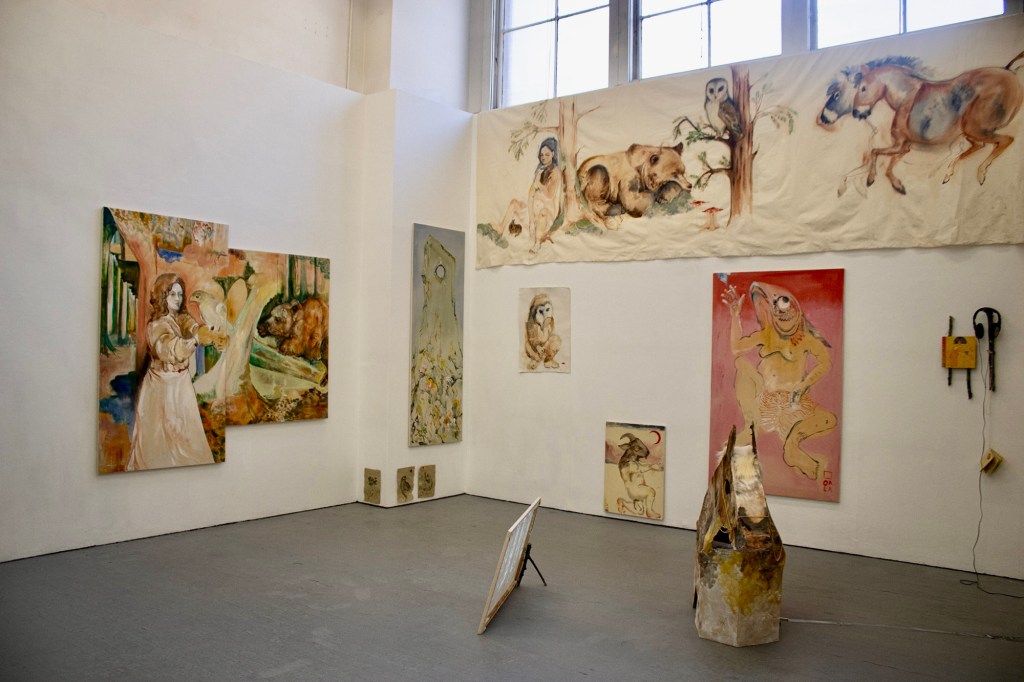
It was actually really difficult to let that piece go, but it was also why I’ve made so many pieces now that can be rolled up. Like that piece there, that folded up bit of canvas. The portability of the work is really important to me, now.
MC: It’s really nice, the fact you don’t feel the need to always work on stretched canvas. You’re often using unstretched canvas, sort of stitched together, different sizes, quite scrappy.
GH: I really like the fact that with unstretched canvas, you can just sort of add a bit if you want to. Me and my friend, we used to say it’s so male to want to make canvas act like it’s a solid surface, and to reject textile work and the importance of textiles as a painter. Because we’re working with textiles, all the time, and it’s really important to respond to the medium you’re working with instead of just gesso-ing the fuck out of the fabric and creating a really sturdy, hard surface, and stretching it until it’s taught and just completely dominating it. You’ve got to be realistic about the fact that you’re working with a fabric. It’s why I work with water mixable oil paints, because I can really water it down, and it just absorbs into the fabric. And you can lift it up, fold it, waft it in the wind, and it moves.
I think about it a lot – people say that I’m quite good with words. And I find it really interesting, because I didn’t talk till I was five. It’s common for autistic people to be non-verbal, and so I really respond to non-verbal forms of communication. It’s sort of why I made the house, because if I make an environment, then I can explain to people what I mean just by them entering it. It’s better than if I tried to describe it. I really responded when people were like, Oh, I didn’t realize how dysregulated my nervous system was until I went and sat in the house and felt calm. And I was like, yeah, that’s what I want to tell you!
MC: By extension, that feels like what all of your work is doing. Even the paintings – you aren’t in them, but the magical, Midsummer-Night’s-Dream atmosphere that you create, is so involving.
GH: I think a lot about the theater sets. I think it’s also the symbolism that people associate with animals. I’ve never interrogated why I paint animals because it’s one of those things I can’t see from the outside perspective. It feels so natural. Obviously, in Devon you’re surrounded by animals all the time, it doesn’t feel like unnatural to think about them. But here it does, and it’s been quite poignant when I use animals and trees and nature – it’s quite pointed against the cityscape that I’m around right now.
MC: That leads me to ask you where you see your work going in the future. Obviously, you’re working specifically towards your Slade MA Degree Show at the moment. But if you stay in the city long-term, I can imagine your work is going to get increasingly pointed!
GH: Well, currently my dream is to go work in the Outer Hebrides or something! I think practically first, because I can never tell what the next thing is going to be. Like this whole body of work started from a culmination of my frustrations with central London. I had a big painting that I was working on, which was very pretty, carefully painted. And I just came in one day, really angry and frustrated, and I painted the Minotaur smoking a cigarette. Just looking really grumpy- he’s showing it all, he’s naked, and he’s angry. And I was like, oh, this is something. This feels exciting.
And then the other thing was being on the beach in Cornwall, and I decided that I wanted to do watercolor paintings using salt water from the sea to wet the paper. And then it started raining, and I was on the beach trying to paint a landscape. So on one piece of paper I was doing the landscape, and then the other one just kind of happened. It started as an owl, and then it became an owl person. And I thought, the Minotaur doesn’t have to be the only animal that’s got a human body. So I started doing quite a lot of fish people. I really liked how that work came out, because the salt water crystallized the watercolor in places as well. Every mark that I made was getting washed away by the rain. So it was an intuitive working experience that I loved. And also that kind of feeling, when you’re in the rain and you’re like, oh, fuck it. I’m just going to get wet now. I can’t worry anymore, which is really great state to be in when you’re making work.
MC: I’d love to ask you the final question now, which is to give me three names of some artists that inspire you and have some kind of accordance with your practice?
GH: I mean, here in the studio I’m next to my friend Hannah Naify. It’s been interesting this past year, being separated by a wall, but our themes are quite similar. It’s like a weird symbiosis of ideas, and everyone’s sort of cross-pollinated in this really amazing way. With techniques and visual iconography… Hannah also works a lot of animal symbolism, but how she approaches that is different from me as well.
I want to say one of the tutors here as well. Just as a personality, I think Nadia Hebson, the head of painting here at Slade, is really important in the ways that she’s very open about financial issues, being a London artist, being stuck and not knowing what to make next, and having a portable studio as well, or not having the conventional studio space. The way that she talks about making work is really, really influential.
The third is Rose Wylie. She’s a very old British painter who has not been recognized until quite recently. You might have seen this video of an old woman in a studio where she just has piles of newspapers everywhere, and the paints on any bit of table as her palette, and it looks like it’s gonna catch fire. She’s really picked up this year. Her work is very immediate. I think the way that she works is really amazing.
It’s kind of a cliche now, being a female painter who doesn’t get recognized until they’re old, even though they’ve been working this entire time. I think that’s a really interesting element of being a female painter. There are so many artists I can think of from art history who are like that. I think about Rodin’s assistant, Camille Claudel. She was one of the artists in his studio – I think she did all the feet in Rodin’s sculptures. But I remember that she would make all these incredible sculptures in clay, and then she’d bury them so that they’d melt in the soil. And she never showed anything of hers. There are so many female artists – like Hilma Af Klint, who wanted all her work to be burnt after her death – all these unrecognized women who are probably out there who just never got seen, or everything got destroyed. I’m trying to not do that, even though it’s quite a big urge to just throw it all away. But it’s important to learn from those women from art history. And to say, it is important that people see this work.
 Milkteeth
Leave a comment