
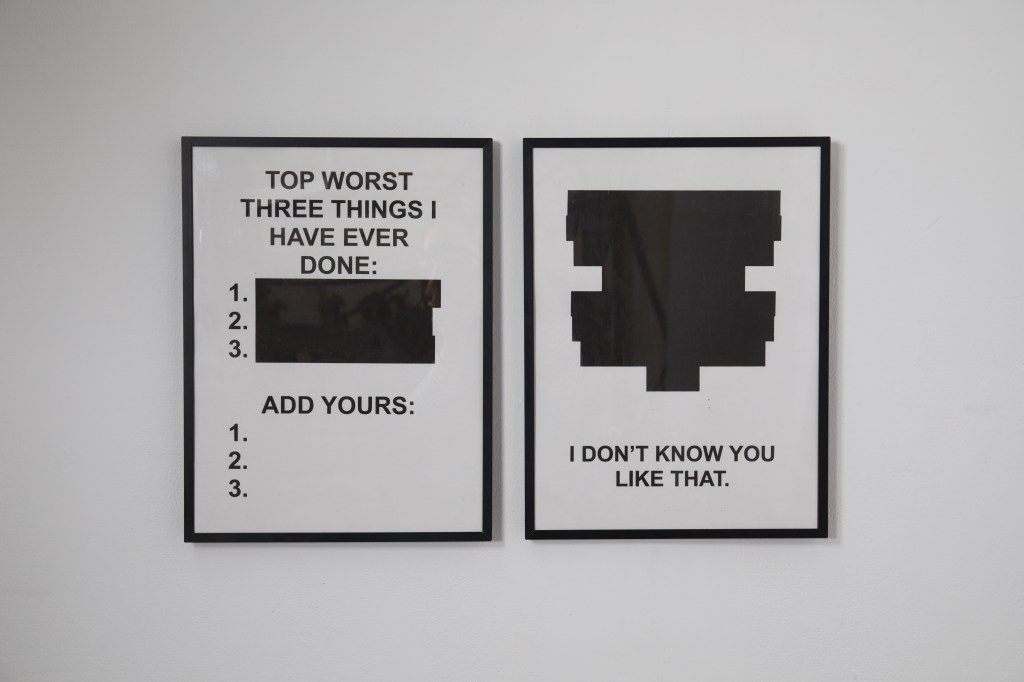
MC: I saw your Degree Show – gorgeous. And I realised that I had actually seen your work before, at Lily Petch’s show ‘Rift’ at Greatorex Street, where you made those little birdhouses. I was wondering if we could start with you walking me through your degree show presentation, and just explain – or don’t explain if you don’t want to! Just talk me through it.
MSKJ: I’m going to go on a tangent, but it links to this point. We had a crit with Imani Grace-Jordan, who is this curator.
MC: Is this Imani from Languid Hands?
MSKJ: Yes, it was fantastic. I was talking about my works, and they said, you don’t always have to give the personal! I was like, oh no! How do I place my work?
But the degree show was a culmination of everything I’ve made over the year. In short, it kind of felt like a manifestation of how I saw my boxes, my work, existing in spaces.
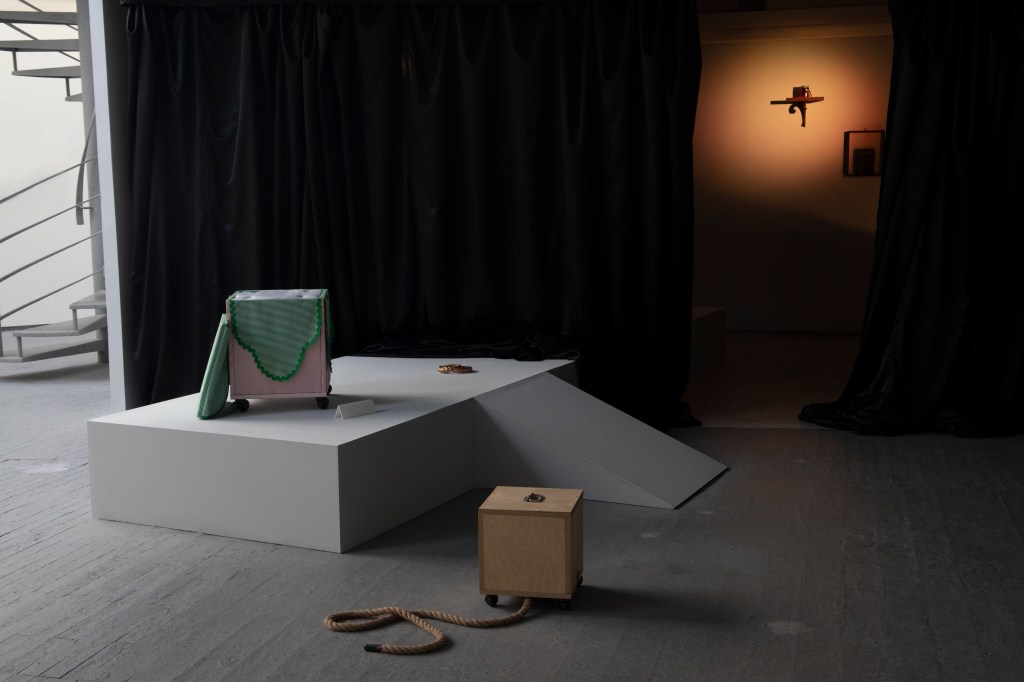
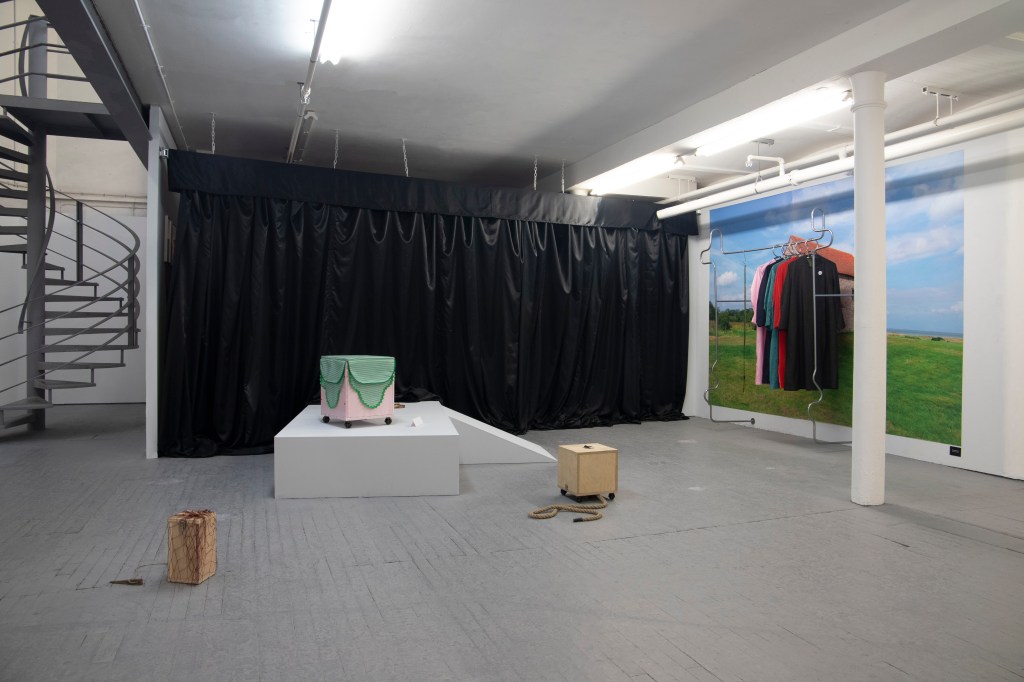
The big curtain divide was the starting point of how I wanted the space to be interacted with. Having this outside and inside presentation, being two very separate spaces but still joined by that central plinth.
The work itself is really personal, in that through the containers I am trying to place people and emotions and experiences and trying to physicalise them and make them more present. I originally started making them in the end of second year, beginning of third year, as a way of looking after objects that I’d inherited because I didn’t know how else to preserve them. I didn’t really want them in my house, but I didn’t want them to be packed up into a box in the corner. So for me, intertwining them with an actual artwork, making them into an artwork, makes them a bit more solid. Then also the boxes became people, because they were holding the objects which I saw as the conduit of a person.
MC: So the objects are inside the boxes in the show, but you never show the contents.
MSKJ: Yes. Well, two of them have objects inside them, which were older ones that I made earlier in the year. One of them I made in 2022, but I still showed it because it’s the most important one, the first one I ever made. Then the boxes which are more decorated have sound in them, and one of them has a person – or what I see as a person – in it. Then the big brown one was a resting place, and that’s why it had the mattress and cushion.
MC: So nostalgia is really important to you? That was my main takeaway from your show. I went in, and I was feeling… what’s the word for when you’re nostalgic for something you didn’t experience? I was trying to work out why it was hitting me so hard. Something about the music – I think it was playing Penny Lane when I went in. What is this work dealing with memory, and dealing with death, and how to memorialise people? How do you feel about inheritance in that way?
MSKJ: It’s a strange one. I think you’re absolutely right, of trying to hold something you didn’t experience. I think when I first started making work about death, I was doing it for my dad. I was trying to hold his experience of death, or how I saw it through him. But as time has gone on I have also started to think more about my own relation to death, about how I experienced it at a young age, about how my parents experienced it, how I will experience it. For me, it is the most universal thing. Death is an integral part of existing. The fear of it is innate. But also, that fear is almost ignored or pushed aside by society.
When I did my dissertation, I was looking at Sophie Calle’s film ‘Couldn’t Catch Death’ where she filmed her mum dying for about 80 hours. At the Venice Biennale she screened the final 13 minutes. It’s a film but it looks like a still, because of how still her mother is, and the fact that the nurse then comes into the shot and checks for a breath. I think artists, in relation to a lot of things, are so personal. I think there’s something so brave about that.
In terms of inheritance… I think that inheriting that experience feels really important. The songs that were playing in the show were a collection of funeral songs that I compiled from different artists and family and friends. It became a publication. And it was a three-day-long playlist of forty-five people’s funeral songs. It was really interesting how all the different songs changed the mood of the space. Some people had really religious hymns, and it really made the space feel like a place of worship. But at other times it was dance tunes. It became this weird thing, like people have been here but they’re no longer here. Music, I have realised this year, is really integral to memory. It really places you in a time and place.
MC: Well, isn’t it true that in all cultures, pretty much, music plays a part in funerals or death ceremonies or traditions. I think that is why I found it so moving – it is universal. That’s why your work chimes.
MSKJ: I hope so!
MC: There’s something really interesting going on in your work in relation to public and private, to do with these kinds of topics. Obviously, you’re not showing these objects at all – they’re just for you. I’ve been thinking that your work… it’s confessional. A lot of stuff about telling the truth. Particularly with the badges and the confessional texts. I was wondering what is your relationship to the idea that, as an artist, you have to be confessional?
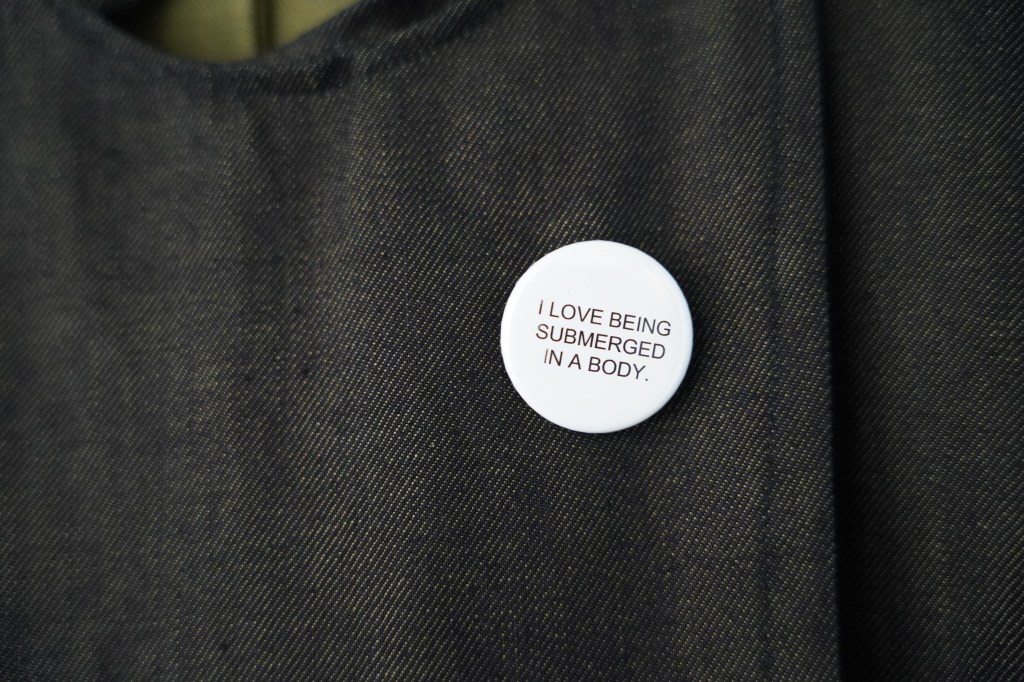
MSKJ: That’s a good question, and it’s something I’ve been struggling with a lot for all of my degree and my foundation. How much truth do you give? Is it a space where the truth that you’re giving is going to be received? I think a lot that the fear of telling the truth is a fear of how people are going to react to it, not that you don’t want to say it. I wasn’t raised in the church at all, but there’s something about confessional boxes I find really fascinating, in terms of this space that is just for telling the truth. Obviously, within Catholicism you have to repent or whatever. But for me, actually having that truth aspect makes people interact more sincerely with the work.
I’m quite interested in toeing the line between being so truthful that people think it’s a lie, and making people uncomfortable that you’re being so honest.
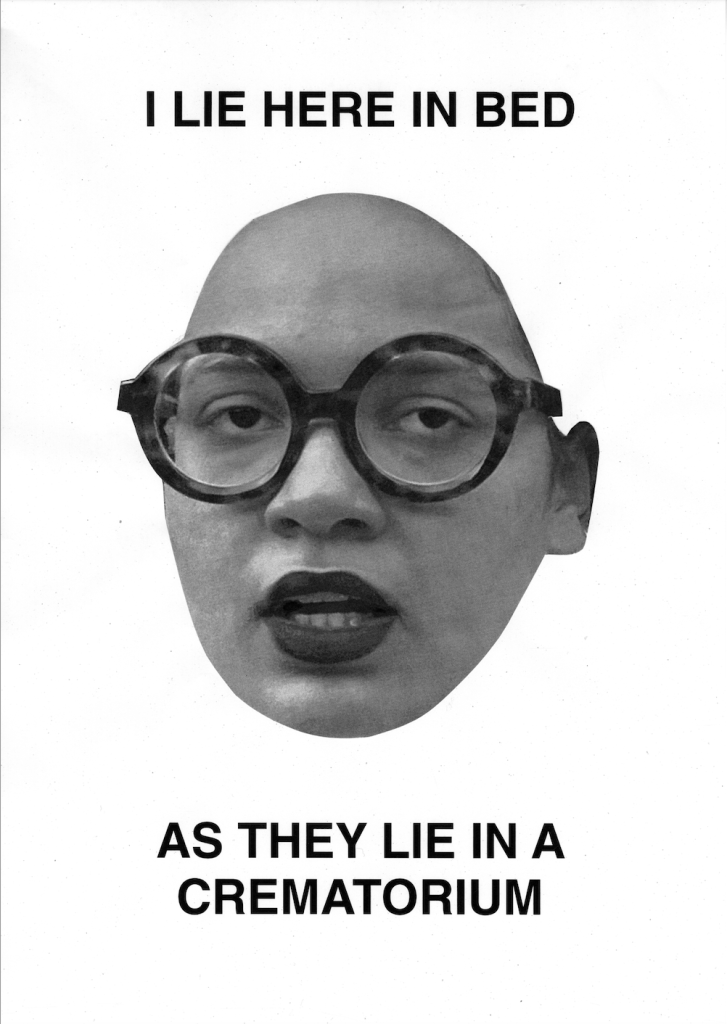
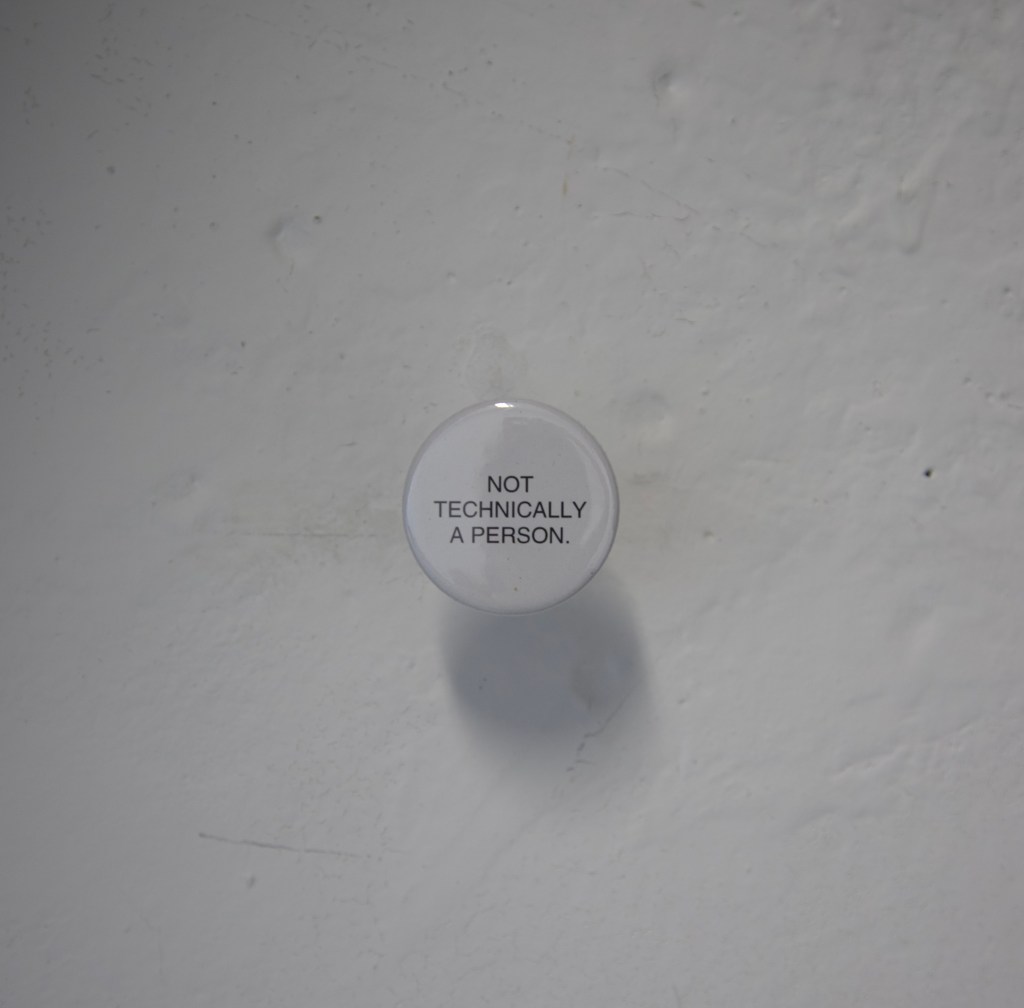
But also, especially within the text work and the badges, because it’s been done in quite a plain format there’s less of the personal aspect. People have been like, is it lie? Is it a truth? Are you being sincere?
MC: I saw the work that you did with the ‘two truths and a lie’ text, the performance.
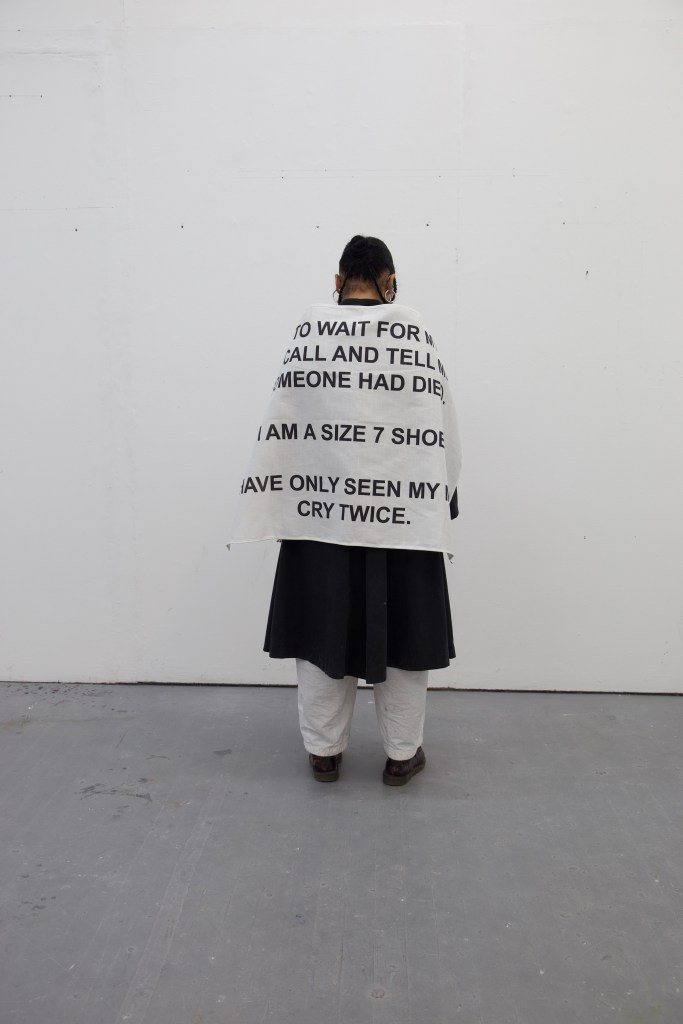
MSKJ: Yes, and even when there is a lie it is always just a shifting of the truth. It’s so close to a truth that it is a truth. I think it is difficult in making art – how honest are you? Are people going to be receptive to that honesty?
MC: I suppose Tracy Emin would be the extreme example of that.
MSKJ: I remember talking to an artist about that. How much do you give, and is there enough left for you? When I create work that is really truthful I am giving a lot, but I am not giving to the point where I am depleted.
MC: That’s interesting. You said that you are not interested in the idea that you tell truths in order to repent. But is it not a feeling of exorcising something out of you?
MSKJ: I think it is about getting it out, yes. The big vinyl on the wall of the degree show is of a church. I went there, it is church which has a lot of importance in my dad’s childhood, but also when I was nineteen I went there on a site visit with my parents. I didn’t tell them why we were going, but when we got there I told them ‘I want my ashes to be scattered here’. They thought we were just going out!
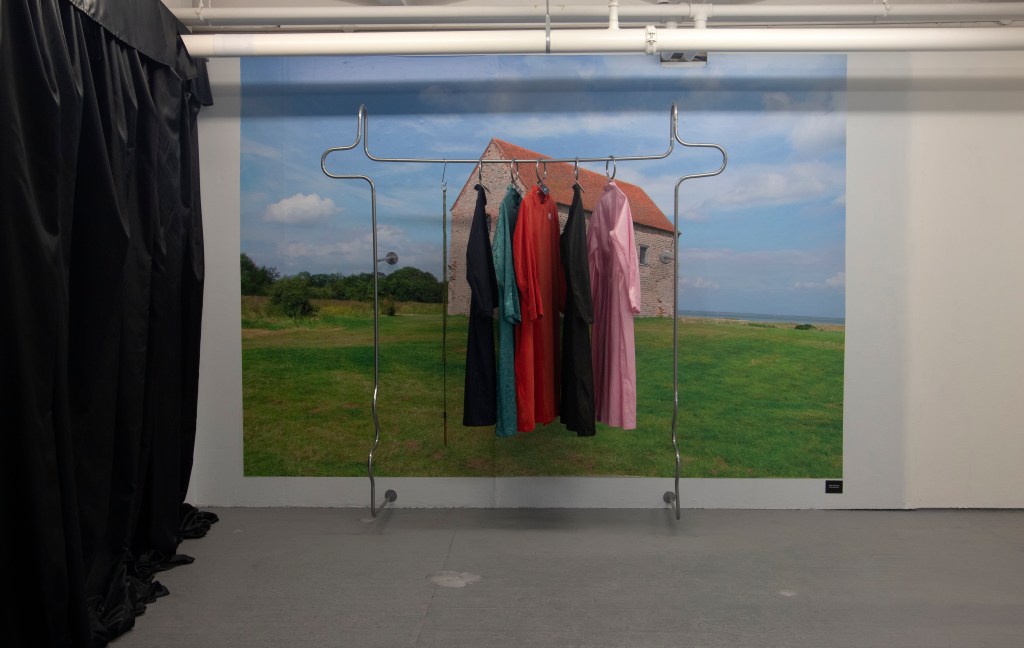
I think that brutal honesty is important – I don’t get off on the unknown. When I experience art, I quite like when there’s a sincerity to it. I find it difficult when there’s a hidden meaning, or the meaning isn’t what you think it is. I can’t deal with the mind game of it all.
MC: This postmodern idea where everything’s a reference to another thing makes it kind of lose its heart, in a way. I do feel that. What about the link between brutal honesty and humour? Because your work is super funny.
MSKJ: Yeah I like that, I hope it’s a little bit funny. I think that humour, in terms of thinking about death, is a coping mechanism. I remember when my dad’s friend died, he wanted one of those laughing track boxes inside his coffin. He wanted there to be humour in it, for it not to be morbid.
MC: Very dark humour!
MSKJ: Exactly, dark humour, off-the-cuff comments where you don’t really know whether the laugh or cry. I think also that laughter is a tool for covering up sadness. A lot of comedians use humour to glaze over the sad reality of things. In my work, I do mean for it to be intentionally funny, but I think that a lot of the humour comes from like, oh my god, why have you put that on a wall!
MC: It’s the juxtaposition of your work. I’m thinking of the collages with your face and the sad text, and also the birds, the magpies. What were the magpies about?
MSKJ: I just really like magpies! I really like the fact that their number has such an impact on the day.
MC: Are you a superstitious person?
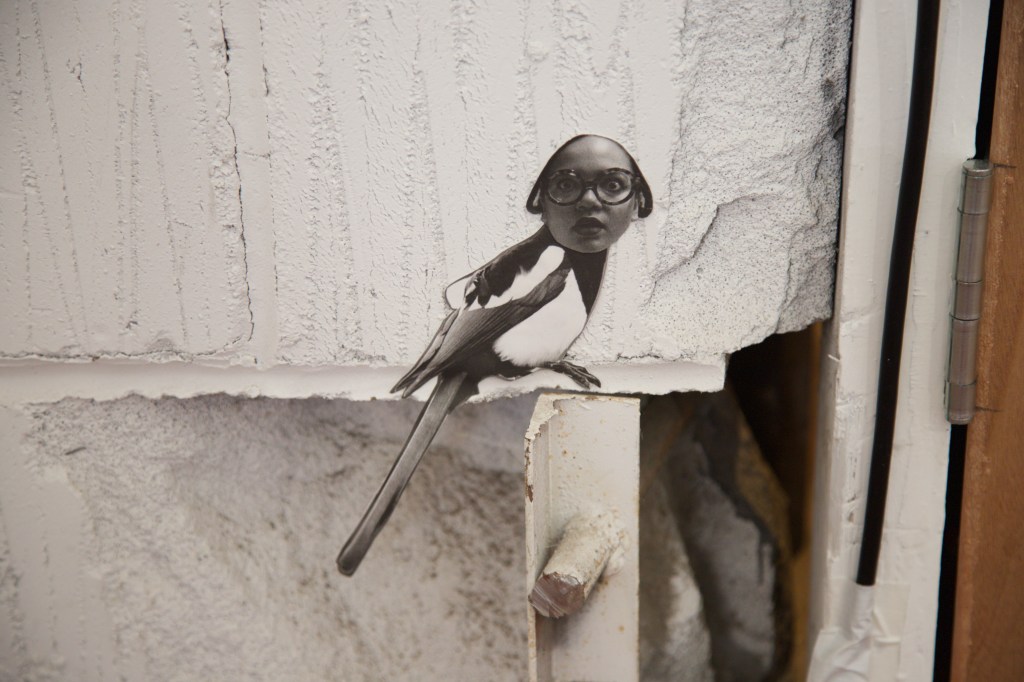
MSKJ: Only for magpies. For some reason they really hold a power – like where’s the other one, there’s only one, it’s going to be a bad day! I think for the Greatorex show I showed eleven magpies, and I think it symbolised something about good health. I don’t know where that structure came from. I think superstition, again relating to death, is really interesting. They kind of go in line with each other.
MC: I was thinking that you do often use symbols which have a really rich existing history. They are symbols that are universally known – the birds, the churches, and homes. And I think this links to the badges. Like you are wearing your heart on your sleeve, in a way. I think it is interesting, the way you are dealing with that in terms of identity and the way we want to present ourselves. Is that something you are interested in?
MSKJ: It is, and I think with the badges especially. They were the first time I started using text in my work, and it felt like it really worked in terms of wearing your heart on your sleeve, your truth. But also, you don’t know who made them. When I give them to people, there’s no grounding as to where they come from. It might not be my reality, and the same for whoever’s wearing it – it might not be their reality or their truth. It allows for anonymity.
MC: That feels very present-day, right? It feels like something that we all continue to do because we are consumers, but at the same time we are all super individualised. It’s interesting, more interesting in a way than creating something from scratch and saying ‘this is me to my core’. It’s more of an assemblage of yourself.
MSKJ: I think it is really important to take from your surroundings, because it does still create this image of you and it does still help to build the person that you are but not in a way where you are baring your soul. With the St Christophers – there’s a few of them in show, on the platform and a few of the boxes…
MC: What’s a St Christopher?
MSKJ: Again, Catholicism for some reason really intrigues me. St Christopher is the patron saint of safe travels. When I was twelve I got a St Christopher which belonged to my uncle, and then when my grandad died I got his St Christopher. And so I started collecting them and giving them to people as well. It felt like a really important token of care.
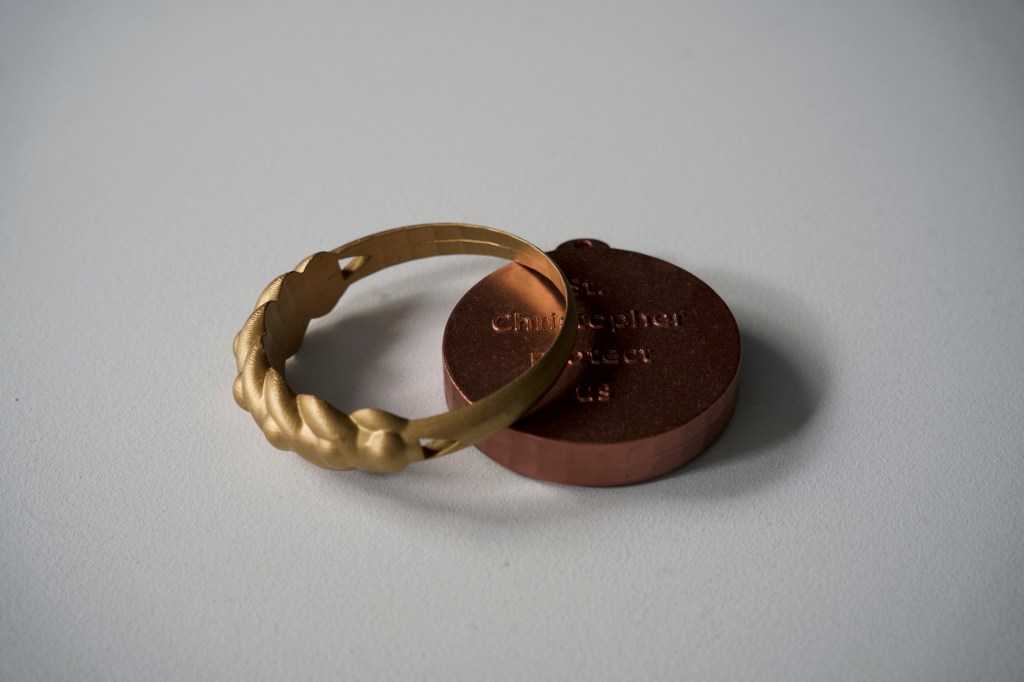
It is a superstitious idea that you need to wear this to have a good journey to wherever you’re going. Whatever that journey entails – a long distance, but also a life journey. But it also has no meaning. I mean, magpies don’t actually affect our lives, but it feels like they will. It’s the same with the St Christopher.
MC: I was thinking in your work that there is a lot of playfulness surrounding the naming and meaning of things – badges, symbols. It’s not like your work is super ironic, but it does feel like you are playing with the idea of sincerity.
MSKJ: I think that I realised this year that the fabric and materiality of the work really helps to play into that. For people, it places the work into a different time which is very personal to them, which I like. They can project their relationship to it onto it.
MC: Talking of materiality, I’m interested to hear what your studio practice is like. Your work is very varied, very mixed-media. Do you scavenge for your materials?
MSKJ: No. I have a rule that I don’t really like to use or replicate things that aren’t personal. So it is a lot about having and adding to that collection of objects that are personal, and then altering them. Although with the birdhouses at Greatorex Street, I got them at a car boot sale. I love car boot sales, I would go to them as a kid. But I’m really interested in replication as a means of preserving as well. Not just boxing things up and having them maintained in that way, but having the repetitious versions of something.
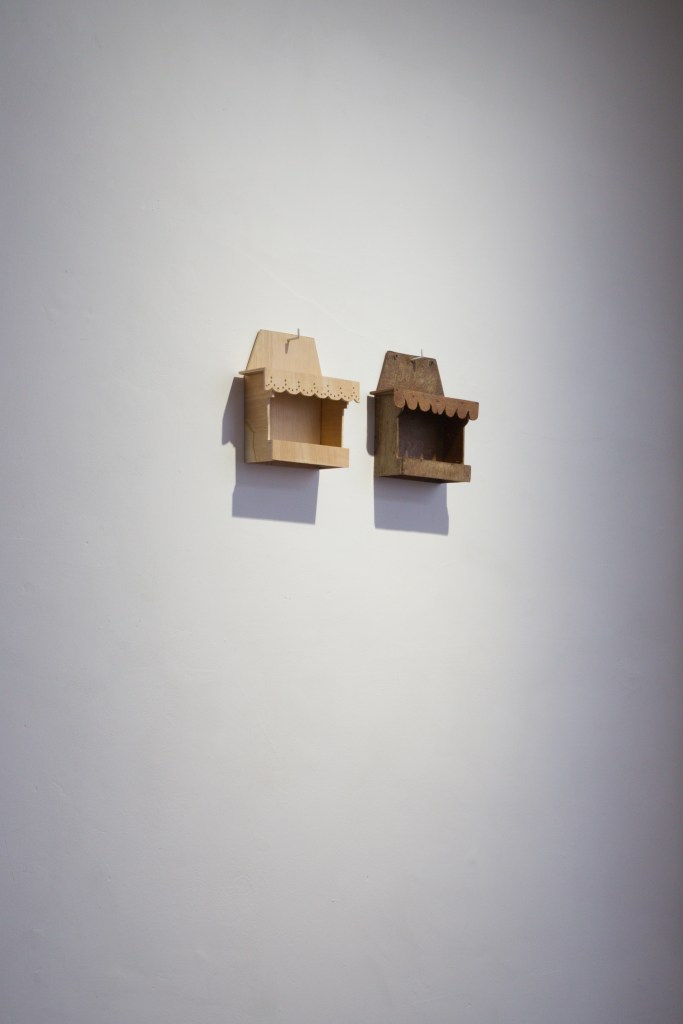
MC: So do you feel that, in repeating something which is meaningful or making a replica of a meaningful object, that the repeated version is less authentic?
MSKJ: Not really, because when I make it, it is done with so much care that I feel that the original meaning is kind of put into it. When I made the large versions of the ring and the St Christopher pendant, it was done to replicate objects that I’d lost. So they then held what the originals could no longer hold.
MC: That’s interesting. So it’s about the intention. I’m super interested in ideas of preservation. The archive for me is so interesting because it is false, it is a construct. How do you feel about the archive – the personal archive or the institutional archive?
MSKJ: I feel like UCL has a really jaded history with archives. It has the largest collection of eugenics-based images and material in the UK. But in terms of my personal archive of inherited objects there is a real care and importance. I did a project when I was fourteen with my dad where we dressed up in my grandma’s clothes after she died and we re-enacted things that she would do. I still have all the clothes, because that’s an archive of her. The clothing, how she dressed, was really representative of how she was in different stages of her life. So keeping the clothes is a way of preserving her, through the object.
MC: I was interested in the archive because we think of it as the very basis of truth – we say if something’s in the archive then this must be the whole truth of it. But obviously there is so much that is missing and not recorded. It’s a matter of dictating what reality is. I think that what you are doing, recreating things that are lost, is so interesting. It’s like critical fabulation. Not so much dealing with institutional archives, but on a personal level you are navigating around an absence within an archive.
MSKJ: Navigating around the absence of the person who would have made the archive, or interacted with it.
MC: Yeah, you are really playing around with the mechanics of how history is made, in this way.
MSKJ: When you are clearing a house out after someone has died, what you keep is kind of a critical fabulation of their existence. You are very much picking and choosing what is important to you in that moment.
MC: That goes back to nostalgia, right? That rose-tinted version of the past.
MSKJ: Even with the archiving of people’s funeral songs, it will change so vastly with time – how people relate to it. There is something very interesting in what was decided in that moment. The nostalgia of looking back on it and wondering how you would have done it differently.
MC: I wanted to ask you how your practice changed since you began? When did you first become an artist?
MSKJ: I think I only thought of myself as an artist from this year. Before I was an art student. Materially, it’s changed a lot because recently I’ve been really interested in everything being constructed by hand, built by me. In the show, bar the wall vinyl, everything was made by hand. I think that having that relationship to the material helps imbue the work with an importance.
In third year, I was scared of my work getting too personal. I got really interested in orgone energy, which is this pseudoscience based on life forces. So, I made boxes which were orgone accumulators, and they had objects inside them. The theory of orgone energy is that, to give a layman’s explanation, in capitalist systems there is an emotional plague caused by not being in tune with your body, so you use orgone accumulators in order to regain this life-force. So you would have this orgone blanket, or this huge orgone box that you’d sit in. But I was more interested in putting the object in there, and having that object imbued with the life force. But I think, when I was doing that, it was too removed from the personal. I couldn’t relate to it. I didn’t know why I was doing it. So this year, I’ve realised that there is a power in the personal, and being honest with the materials you use.
I think I am really interested in using more found images and distorting them and having them really affect how the sculptures are interacted with. Because for a viewer I think it’s difficult when the box is on its own to understand that it relates to a person or an emotion.
MC: What has been your experience of being an artist who also has to work a job, and existing in the time that we do where it is becoming harder and harder to be an artist, especially a sculptor?
MSKJ: I think it is important to me to maintain jobs that are within the art world, within a creative means – I work as a studio assistant, and I have worked in a fabrication studio. Because also, I want whatever job I have to be skill-based, where I am learning a new skill which I can pass on. But I also feel it is a lot of grinding! It is difficult being a sculptor. All the conversations we had about pricing work or whatever was always framed through painting or 2D works. It’s difficult when you make big, cumbersome works which take up space.
MC: I imagine your work in particular is quite difficult to market. And you can’t get rid of these boxes if they have your family objects inside.
MSKJ: Yeah, also because it is so personal. This is the problem I’m having. I can’t throw that away, and I can’t throw away the box that holds it. Even the wall vinyl – how could I throw away a picture of me and my mum, or this important church, or anything like that?
But I am quite excited about what’s to come. Me and Georgia Brady-Tompt – she was on the first floor in the degree show – we are looking for a studio together. We are really excited about each other’s work and each other’s processes of making. I think it’s quite similar, in that we have a base of things or materials and we work with those, rather than hunting out materials. I’m excited about that.
MC: So would you like Georgia to be one of your three names of recommended artists? It can be anyone, ideally someone who is your contemporary, someone I can go chat to.
MSKJ: Georgia definitely. Her interest in these non-existent spaces. Onosiokhue Yakubu’s work as well. She has done a lot of rubbings of items in the institution and made this sound piece. Her work is really interesting. And then I think Jem Crook. I love Jem’s work, the nostalgia element and the sincerity. It feels very solemn in a very important way – his work has consistently been very heartfelt. I think he has a really wonderful relationship with objects. We see objects in a very similar way, in that they hold people and act as an extension of them.
MC: Okay, thank you so much! I’m really excited to see what you do next.


Leave a Reply