
MC: How did you start at the beginning as an artist? What was the first time you ever considered yourself as an artist?
TG: I mean, as far back as I remember, I was always drawing. It was the only thing I was properly glued to. I was always drawing cartoons and stuff like that. Then I went to Arts University Bournemouth, and I graduated there in 2019 and then COVID happened. I decided to become an art teacher, and then became fully qualified. I then started Slade in 2023. So I think I’ve always kept myself busy, kept the pressure on – school, college, foundation, undergrad, becoming a teacher, and now masters.
MC: In your practice, it seems that drawing is not really your area anymore. What was the move like from that to the quite conceptual installations that you do now?
TG: I think drawing is actually still quite important to it. I’m always carrying around a little sketchbook and just putting the roughest sketches together, ideas for things. In a weird, roundabout way, I think that because I work with found objects like bits of bikes and bits of furniture, kind of attaching them, there’s this direct way of making that resonates a bit with drawing. I feel like, in a way, the things I make are drawings that have come to life. Everything starts as a drawing. Sometimes it may it be an idea, and then over time it’ll evolve and it’ll look nothing like what I started with. That was basically the degree show in a nutshell, a rough sketch that transcended into something completely different. But yeah, I think the sculptures are married to the drawings.
MC: I’d love to hear about where the idea of the degree show started. Could you maybe talk me through the show?
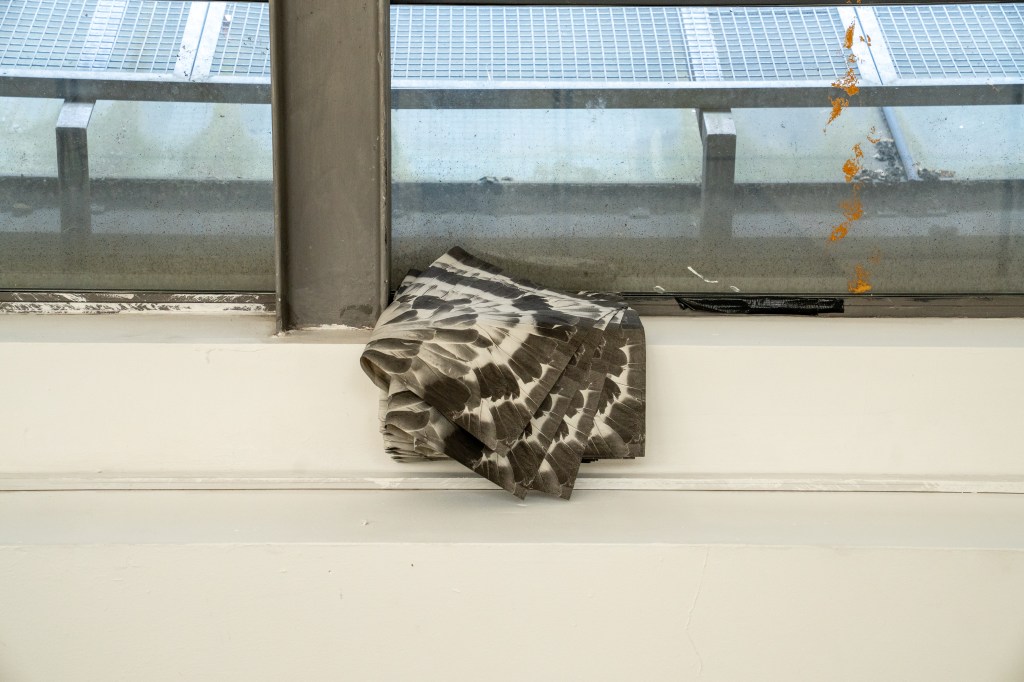
TG: I’ll start with the main thing that you see as you come in – the feathers. That came from a phobia I have of dead birds.
MC: That’s surprising, because it’s such a beautiful, tender thing. I didn’t think it would be fear related!
TG: It was kind of an idea that I had before starting at Slade, exploring this phobia of mine. At the Slade, I remember having a tutorial with Holly Hendry, and this is after my first crit. And she didn’t mean it in a negative way by any means, but I remember she said something like – you seem quite detached from your work. That really stuck with me. Because at the time, I was making stuff that essentially wasn’t personal to me, which isn’t necessarily a bad thing. But the comment stuck with me, and I was like, what if I made work that was more personal?
So essentially, the work stems from a traumatic thing that happened when I was a kid, and because of that I literally cannot go near dead birds – which is obviously a problem living in London because there’s pigeons everywhere. And this dominoed into lots of stuff. So on top of this phobia, I am always on high alert of things, and I tend to confuse through my peripheral things as dead birds. Like newspapers. So that’s where the idea for the material came in. Last year, I made a different version of the work, and this was when I could barely go and pick up a feather. So I asked Gabriel on my course, and they gave me a feather. So I scanned it, and I made just a simple repeated pattern. I think that was a pivotal turn for me.
I think at that point, there was a lot of a thought process as to how I want people to feel when they look at it. I remember having a lot of discussions with people, they were saying, well, do you want people to also be frightened of this thing? Or do you want it to have a kind of humorous quality? And I wasn’t really quite sure. I think one great thing about the work that was in the degree show is that there were a lot of mixed reactions to it. One of my friends, it made her shudder a bit, when it did that ripple. It’s about the idea of this thing being alive – but not necessarily looking alive. It’s the sort of puppet show-ness of it, alluding to the idea of something that has a bit of life to it.
MC: There’s something inspirational but also quite dark about what you’re essentially exploring, which is exploring the absolute minimum of what makes something alive. And in the bird pieces, it’s a tiny bit of movement and breath. And then in your other sculptures, it’s just a slant, or a slight tilt of a chair leg. And it’s bizarre to see how little we need to put a personality onto something, because I think that’s also where horror comes from. It’s like, why do we find dark shadows scary?
TG: 100%. It’s all about what I call the smidge of life. The smidge of life that you could put onto things. And a big part of the thought process came from being recommended ‘Powers of Horror’ by Julia Kristeva. She talks a lot about the abject. I had heard the word before, but I didn’t really know what it meant. She talks a lot about the corpse as an example of the abject. Because it’s got a duality to it. It’s simultaneously an object, but also it’s an aftermath. It’s something that was once life and is now death.
MC: You always think of the abject as being really over the top and gory, blood and guts and in-your-face horror. But actually, I think it’s just where things are where they’re not supposed to be. Slightly uncanny, where something’s almost right but it’s not quite right.
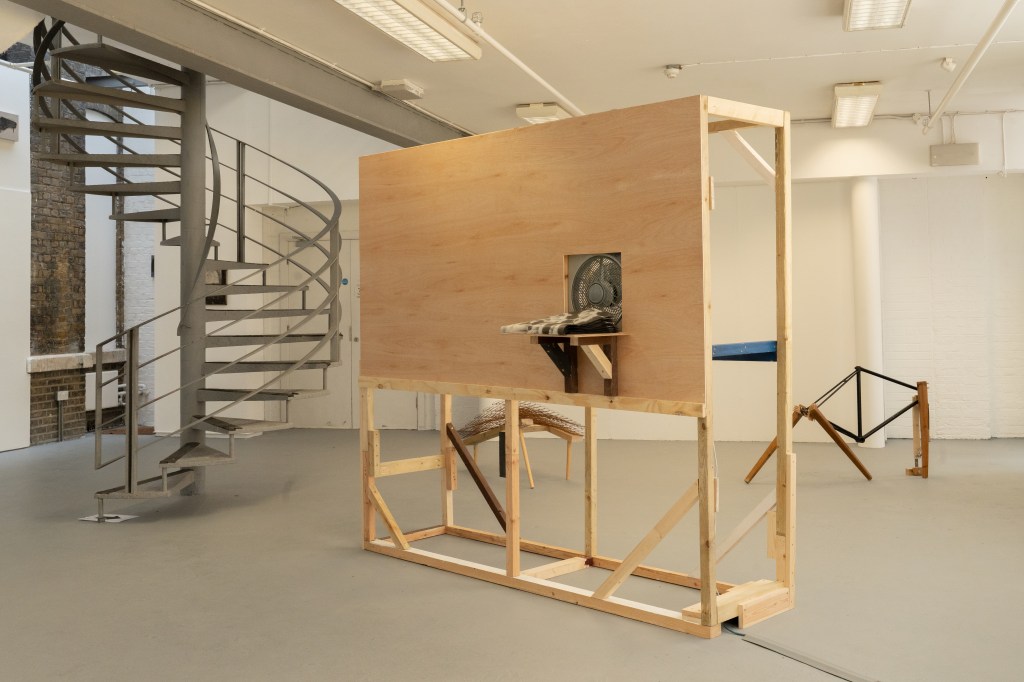
TG: It can be quite subtle, yeah. I quite like the idea of something emotive coming from something quite subtle. And that’s why I liked the newspaper bird, because, again, people were interacting with it in different ways. Some people found it just nice to look at. Some people found it quite funny. Some people found it a bit eerie. And I suppose, for me, this was the end point of the question of how I want people to feel – they can just have their own relationship with it. Because it would be bizarre for me to want other people to inherit my phobia!
MC: I agree, it would potentially be a bit disingenuous to make the show just entirely about exorcising your own demons. As if the show is your own therapy. I don’t know, maybe you did feel like it was doing that?
TG: Actually, I think it worked! Because the version of the newspaper bird you saw this year was much more of a complex design compared to the first version, because I wanted to try and imitate the wing pattern. And I actually managed to go round picking up feathers. I was very reluctant doing it, but I went to my hometown in Sussex, and I managed to go around the woods. There were loads of crazy feathers and I managed to go on a little trail, picking them up. And that’s what I used to scan in and make that work.
MC: So you did overcome something, physically and mentally, in making the work.
TG: Definitely, yeah. I can definitely hone myself a little bit more now. And I found I actually really like birds.
MC: One of my favourite works of yours was when you did the little video of the newspaper feathers in a tree. That’s lovely, especially now I know it’s about a dead bird. You’re sort of putting the bird back into its natural habitat, bringing it back to life that way.
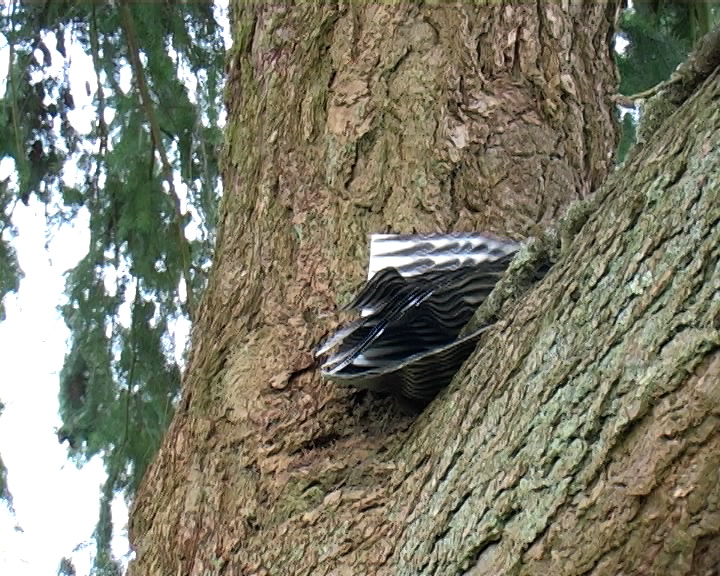
TG: Yeah, that was the first version. The word animation became a big deal for me. Another tutor made a point of saying that, you know, it’s quite interesting that you’ve taken an idea of something that is inanimate in both the sense of a newspaper and dead bird, but you’ve also reanimated it. It’s an idea of illusion of animation, illusion of movement.
MC: So moving on from that piece to the ones behind it – the other creatures, the furniture. I guess that’s an older project then?
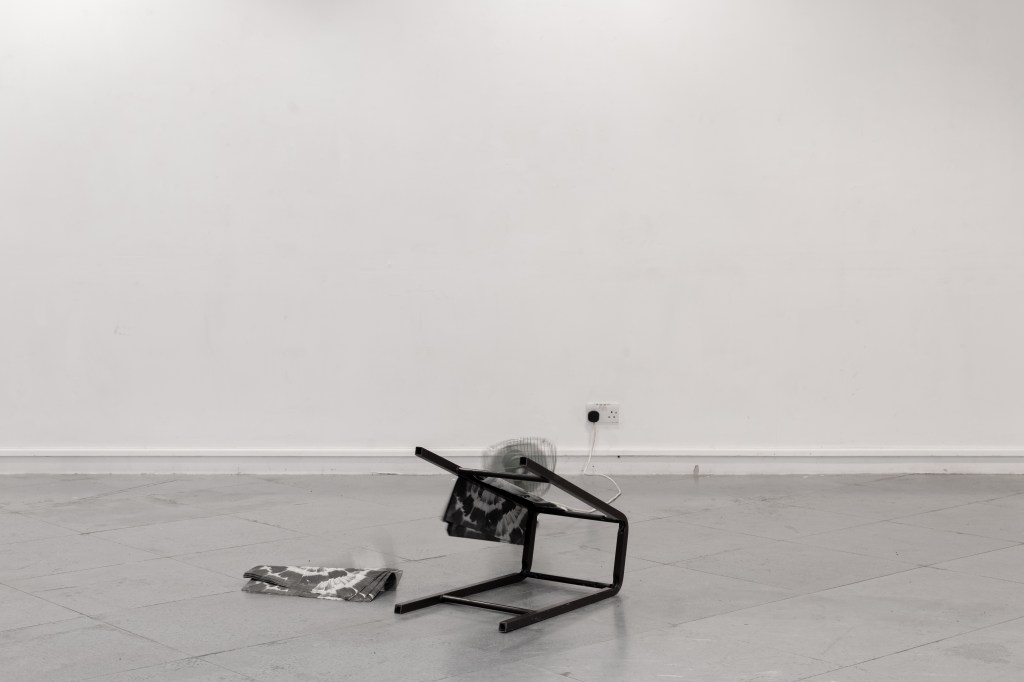
TG: They were kind of simultaneous. At Slade, I was always either in the print lab, or knocking about the studio with bits that I’d just carried in from the street. All those materials were probably collected within a mile radius of here. Those works were always kind of ongoing. The idea behind them also stemmed from an idea of the abject in that they’re all found materials, they’re all parts of things that have come together. It’s mainly parts of furniture and bits of bikes as well. I think materials are really important to me. And I think the reason I use those materials specifically was because I was interested in this idea that they once held quite an intimate place in somebody’s life. Obviously, furniture is very connected to the body. And I find that when something is sort of discarded, it holds an element of the abject to a point.
MC: Like an aftermath, like a corpse again.
TG: Yeah, exactly, but in a less horrifying way! I quite liked the idea of these things, not necessarily coming to life, but being recontextualized and recomposed with different bits from other places and existing in a new context, whilst also retaining something from what they were before. That was quite a tricky hill for me to overcome, because at some point I was just making these things that just looked like animals. It was as if the material was a bit lost. What I quite like about those degree show works is that you can see it’s just a mattress that’s being warped, or you can see it’s just a bike frame standing on a bunch of table legs. It’s important that the material is very on-show, and you can see that’s what they are. But at the same time, they’re giving a little bit of something new. The idea of how they’re positioned or configured, it suggests that they could be animated. It’s like – not an illusion, but the synonym of a hint. The idea of movement, that’s what I’m trying to say.
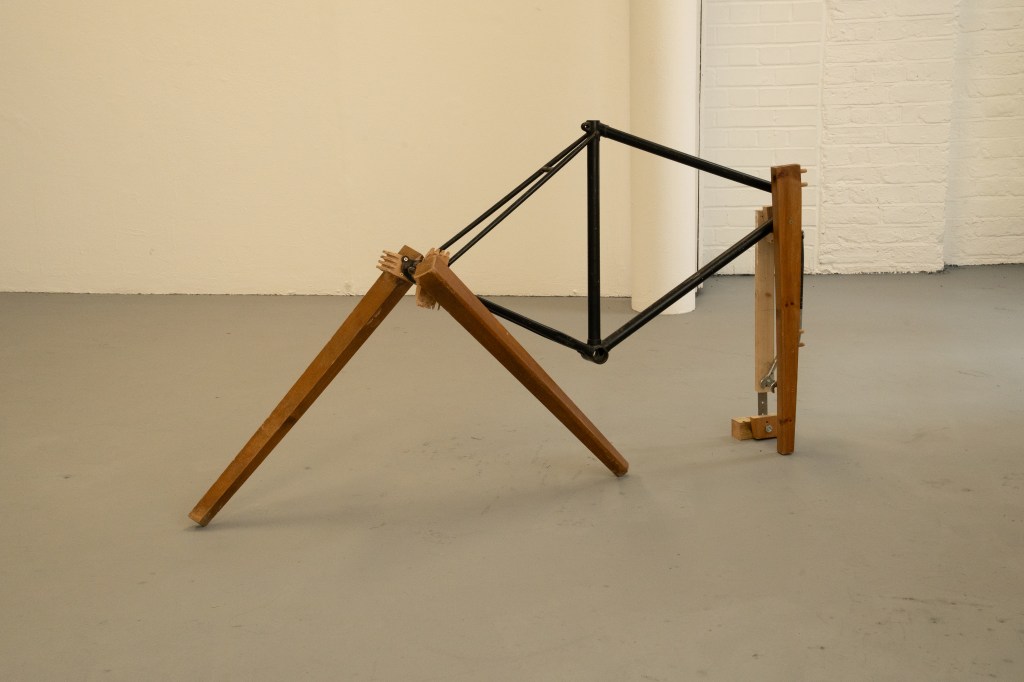
I quite like them composed with the newspaper birds – having things that looked like they can move, right next to something actually moving – they sort of bounced off each other. I think the most fun thing about making those was that, when it came to the printing, I felt more like an artist there. Just going in, like, okay, I’m going to make this thing, and then I’m going to leave. Whilst with the found material sculptures, they were much more exhausting in that I could bring something in today but if they don’t come together, then I’m not gonna make it.
MC: It gets somewhat more unconscious when you’re dealing with a found object, because you don’t get full control. You kind of have to commune with the materials a little bit. You have to just vibe with this object to see what it tells you and to see what life you can find in it. So there’s something of the imagination in it, which speaks more to what it is to be an artist, perhaps, than coming up with something completely from scratch as a total designer. Using found objects has that really interesting extra quality, where it’s almost like you’re collaborating with the material.
TG: Exactly. I think limitations and rules have been really quite helpful for me.
MC: You’re also giving objects, furniture, things that we normally serve us… giving them agency. When I was looking at the table-like creature that you made – the slanted table with the legs a bit skew-whiff – it reminded of the Meret Oppenheimer’s ‘Object’, the furry tea-cup you can’t use.
TG: It’s an interesting word, isn’t it, use and what’s useful. Meret Oppenheimer was in my head a lot when I was making the bag upstairs, the bag with the fur. But in the case of those found objects, they’d all basically been already broken or worn in. So there’s all these factors: this is something that’s going to be chucked anyway. This is a low carbon footprint way to give it a bit more life, more usefulness.
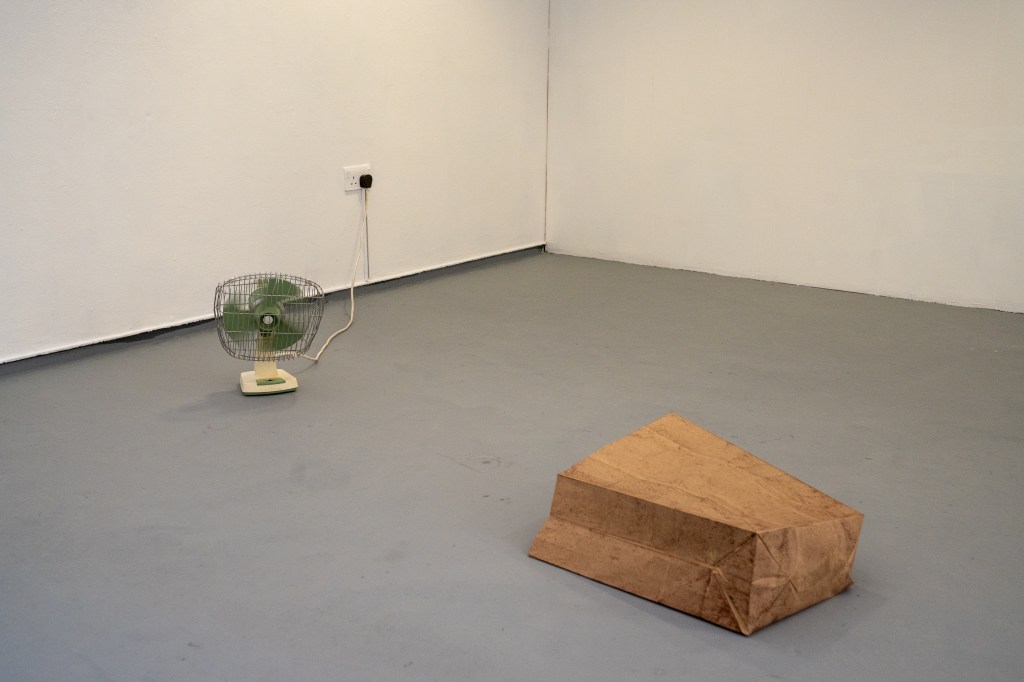
Generally, the ideas came about just by walking around and seeing all these arrangements of objects and things that people would just leave outside their house. I went to New York last year, and they don’t have it there quite the same. It feels like a very London thing. There is a kind of weird element of community there. And, yeah, it could be argued that it’s just people being lazy, just dumping a big bag of stuff outside a charity shop. But sometimes people are thinking, maybe someone else will need, I don’t know, a fan, so they just leave this fan outside their house. And I think that the idea for that was quite important, because it was, for lack of a better term, collaboration with a stranger. And going back to what I was saying earlier, with limitations, it’s helpful just basically being reliant on how London works in that people do just leave stuff around the place. I’ve not got too much of a budget for materials, but I can trust that on my way to Slade, I will find some things that I could maybe make something out of.
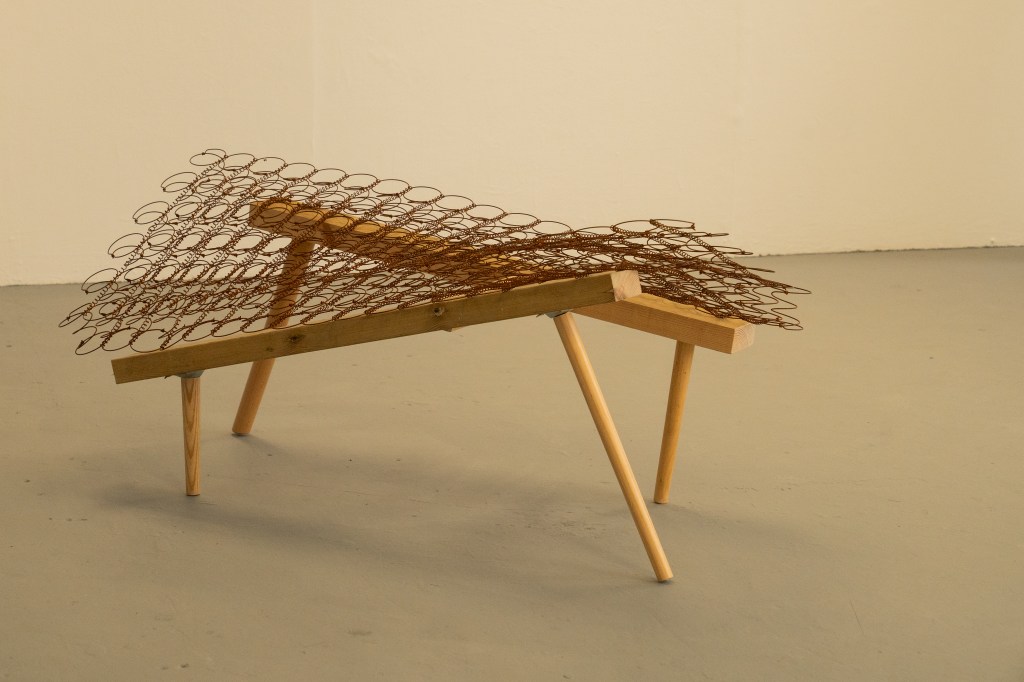
But what I really like about the works I showed is that some of the parts were stuff that I found a year ago, and some of the parts were stuff that I found maybe a couple of weeks before the install process. So it was all these different times and places just coming together and manifesting in the sculptures. The mattress one – that’s my favourite, personally, just because I found that mattress last year and I just thought it was such a beautiful object. And again, it’s just a mattress – it’s been stripped apart, but it’s a mattress. Someone has slept on this. And it was just being left on the road. There’s something so interesting about that for me. So I took it, and I never quite found the right use for it.
And then the idea came for the sculpture, a couple of weeks before the start of the install process. Those legs, if you look, they’re the standard kind of IKEA-ish furniture legs that you’d see for coffee tables or stools – you know, beige, smoothly processed. And I realized I had three of that type of leg, and they were all different sizes and thicknesses. So I thought, if I can stand this mattress on the same type of leg, but they’re all different sizes, then I can make it warp. I just need a fourth leg. And I went out the back of Slade, and the fourth leg was just there right by the skip. It was very much like everything just aligned in that moment. The sculpture probably took me maybe an hour tops to make. But when you count in all the time of eventually finding all those the right bits, you could argue it took forever.
MC: It’s so interesting, the idea that most of your job as an artist is actually just walking around London! Obviously, finding and using cheaper materials is something that lots of art students have to think about, because it is so expensive to buy anything good. Do you think you’d be making the same type of work if you didn’t have to scrounge around for materials? I know that you have a previous work that you made -the metal, boxy sculpture with the feet- that’s purely fabricated, right?
TG: You know what? That is the work that I had the tutorial with Holly Hendry about, where she said I seem quite disconnected from the work.
MC: I asked about that because it seems like that work is dealing with the same ideas about animating and creating life. The only difference being that you’re not finding the object on the road – you’re creating them yourself.
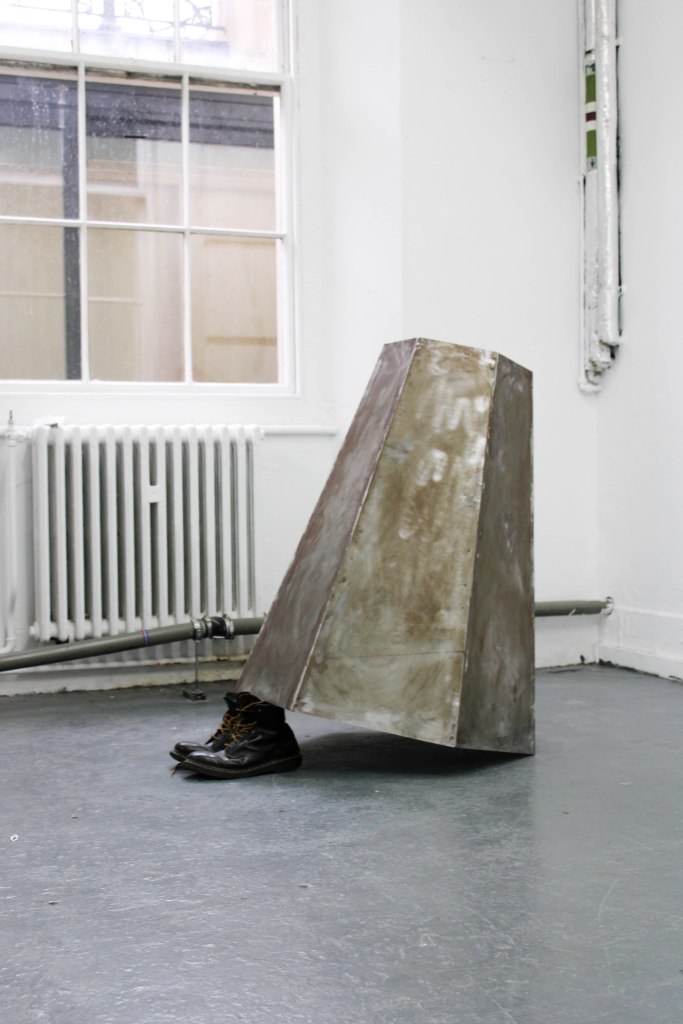
TG: That was the first thing I made at Slade. It had a couple of names – everything always has multiple names because I always just changed my mind – but the name I landed on was ‘Steel Cap Boots’. A lot of it came out of this big ball of pressure that I felt starting at Slade, this feeling that I had to make something big and impressive and metal. That was the most money I spent at Slade too, in that first term. After that I spent no money. I bought a bunch of sheet metal, and I spent weeks doing all the maths to put that thing together – only for it to end up being propped up against a pair of boots.
At that point I was thinking a lot about the idea of something having life, having this animated quality to it by just doing the bare minimum. Like putting some shoes on there. The shape came from the idea of a body that could match or fit inside the form. But I think I didn’t have enough rules then – it was a bit all over the place. I do really like that work, I don’t think I’ll ever make anything like it again.
To answer your question. If I had all the money in the world and I could just do whatever… it’s tricky. I think I’d stick to stuff that is focused on animation, material-wise. But one thing I’ve realised throughout this process is the importance of materials. Materials have to have some sort of significance or context, they have to mean something.
MC: Going back quite far into your history – you seemed to do quite a bit of audio-visual work back in the day, and you were part of the Noematic Collective. What was this, and how does audio-visual play into your practice?
TG: During my BA, I got really into sound and a bit of video. Noematic Collective were basically a sound-art collective. I still have the boiler suit, and I still use it in the print lab! At that point, exploring sound was very new to me and therefore quite exciting. That actually helped start my investigation into ideas of animation.
I made an artwork which were these monitors that had audio-responsive animation on them, where colours and shapes would move according to the audio and voices would come out of the speakers. I think that was important, but for me there was more of an interest in the sculptural side of things. I might come back to sound at some point, but it was definitely a sort of stepping-stone into being more interested in something else.
The sculpture was exploring the idea of a machine, but also these different parts – separated but embodying the different parts of a living thing. There was sound coming out of one thing, and something moving on the other thing, and with all of these things going on it felt like there was a life there. I think I like breaking things down. I really hate the word minimalism, but I suppose I am a minimalist!
MC: I would like to ask you what it was like working within an artist community at Slade? And now that you’re graduated and you’re in the working world, how do you relate to the idea of an art world?
TG: I was always working part-time when I was at Slade, which I think was good for me. A taste of the real world. Going back into the real world has felt less overwhelming as a result. But I really like my job, I really like teaching, so it’s not too daunting. It really did feel like going in between two universes. I do think teaching has shifted my practice a bit. I’m now a firm believer that play is really important in art, and I’ve realised that through teaching.
Of course, when you do your undergrad, you’re in your late teens and early twenties so it’s more of a sense of emerging independence. But when doing a Masters, there’s a feeling of having all these artists around you – some who’ve pretty much had careers already. I did feel at points like a bit of an outsider. Sometimes I’d be coming from a day of teaching at school and going into a room with a bunch of people of mixed ages and mixed backgrounds having a discussion about latex. And I love it for that! I hope those connections will stay as strong as ever. It’s a massively privileged thing to have, so it must be appreciated. In a sense, it’s playing with the most random mix of people, but you all have that shared, ridiculous drive.
MC: it’s nice to hear about the Slade as I imagine it is. For my final question, could you give me three names of other artists who you would recommend I go speak to, or who have some accordance with your work?
TG: Firstly, Jess Heritage for sure. For the Slade degree show, she created a performance that was also a stage. Aesthetically similar to mine, with big open-ply walls and monitors, with a voice coming in and out. She has been a great mate throughout my time at Slade, and her work is fantastically dreamy. She manages to tap into this weird element of subconsciousness and dreaminess… it’s inexplicably mesmerising. She does this through word playback and audio-visual elements that are just genius. I’d like to get inside her head and see how her brain works.
Henry Burns. He did lots of mad stuff with Pyrex plastic – it was a floating sculpture on top of the tanks, with monitors. It’s incredible watching him work, because he works very quickly and makes very large-scale, ad-hoc things at super-speed. I could never make anything like that – very complex.
Rebecca Moss. She visited Slade last year, and I managed to get a last-minute tutorial with her, and it was the best tutorial I ever had. Her work is very silly and clever and whimsical and great.
MC: Thank you very much! It was so nice to see the show, and so nice to hear more about the work.


Leave a Reply